Vision 2050’s first test and what the auditors found

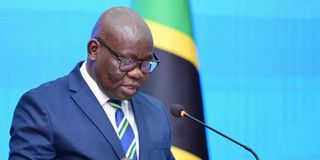
Controller and Auditor General Charles Kichere.  PHOTO | FILE

On April 1, 2026, Prime Minister Mwigulu Nchemba stood before Parliament in Dodoma and formally launched Tanzania’s Vision 2050 — a 25-year blueprint targeting a $1 trillion economy and a per capita income of $7,000.

The budget instrument for its first operational year is Sh61.9 trillion, the largest in the country’s history.

Having participated as an expert in the drafting of Vision 2050, I understand the ambition it encodes.

The political will is visible. The question that should sit on every serious investor’s desk is: can the institutions deliver it?

Two days earlier, on March 30, Controller and Auditor General (CAG) Charles Kichere presented the 2024/25 annual audit report to President Samia Suluhu Hassan at State House.

The headline was encouraging: 99 percent of audited entities received clean opinions, up from 96.9 percent the previous year. President Samia called it a thorough job.

The media led with the progress. However, sophisticated readers know that the headline opinion and the body of the report are different documents, and that the body that matters most for investors.

The most consequential finding received almost no attention. Out of 38,181 audit recommendations issued across previous years, only 36.7 percent have been fully implemented, 43 percent remain in progress, and the rest are unaddressed.

Tanzania’s oversight architecture is generating findings at scale: 1,553 audits this year alone, spanning financial statements, performance reviews, ICT systems, and special investigations. What it is not generating, at anything like the same scale, is corrective action.

A clean audit opinion tells you that the books were properly kept. A 36.7 percent implementation rate tells you what happens after the auditors leave — very little.

The Prevention and Combating of Corruption Bureau’s (PCCB) report deepens the picture.

The PCCB reviewed 1,864 projects in 2024/25 and identified irregularities in 913, nearly half, of which only 66 were subjected to formal investigation: a conversion rate of 7.2 percent.

For every ten projects flagged, nine face no formal inquiry. The monitored projects carry a combined value of Sh14.3 trillion, up from Sh11.4 trillion the year before.

As the scope of oversight grows, the gap between identification and investigation is not narrowing, but widening.

The state-owned enterprise picture warrants the same read, and it carries direct implications for Vision 2050’s delivery model. The Vision is explicit: public-private partnerships are its primary financing mechanism.

Yet the institutions expected to anchor those PPPs — TANESCO in energy, the Tanzania Ports Authority in logistics, the Tanzania Airports Authority in connectivity — operate within a parastatal sector where total losses declined to Sh307.1 billion from Sh412.3 billion the prior year, an improvement the CAG himself qualified.

It was driven largely by government subsidies of Sh105.2 billion, not operational efficiency gains. “Losses have effectively been shifted to the government,” Kichere said.

Twenty-two public entities continued to post losses over periods of one to five years. A private investor entering a PPP with a counterparty that requires annual subsidy support to show improved numbers is not entering a partnership on equal terms.

There is a further data point that received no headline coverage and is directly material to foreign investors.

Government debt rose 13.04 percent to Sh110.05 trillion by June 2025, but the driver is nuanced: currency depreciation alone added approximately Sh2 trillion to the debt stock.

Tanzania’s debt-to-GDP ratio of 40.7 percent remains well within the 55 percent threshold, and domestic revenue collection hit 99.4 percent of target.

The fundamentals are sound, but Sh2 trillion in exchange rate losses without additional borrowing is a currency risk disclosure that any investor with shilling-denominated exposure — in infrastructure, real estate or long-term concessions — must factor into their structuring.

None of this is an argument against investing in Tanzania. It is an argument for investing with precision.

The country’s macroeconomic trajectory remains among the strongest in East Africa — 6 percent GDP growth, inflation at 3.3 percent, record FDI of $1.72 billion in 2024.

The reform architecture built through instruments like MKUMBI II is genuine. What the CAG report provides is the institutional stress test that every serious capital allocator needs to run alongside the growth story.

Parliament now has 87 days of budget sitting ahead of it. Speaker Zungu’s first major test is whether this CAG report is treated as a governance instrument or a ceremonial one.

The distinction matters well beyond domestic accountability. DFIs, sovereign wealth funds and institutional investors evaluating Tanzania’s Sh477 trillion Vision 2050 investment pipeline will be watching how the legislature responds to a 36.7 percent implementation rate and a 7.2 percent investigation conversion.

The oversight architecture exists. The question is whether those deploying capital into it and those governing it are prepared to make it count.

Amne Suedi is an international investment lawyer, Honorary Consul of Switzerland to Tanzania, and Chair of the Switzerland – Tanzania Chamber of Commerce.