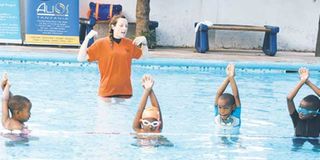
Hamilton Aquatics Swimming Club instructor Katy Morris trains young swimmers at Dar Swimming Club on the fifth day of her seven-day clinic at the Dar es Salaam International Academy yesterday. PHOTO | MAJUTO OMARY
Dar es Salaam. ‘Life is full of challenges – especially when we are hit with something unexpected; and failures are the pillars of success.’
These two-in-one popular sayings are about how facing and surmounting challenges makes a successful individual. There are so many experiences which have amply demonstrated the veracity of these sayings.
Indeed, we can effectively cope with some of the challenges; but, admittedly, some of them are hard to surmount. In any case, most of these hard experiences are challenges in life. Examples of challenges in day-to-day living include those which must be faced by school children: examination challenges, peer groups challenges, school bullies challenges...
Whatever the challenge, we need to develop our physical and mental strengths in seeking to effectively cope with the challenges.
This is what the Tanzania Swimming Association (TSA) has decided to focus upon in developing the swimming sport in the country. Swimming is one of the most popular sports in Tanzania as well as in the world. Our nation is surrounded by water and swimming is one of our great passions.
As well as being fun, swimming is a great way to keep fit, stay healthy – and make friends. Swimming is also a healthy activity that you can perform for a lifetime. It is a low-impact activity that has many physical and mental health benefits.
So far, Tanzania has gained popularity in swimming after winning various honours – even as TSA struggles to shape and develop the sport.
Challenges
Tanzania does not have a 50-meter Olympic Size community swimming pool. Instead, the country does have 25-meter privately-owned swimming pools that are routinely used to stage various national and international swimming competitions.
The more famous swimming pools are owned by international schools and the University of Dar es Salaam (UDSM), which is a little less than 40 meters. Some swimming clubs in the country hire them, for which pay high costs.
However, these 25-meter privately-owned swimming pools also do not have modern equipment like diving blocks, and ‘touchpads’ used to record swimming time.
We have experienced this in every competition, whereby timekeepers resort to using ordinary stopwatches to record times for the swimmers. In the event, various cases caused by errors in time-keeping are on record.
Such challenges involving swimming facilities are very common in the sport in Tanzania – unlike in many other countries like Kenya next-door!
Success
Despite the challenges, TSA has decided to put a STOP to them as it struggles to surmount them all in the interests of the sport at the national, regional and international levels.
In any case, Tanzania has competed in many swimming tourneys, and has managed to come out with some commendable results. Some of the events are South Africa’s Levels One, Two and Three tournaments, in which Tanzania has managed to do reasonably well – especially compared with neighbouring countries in the East African region.
All in all, Tanzanian swimmers have shown great improvement in both local and international swimming competitions following untiring inspiration from their club leaders, coaches, the national swimming governing body, the government and their parents, guardians, sponsors and well-wishers.
Indeed, Tanzania won the African Zone Three Swimming Championships (Cana Zone 3) twice in a row.
The first time was in Kigali, Rwanda, in 2016 – and the Dar es Salaam tournament in 2017. Last year, Tanzania finished third in the event held in Sudan-Khartoum.
Apart from that, talented Tanzanian swimmers have routinely been scouted and given scholarship to study and trainin swimming at the St Felix School in the United Kingdom (UK). The swimmers include Collins Saliboko, Dennis Mhini, Dellvin Barick, and Christopher Fitzpatrick in the boys category, and Maia Tumiotto, Sonia Tumiotto, Chichi Zengeni, Smriti Gorkan and Natalie Sanford in the girls category.
Prominent Tanzanian swimmer Hilal Hilal is also undergoing a training programme in Dubai following a sponsorship granted to him by the World Swimming Federation (Fina). Other Tanzanian swimmers receiving training out of the country are Isam Sepetu, Rania Karume and Christian Shirima. Shirima is in Ukraine.
Fina recognition
Despite the fact that Tanzania has no modern, 50m swimming pool, Fina has nonetheless given the country the honour to stage one of the world’s swimming championships qualifying event.
The event – titled the ‘National Swimming Club Championships’ – will be held in April this year, and is expected to attract swimmers from abroad to Tanzania to jostle for positions in the 18th Fina World Aquatics Championships in Gwangju (‘City of Peace’), South Korea, from July 12 to July 28, 2019.
TSA Secretary General Inviolata Itatiro said this is a top honour for Tanzania in general, and the association in particular. To that end, TSA has already started preparations for the clubs Championships.
“We are struggling to solve challenges facing the game. While we are waiting to know our fate, TSA – working in collaboration with Swimming Clubs – has invested in technical... That’s why we have prominent swimmers who have so far benefited through their talent, and secured scholarships abroad for further training.
“St Felix School Head Coach Sue Purchase has seen great swimming potential in the country, and decided to offer them opportunities to study at the school at relatively low cost. So, our swimmers are studying and practising swimming. It is milestone for the sport, and we hope the country will benefit immensely from it,” said Inviolata.