Zanzibar VP Abdulla orders ministers out of offices, into the field
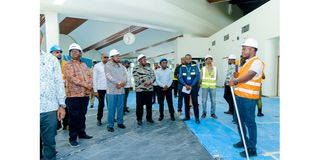
Zanzibar’s Second Vice President, Mr Hemed Suleiman Abdulla (third left), listens to explanations from Engineer Emanuel Holehole on the progress of construction of the commercial centre and Terminal Two passenger building at Abeid Amani Karume International Airport (AAKIA), Unguja, Zanzibar, on Sunday, July 5, 2026. PHOTO|JESSE MIKOFU.
Unguja. Zanzibar’s Second Vice President, Mr Hemed Suleiman Abdulla, has cautioned ministers against confining themselves to offices and paperwork, insisting they must instead go into the field to listen to and address citizens’ concerns.
Mr Abdulla made the remarks on Sunday, July 5, 2026, during an ongoing tour inspecting various development projects, including Terminal 2 at Abeid Amani Karume International Airport, the Mangapwani oil offloading facility at the integrated port, and road infrastructure works.
“I have already issued instructions, and as the government chief executive, I do not want to see file-based ministers. I want them to go to the field and listen to the grievances facing citizens,” he said.
He added that leaders who engage directly with citizens are better placed to understand challenges and provide solutions, unlike those who rely solely on office reports.
“If you wait for reports in the office, you can be misled. Our leaders have already spoken, and my directive is that we go to the field,” he said.
However, he commended the Ministry of Works and Transport for what he described as strong performance in supervising major development projects.
Speaking on the construction of Terminal 2 and the commercial centre at Abeid Amani Karume International Airport, Mr Abdulla said the area is strategically important and, once completed, will contribute significantly to economic transformation and tourism growth.
“This is a very important area in the upcoming AFCON games, and it will serve as a key gateway to support our success in the tournament because one of the main entry points will be the airport,” he said.
He added that improved infrastructure would boost economic growth by increasing employment opportunities and enhancing service delivery across sectors.
Minister for Works and Transport, Dr Khalid Mohamed Salum, said Terminal 2 will have the capacity to handle 1.4 million passengers annually, while Terminal 3 will accommodate 1.6 million passengers per year.
“Once these facilities are completed, the airport will handle 3.6 million passengers annually. Currently, we handle about 2.6 million passengers, so our capacity has increased,” he said.
Inspecting the Mangapwani oil offloading facility, Mr Abdulla said there was a need to ensure local companies are given opportunities to participate in major infrastructure investments and tenders.
He said the facility will significantly improve fuel availability in Zanzibar and enhance supply reliability.
He added that, beyond faster fuel delivery, the project could also help reduce fuel prices due to lower logistical costs associated with offloading fuel on the islands.
Zanzibar Ports Corporation (ZPC) director general, Mr Akif Khamis said the government implemented the project in partnership with a local firm, UP Ltd, at a cost of about $15 million.
He said the former Mtoni fuel facility could only handle vessels of up to 2,000 tonnes, which often led to fuel shortages.
He added that ships now arrive directly from Saudi Arabia to deliver fuel to Zanzibar, unlike in the past when supplies depended on ports in Dar es Salaam and Mombasa.
“Two ships have already arrived. The first came on May 31, 2026, and the second on June 26, 2026. Both vessels from Saudi Arabia carried petrol, diesel, and aviation fuel totalling over 35 million litres,” he said.
He said the new infrastructure is designed to handle modern operations, including larger vessels carrying up to 100 million litres.
He added that modern equipment has also been installed to accurately measure fuel quantities and volumes.