Tanzania and the United States have maintained diplomatic relations for about 65 years, building a partnership that has steadily expanded from diplomacy to trade, investment and people-to-people exchanges.
Growing business links and increasing travel have strengthened economic cooperation, while the Tanzanian diaspora in the United States has become an important bridge between the two countries. On July 2, 2026, the two governments further reinforced their partnership by signing a five-year health memorandum of understanding worth Sh8 trillion.
Against this backdrop, the Tanzanian Embassy in Washington, DC, is intensifying efforts to promote two-way trade and investment through commercial diplomacy.
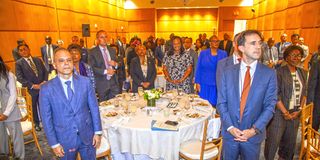
One of its flagship initiatives was a Business Luncheon held on May 6, 2026, at the Ronald Reagan Building and International Trade Centre. The event combined Tanzania’s National Day celebrations with an investment promotion campaign aimed at showcasing the country’s economic progress and attracting American investors.
Rather than focusing solely on diplomatic protocol, the luncheon highlighted the experiences of American companies already operating in Tanzania while positioning the country as a competitive investment destination and a regional trade and logistics hub.
Speaking at the event, Tanzania’s Ambassador to the United States, Dr Elsie Kanza, described the gathering as both a celebration of the longstanding partnership between the two countries and a reaffirmation of Tanzania’s commitment to trade, investment and strategic partnerships.
She said the Government remained committed to maintaining a competitive and investor-friendly business environment, assuring investors that Tanzania remains open for business.
The event also featured a panel discussion during which executives from companies operating in Tanzania shared their experiences and encouraged other American firms to explore opportunities in the country.
The Embassy said the timing of the luncheon reflected the growing importance both governments attach to commercial diplomacy.
The event also provided an opportunity to counter negative perceptions about Tanzania by allowing policymakers and business leaders in Washington to hear directly from investors with first-hand experience of operating in the country.
The luncheon attracted senior officials from the US Government, members of the diplomatic corps, representatives of development finance institutions, business associations, think tanks, non-governmental organisations and the Tanzanian diaspora.
Among those attending were Ambassador Eric Kneedler, Acting Director of the US Department of State’s Office of East African Affairs, ambassadors from several African and other countries, as well as representatives of the International Monetary Fund, the World Bank Group, the International Cotton Advisory Committee and the US Chamber of Commerce.
During the event, District of Columbia Secretary Kimberly Bassett presented a proclamation declaring April 26, 2026, as Tanzania Day in Washington.
Dr Kanza outlined Tanzania’s investment proposition around four key pillars.
The first was credibility. She noted that Tanzania is East Africa’s highest-rated sovereign, with a B+ credit rating from Fitch and a B1 rating from Moody’s, reflecting improving macroeconomic stability and stronger economic fundamentals.
The second pillar was infrastructure development. Electricity generation has more than doubled over the past five years, largely due to the commissioning of the 2,115-megawatt Julius Nyerere Hydropower Project, improving energy security and supporting industrial growth.
The third pillar was Tanzania’s strategic location. She said the country’s role in the Central Corridor, reinforced by a memorandum of understanding signed with the Northern Corridor in January 2026, strengthens its ambition to become the leading logistics and trade gateway for East and Central Africa.
She also highlighted Tanzania’s vast critical minerals resources and major liquefied natural gas projects, saying they have the potential to transform the country’s economy in the coming years.
These priorities, she said, are aligned with Tanzania Development Vision 2050, which aims to achieve high-income status through private sector-led growth. The Government expects the private sector to contribute about 70 percent of the projected $1 trillion economy.
Dr Kanza assured investors that Tanzania protects both domestic and foreign investments under national legislation and international agreements and remains committed to resolving challenges through dialogue with investors.
The panel discussion, moderated by Kendra L. Gaither, President of the US-Africa Business Centre and Senior Vice President of the US Chamber of Commerce, featured executives from The Friedkin Group, Global Export Marketing Company (GEMCO), Kostiv Investment Group and the International Finance Corporation (IFC).
Their testimonials provided practical insights into Tanzania’s investment climate and reinforced confidence among prospective investors.
Representatives from global companies, including Abbott and Citigroup, also attended.
One of the event’s major announcements came from The Friedkin Group, which revealed plans to establish Auberge Safari, a collection of nine luxury properties across Tanzania under its internationally recognised Auberge Resorts Collection brand. The investment further strengthens Tanzania’s position as a premium tourism destination.
Dr Kanza also highlighted the growing commercial relationship between the two countries, noting that bilateral trade exceeded $1.4 billion in 2024, the highest level recorded to date.
She identified mining and critical minerals, healthcare, banking and financial services, tourism, agriculture and manufacturing as priority sectors for future investment. These sectors support the Government’s ambition of positioning Tanzania as a regional hub for food production, healthcare, trade, logistics and investment.
The Embassy aims to increase bilateral trade to $3 billion by 2030.
According to the Embassy, trade between the two countries has more than tripled since 2021, when it stood at $380.2 million, reflecting growing investor confidence and stronger economic ties.
It is also working to sustain US investment in strategic sectors. Recent developments include the signing of a $300 million agreement with US-backed Panda Hill Tanzania Limited and continued negotiations on major projects in Mahenge graphite, Kabanga nickel and liquefied natural gas.
The Business Luncheon demonstrated how commercial diplomacy can strengthen bilateral relations while creating opportunities for trade and investment.
Beyond attracting influential policymakers and business leaders, the event generated fresh investment commitments, reinforced confidence among existing investors and showcased Tanzania’s economic progress.
It also highlighted the important role played by the Tanzanian diaspora in strengthening business and people-to-people ties.
The event concluded with a vote of thanks by Mr Pius Mutalemwa, President of the Tanzania Community in the Washington Metropolitan Area, underlining the diaspora’s growing contribution to expanding economic cooperation between Tanzania and the United States.