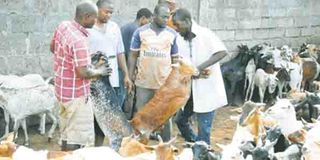
It takes a whole army of men to prepare the meat that we eat. However, safety measures are often not observed. PHOTO\FILE
What you need to know:
Positioned in front of every blanket with items for sale, the oil-lamps are arranged to lead the way towards the main gate. Beside the gate some men are grilling spiced meat. The only source of light comes from a glowing charcoal and their torches. Some have attached torches to their head using a simple piece of twine.
It is 2:30a.m on Friday. The heavy black gate of Vingunguti slaughterhouse is wide open. Outside the gate, men and women are buying or selling food, meat, cell phone-vouchers, and water among other things. There are women on both sides of the street, selling vegetables with their oil-lamps nearby.
Positioned in front of every blanket with items for sale, the oil-lamps are arranged to lead the way towards the main gate. Beside the gate some men are grilling spiced meat. The only source of light comes from a glowing charcoal and their torches. Some have attached torches to their head using a simple piece of twine.
Around the grills, other men are waiting for their food. A number of men wear bloodstained white coats and a pair of white or black gumboots. Others are just wearing sandals, t-shirts and shorts. Although they do not wear the same clothes, they all are working at the Vingunguti abattoir.
In the slaughterhouse, a brown bull is pushed and pulled to the centre-area by two men. The bull is one of the last animals to be slaughtered this night. They step on the dark-red concrete floor. The blood from the previously slaughtered cattle has made the floor slippery. Some blood is smeared over the white tiled columns holding the tin roof of the shed.
The two men use two ropes, one attached at the beast’s head, one at its hind leg. The bull has no means to escape, he loses his balance in no time, cracks literally on his back down to the floor. In the next moment, the four feet of the animal are tied together. The beast is now ready for the knife, ready for its last journey to Walhalla.
The brown bull is lying on the floor, breathing heavily, the eyes wide open but not making any sound. Two other men are approaching the animal. Both are wearing gumboots.
The one who finally kills the beast is wearing a bloodstained white apron, a red T-shirt and a beige hat and carries a long knife in his right hand. His assistant, who has to expose the throat of the animal, is just wearing jeans and a sleeveless blue shirt.
While the assistant is stretching the animals neck, the man with the knife bends down, grabs the animal’s throat and starts to cut it. A hissing and gurgling sound indicates that the first cut is successful. After the second cut, light red blood is streaming towards the drain. With a stab in the bull’s chest dark red blood bubbles from the inner of the animal to the floor, joining the light red blood on its way to the drain.
As the blood drains down the concrete floor, slowly but steadily, the men continue their work as the next cattle waits for the knife: stretching the neck, cutting the throat, stabbing in the chest, stretching the neck, cutting the throat, stabbing the chest... Both are working with economic and routine movements, yet they are sweating. Neither hands, apron nor knife is washed as the men continue to slaughter animal after animal. It takes approximately half a minute, until all the blood has gone down the drain. The men have to wait a little longer to release the rope to avoid being beaten by one of the moving hooves.
The life of the animal has gone, and the next two men are doing their work. First, the bull is turned on his back. Then, one person cuts the skin from the thoracic bone up to the testicles of the bull with a short but well sharpened knife. The other person is just cutting off the bull’s hooves. These are later cleaned, skinned and finally sold.
One man tears off the skin from the belly of the animal. The skin is used as a carpet, on which the carcass will lie during the process of dismantling.
Another man then uses a short but well sharpened knife to open the bull’s belly. Carefully, he follows the line from the thoracic bone down to the bull’s testicles. Two other men take over and release the huge stomach and the intestine out of the body.
The men transport the stomach towards the open space behind the slaughtering area. There are big blue and green barrels filled with water. The intestine and stomach are emptied, the latter is cut into pieces, while the first is just further rinsed with water.
William works in a sleeveless shirt, shorts and sandals and a black hood. He usually starts at midnight. He washes and cuts the stomach of some heifers and bulls and later sells them on the market. None of these men are wearing gloves. While talking to William, one of his colleagues opens a part of a bovine stomach, emptying it on the concrete floor. After the residuals have been washed away, the man continues to clean the stomach with running water provided from different sources.
Two other men are now working on the bull: liver, heart, lungs and all other remaining inner parts have been taken out and thrown into the blue and green barrels for cleaning. The carcass, which still lies on its skin at the floor, is cut into two halves.
One man, wearing a sleeveless grey shirt, shorts and brown shoes swings his machete over his head.
With power and skill he chops the machete through the thoracic bone of the carcass. He has to hit four times to open the thoracic bone. He throws his machete in the body of the animal and grabs his axe. He swings it over his head and hammers the wedge in the animal’s spine. He just chops of the head from the rest.
Again, he swings his axe over his head. The well sharpened wedge of the axe sinks with a sound of splitting and cracking bones into the animal’s spine. This time, he is following the spine to cut the body in two halves. As his colleagues, he is working with very economic and routine movements. Approximately ten times, he swings his axe over his head, pounds the sharp axe in the animal’s spine, following its line from head to tail.
Next, he cuts the beef again with a short knife, but this time he follows the ribs. The quarters are now light enough to be carried by one man. One of the carriers is wearing what was once a white coat. He lifts the quarter on his right shoulder and walks out where the first meat supplying trucks in town are waiting.
Inspection
But before he gets there, he presents the piece of meat he is carrying to the veterinarian. Without the meat being stamped and approved as “fit for human consumption”, it cannot enter the marketplace. The inspection does only take some seconds. And it does not seem as there is meat being rejected frequently.
Another inspection takes place before slaughtering. The animals undergo a health-check before being slaughtered. If one seems to be sick or has just received medicine, it is rejected of being processed.
At around 4 a.m. the market area has come to life. Without being cooled or hung, the meat is directly sold and transported to the butcher-stores.
Growing concerns
Although there are inspections done, fresh water and somewhat skilled labourer, the hygienic conditions are in question, especially since there are many animals being handled at the same time by an army of workers.
Since they lack enough space, sometimes they step over other carcasses lying on the ground. The workers do not wash clothes, hands or knifes frequently, which together raises the risk for cross contamination.
In 2013 Tanzanian Veterinary Journal published the results of an assessment of hygienic practices and faecal contamination of beef at Vingunguti. The results were not appealing. In all the samples analysed, the researchers isolated Escherichia coli (E. coli), a germ living in intestine parts of humans and animals and thus is used as a indicator for faecal contamination.
In other words: having the carcasses lying on the floor and many workers involved without providing them any mean to clean their clothes, knifes and boots, faecal residues are spread over the whole place. This would obviously result in cross contamination.
But economically speaking, the system provides many jobs. As the capacities are not fully used, the workers can easily adapt to rising or decreasing demand.
As a team of researchers putted it: “the food system which is feeding Dar es Salaam, may not be perfect, but it delivers food every day at a scale that meets the food needs of eaters in Dar es Salaam. It does so in a way that responds well to the needs and circumstances of those eaters, especially the majority of poorer residents.”
Now one could blame the government for poor management, one could blame the butchers, that they do neither know nor care, what they are doing. Or one could blame the people who wish to eat more meat, causing pressure on slaughterhouse capacities.
In any case it would be wise to rinse the meat with fresh, safe water and grill the meat carefully before consumption. Doing so would at least reduce the risk of infection caused from E. coli.