Dilemma of outspoken MPs appointed deputy ministers

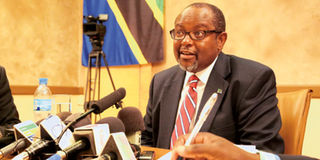
The Chief Secretary, Mr Ombeni Sefue, unveils a new Cabinet line-up at State House in Dar es Salaam at the weekend. PHOTO | FILE

What you need to know:

  • Some of the newly appointed ministers, who portrayed themselves as critics of the government in Parliament, face an uphill task of repositioning their public image

Dar es Salaam. What happens when a Member of Parliament critical of the government is appointed minister? It is a tricky appointment so to speak.

All of a sudden the lawmaker turned minister has to defend the government including in issues he loathed.

This is the tight spot facing three ministers whose appointment was announced by the Chief Secretary, Mr Ombeni Sefue, at the Magogoni State House on Sunday.

Mr Godfrey Zambi, who has been appointed deputy minister for Agriculture, Food Security and Cooperatives, and his Livestock and Fisheries Development counterpart, Mr Kaika Saning’o Telele, are a living example of the dilemma.

While Agriculture was under constant criticism from Mr Zambi, especially on minjingu fertilisers, Mr Telele was a relentless defender of pastoralists against a number of government plans.

Mr Telele was chiefly opposed in and outside the House to eviction of pastoralists from game reserves particularly Ngorongoro Conservation Authority Area (NCAA) situated within his constituency.

 But Mr Zambi is now expected to lead the government’s drive to promote the minjingu fertilisers he loathed, as Mr Telele is to supervise the relocation of pastoralists he defended the most from game reserves, including his own voters residing within NCAA.

Mr Zambi, the Mbozi East MP, in the last Parliament Sitting demanded explanation from the Prime Minister, Mr Mizengo Pinda, on why farmers in Mbeya Region were forced to use the minjingu fertilisers.

This, he said, was despite regional authorities’ resolve to let farmers use farm inputs of their choice.

 Mr Pinda strived to explain reasons for the government to be in favour of the minjingu fertilisers to no avail.

Mr Zambi expressed his grievances on the minjingu fertilisers several times in the House, during parliamentary committee meetings and whenever he got any              opportunity to do so. 

His persistence compelled Mr Pinda to direct the Agriculture ministry to clarify the complaint.

But when it comes to defending pastoralists, you can equate Mr Telele with the Longido MP, Mr Michael Lekule Lazier. The duo have portrayed themselves as truly pastoralists in the House as a result of passionate contributions in favour of herders.

Mr Telele’s private statement in the House led to the formation of a parliamentary committee to investigate a land conflict in Loliondo where the government and pastoralists have for years been playing a cat and mouse game. 

Effects of the appointments

How the two appointed deputy ministers will cope with criticism they gave outside the Executive bench, remains to be seen.

But the appointments will for sure affect a number of other bodies particularly Chama Cha Mapinduzi (CCM) and Parliament.

 A number of the appointees, who hold other leadership posts as well in either CCM or Parliament, will have to relinquish them to pave the way for fresh elections

According to CCM regulations, no party leader is allowed to continue holding the post once appointed or elected to another high post in the Executive.

Mr Zambi and Dr Titus Kamani currently serve as CCM regional chairmen for Mbeya and Simiyu regions, respectively.

Dr Kamani has been appointed minister for Livestock Development and Fisheries, replacing Dr Mathayo David who resigned in the wake of Operesheni Tokomeza Ujangili scandal.

Their entry into the Executive bench compels them to resign their regional party chairmanship and calls for fresh elections to fill their posts.

Mr Mwigulu Nchemba, who has been appointed deputy minister for Finance, will also have to forgo his CCM secretary-general’s (Mainland) post for another cadre to be appointed. 

Parliament will, in turn, have to fill three posts held by Ms Jenister Mhagama, Mr Mahmoud Mgimwa, and Dr Pindi Chana.

Ms Mhagama, one of the former National Assembly chairpersons, has been appointed deputy minister for Education and Vocational Training.

Save for Mr Mussa Zungu, Mr Mohammed Seif Khatib, also her co-chairperson, has never presided over a single Parliamentary session. But two parliamentary committees will also have to elect new chairpersons following the entry of Mr Mgimwa and Ms Chana into the Executive bench.

Mr Mgimwa, who chaired the Economy, Industries and Trade Committee, has been appointed deputy minister for Natural Resources and Tourism.

His colleague, Dr Chana, who chaired the Constitutional Affairs and Justice Committee, has, in turn, been appointed deputy minister for Gender, Community Development and Children.

Regional balance

Regional balance used to be one of the key criteria, albeit unofficial, for the appointment of ministers and their deputies.

The appointing authorities ensured each region gets at least a minister or a deputy minister, but this was not keenly observed in the Sunday reshuffle.

Regions which ‘lost’ their representatives in the former line-up with their names in brackets are Kagera (Mr Khamis Kagasheki), Ruvuma (Dr Emmanuel Nchimbi), Kimilanjaro (Dr Mathayo David), Iringa (Dr William Mgimwa), Mbeya (Mr Phillip Mulugo), Manyara  (Mr Goodluck Ole Medeye) and Dodoma (Mr Gregory Teu).

The new faces, however, hail from Dar es Salaam (Dr Asha-Rose Migiro), Simiyu (Dr Titus Kamani), Singida (Mr Juma Nkamia), Singida (Mr Mwigulu Nchemba), Mara (Dr Stephen Kebwe), Njombe (Mr Mgimwa), Njombe (Dr Chana), Arusha (Mr Telele) and Mbeya (Mr Zambi).

The Kagera, Manyara, Kilimanjaro and Zanzibar representatives though have not been replaced, they cannot openly complain because, as pointed out earlier, regional balance is not a legally binding criterion, but rather discretion of the appointing authorities.