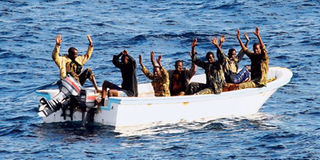
Suspected pirates keep their hands in the air as directed by sailors aboard the guided-missile cruiser USS Vella Gulf (CG 72) (not shown), in the Gulf of Aden, February 11, 2009. A multinational naval force seized the seven suspected pirates in the first such action in its anti-piracy campaign, the U.S. Navy said. PHOTO I FILE
What you need to know:
War against pirates in the Indian ocean may persist as long as international trade routes pass through the Gulf of Aden
Gulf of Aden. A young French soldier stands portside on a ship chugging slowly through the dark waters of the Gulf of Aden. He scans the horizon with a steady but practised sweep of his binoculars.
Set on a mount next to him, oiled and glistening in the clean, early morning air, is an M2HB Browning 12.7-millimetre machine-gun. A long chain of bullets snakes from the gun’s feeding mechanism into a metallic ammunition box next to it, a crouching serpentine trail of lead-tipped venom.
In the distance ahead, a scrappy range of hills looms into view. “That is Bosaso,” the soldier says suddenly in a curt, matter-of-fact manner, perhaps lest I mistake it for Cap Martin on the French Rivieria.
There is no such chance. We are sailing in the Gulf of Aden, that expanse of water that separates Africa from the Middle East, and we are looking for pirates. We are on the French warship FS Siroco, an amphibious landing ship and the crown in the jewel of the European Union Naval Force deployed here.
Up north, many, 11,627 kilometres away, is the Suez Canal which, when opened for business in 1869 changed world commerce hugely by joining the Mediterranean and Red seas. Rather than sailing down the Cape of Good Hope at the southern-most tip of Africa, ships from European harbours headed to the Middle East and Asia could sail down the Gulf of Aden.
Such sea traffic was always going to attract pirates, those hijackers of the high seas. However, the breakdown of Somalia, which has the longest coastline of any African country, soon spilled over from land to the sea, giving piracy momentum.
It started with small, desperate fishermen taking arms and accosting fishing vessels and other smaller craft that strayed into Somali waters. However warlords and enterprising Somali businessmen (piracy, like war, is mostly a playground for men) soon realised the high returns to be realised from organised piracy. Soon they were sponsoring crews to head out into the Indian Ocean and reel in hijacked ships for ransoms that went to the core investors.
Like the Wolves of Wall Street, the Merchants of Mogadishu were quick and ruthless in their pursuit of profit, return on equity, and maximising shareholder value.
From about 2004 the sporadic piracy attacks exploded into a blitzkrieg of hijackings. In 2008 there were 24 pirate attacks. The next year that figure rose to 163, then 174 and to 176 in 2011, not all of them resulting in hijackings.
Seed capital from the equity investors allowed the pirates to assemble larger crews, build skiffs that could go farther out into sea, better arms, as well as satellite mobile phones to communicate better, and Global Positioning Systems to locate potential victims. The equipment was simply taken out of the Capex (capital expenditure) accounts.
The World Bank estimates that pirates took in more than $400 million in ransoms between 2005 and 2012. The foot soldiers took between $30,000 and $75,000 for each ship they brought in with the financiers taking much more – between 30 and 50 per cent of all ransoms paid. The rest went on operational expenses and levies to al-Shabaab and other clan chiefs.
Many of the hijacked ships were commandeered to Bosaso, a major seaport for the semi-autonomous Puntland region of Somalia. When the pirates started successfully taking on large oil tankers they went from being a nuisance to a threat to global commerce. Insurance premiums rose as did the time spent and distance ships had to travel to skirt through pirate-infested waters.
Without a government in Somalia capable of patrolling the country’s coastline or netting its pirates, the response came from the European Union. The FS Siroco is part of the response; one of up to eight ships in a fleet that patrols the Gulf of Aden and the large expanse of the Indian Ocean off the East African coastline.
From the distance, as the helicopter roars through the air, the ship is a small white dot in the horizon but it grows bigger as we draw closer until, with one side-ways manoeuvre, the pilot sets us down on this small floating city that rises five storeys high.
The helipad can take four choppers and there is a hanger inside big enough for another two. Below-deck is a dry dock that can carry and set down as many as four large landing crafts, and plenty more rubber dinghies. Counter-piracy is organised a lot like the piracy it seeks to fight. A larger ‘mother ship’ carries fuel, arms, fighters and supplies, and serves as a launching pad for smaller attack crafts that go out to hit the targets.
However, in a match of firepower against firepower, the 12,000 tonne FS Siroco’s arsenal effectively meant that the pirates had brought harpoons and hunting knives to a gunfight.
The four M2HB machine-guns on board have an effective killing range of two kilometres and can spit out between 450 and 575 rounds per minute. The pièces de résistance, however, are three Breda-Mauser machineguns which can take out Captain Jack Sparrow – or his Somali equivalent – from a comfortable three kilometres, and smash holes through his skiff with their 30-millimetre rounds.
The ship also has a surface-to-air missile system to defend it against air attacks although that is hardly ever manned, seeing as the only plausible air-threat in these waters – perhaps a suicide bomber hurled at the ship from a giant catapult – is improbable.
Before the machineguns are called into play, however, a lot of the anti-piracy operations rely on collecting and analysing intelligence information. Seafarers are asked to report any suspicious crafts to a centre in Dubai, in the United Arab Emirates where they are logged and analysed, before a ship or a helicopter is scrambled to the site of the reported sighting. The shipping industry has also adopted several ‘best-practices’ to deter piracy, from speeding through dangerous portions of the sea, to hiring armed private guards and having them on-board.
Successful piracy attacks dropped 47 in 2010 to 5 the following year. So effective have these combined efforts been that there has not been a successful pirate attack in the Gulf of Aden or off the Indian Ocean in 20 months, going back to 2013.
“First you had failed states, and then this part of the ocean became failed seas,” Rear Admiral Bartolome Bauza, the deputy commander of the EU Naval Force’s Operation Atalanta says, his eyes gesturing to Somalia in the distance. “These are now governed seas; now you need to sort out the failed state.”
While the threat of piracy has receded, officials acknowledge that it has not disappeared. Pirates are still holding one vessel and 50 hostages. On board the FS Siroco, the new President of Puntland, Abdiweli Mohamed Ali Gaas launches a pilot scheme to register the country’s fishermen and give them biometric IDs so that they are not mistaken for pirates.