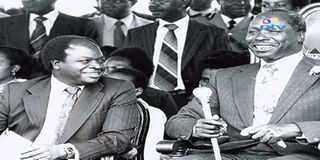
Former Kenyan presidents Mwai Kibaki and Daniel arap Moi. The Kenyan political landscape since the introduction of multiparty politics has been dominated by political alliances. PHOTO | FILE
What you need to know:
The first major challenge that the Opposition faced in 1992 was that they underrated the ability of the ruling party to divide them. The same situation may be facing Ukawa. In Kenya Kanu was said to use Semeoni Nyachae to divide the alliance, according to the Kenyan media. Nyachae, who was in the opposition, had chosen during the election campaigns to confine and focus his attacks on Kibaki the presidential candidate of NAK.
The first major attempt at opposition alliance in Kenya was in 1992, it involved FORD-Kenya and FORD-Asili, the two parties that had split from the original Forum for the Restoration of Democracy (FORD). FORD had been formed as a political lobby group just before multiparty politics was reintroduced in 1992. A number of factors accounted for this failed attempt at opposition alliance.
The first major challenge that the Opposition faced in 1992 was that they underrated the ability of the ruling party to divide them. The same situation may be facing Ukawa. In Kenya Kanu was said to use Semeoni Nyachae to divide the alliance, according to the Kenyan media. Nyachae, who was in the opposition, had chosen during the election campaigns to confine and focus his attacks on Kibaki the presidential candidate of NAK.
Another reason for failure was egoism and individual interests of the major politicians. They saw this as a golden opportunity to ascend to the highest political office in the land. Jaramogi Oginga Odinga as chairman of FORD, had assumed that he would be the party’s automatic presidential candidate when the elections were called. Another major factor for the failure is Kenyan politics was not free from ethnicity and regionalism but in 2002 political parties managed
The way or the method how to formulate those alliances were among the factors undermining the formation of political alliances in Kenya. This was problem in Kenya in 2002 and seems to be a problem as well in Tanzania for Ukawa. For Ukawa the situation can be more difficult because of the legal environment regulating the political parties unlike in Kenya which party alliances is possible.
During the attempts to bring the FORD-People party and the Rainbow Alliance to join the original NAK. NAK had by this time identified Mwai Kibaki as its presidential candidate According to political analyst in Kenya it was not easy to change NAK’s commitment to the Kibaki presidential candidacy.
The same as Ukawa political alliance in Kenya had very limited time to organize themselves before the campaigns. Ukawa started their movement during the constitution making process in 2014.
It was thus important for Ukawa to elect their candidate as soon as possible. In Kenya as well the need for new and people driven Constitution led the birth of the Ufungamano Initiative which brought political parties unity. The same as it was for Ukawa, the Opposition parties in Kenya joined to mobilize support for the Ufungamano Initiative.
Another challenge to NAK which seems to not a problem to Ukawa was the diversity of political orientations of the individual politicians in the parties. The National Alliance Party of Kenya was a conglomeration of about 13 independent political parties which some of them are not represented in parliament while DP, FORD Kenya and few others had a substantial number of MPs in parliament.
Age of the presidential aspirants was also a major issue in the alliance between the opposition parties. Kibaki was about 71 years old while Nyachae was 80 years old. This meant that for the two, especially for Nyachae, this was the last opportunity they had for going for the presidency.
It was thus quite understandable why Kibaki and Nyachae were reluctant to give up the fight for the presidency in favour of any other politician in the alliance.
For Kibaki, the other relevant factor was that he had contested presidential elections twice, first in 1992 and then in 1997 Nyachae refused to join the grand alliance and decided that he would go it alone.
Therefore the formation of political alliances and the disagreement within Kanu were the undermining factors for the downfall of Kanu in Kenya during 2002 election. The four top Kanu officials who had wanted to stand for Kanu presidential seat were frustrated after Vice-Chairman Uhuru Kenyatta had been declared presidential candidate for Kanu. They finally left Kanu and formed the Rainbow Alliance which later joined NAK.
The 2002 Election and the Downfall of Kanu
The nomination of Uhuru Kenyatta as Kanu presidential aspirant in 2002 drew a lot of disagreement within Kanu. This led many potential politicians to join Rain Bow Coalition. On 27 July 2002, the President named Uhuru Kenyatta, the son of the first President of the republic, Mzee Jomo Kenyatta, as his preferred successor and the party’s presidential candidate. This surprised leaders and the other Vice Chairmen who had expected to be named as successor. This became the beginning of the war and rifts within Kanu. These leaders immediately protested against Moi’s choice. Raila Odinga led the other leaders in protesting against Moi’s choice. President Moi, however went ahead with his mission.
The new Kanu Secretary General, Raila Odinga, led the other movement to form a ‘Rainbow Coalition’ to distinguish themselves from the Moi - Uhuru faction within Kanu. This is what happened during CCM nomination, everyone would have expected to see such factions within CCM when politicians like Lowassa leave to form their own movement against choice of the CCM retired leaders, Dr Pombe Magufuli.
Because it was too late to form a new party, the Rainbow Coalition took over a minor party, the Liberal Democratic Party (LDP), and transformed it into a vehicle for their opposition politics.
Therefore the political alliance contested through LDP. This could happen in Tanzania if Mr Lowassa and other aggrieved politicians will decide to cross the line and pick up small parties like ACT, UDP or TLP to run for presidential post.
Political alliance NARC won the December 2002 elections with a big majority. The party’s presidential candidate, Mwai Kibaki, won 62 per cent of the votes cast while Uhuru Kenyatta of Kanu got 31 per cent. Simeon Nyachae of FORD People got 6 per cent. Narc won 125 seats out of 210 seats, Kanu only 64 seats and FORD-people 14 seats.
The winning team of the Kenya Political alliance had the following influential politicians; Mwai Kibaki, George Saitoti, Raila Odinga, Moody Awori, Kijana Wamalwa Charity Ngilu, Kalonzo Musyoka, William Olentimama, Joseph Kamotho, and Kipruto arap Kirwa.
These are the top leaders of DP, FORD-Kenya, National Party of Kenya and the Liberal Democratic Party (LDP) or Rainbow Coalition which formed NARC, according to Kenyan media reports.
The downfall of Kanu in Kenya and the way political alliances fueled the change of regime in Kenya should now be a lesson to Ukawa and other politicians who feel to be offended within party nomination processes.
I would advise those who feel to be unfairly treated in CCM presidential nomination to follow the same route that Rainbow movement led by Raila Odinga and other Kanu leaders stood against Kanu. This will help to reduce ruling party supremacy and open the door for plural democracies.
By Olengurumwa is a Political and Policy Analyst. He currently pursues a Master’s Degree in Public Policy at the University of Dar es Salaam: [email protected]