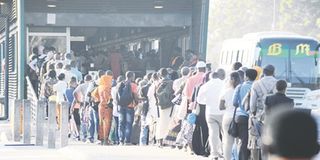
Passengers at the Ubungo bus terminal, mostly who come from Buguruni, Temeke, Gongo la Mboto, Mwenge, Kawe, Tegeta and other places enroute to Kimara and Mbezi find it hard getting a place on the buses given that the buses are usually full with passengers from Kariakoo and Kivukoni when they reach at Ubungo station. PHOTOSI FILE.
What you need to know:
The rapid transit buses, that are branded DART, cut through the city via Morogoro and Kawawa Road, and have been doing so since the middle of May. They run in their own lanes in the middle of the road, separated from all other traffic. The buses are the result of a plan for the city’s infrastructure which the government began to draw in 2003. It is planned that the fast-track buses will cover all major routes in the city and carry the majority of the city’s commuters.
Baraka Erasto was just about to enter one of the blue DART buses for the first time. It was afternoon at the Ubungo Terminal in Dar es Salaam and Baraka had been on the road for long, travelling from Kilimanjaro Region by bus.
Now he was about to board one of the blue buses for the first time, but he was already skeptical. “I almost went over and took the daladala instead, when I waited in the ticket queue,” 31-year-old Baraka said as he sat on a bench in the spacious Ubungo station and waited among other passengers that slid through the ticket control. He had planned to try the new buses, but the first encounter with the novelty had disappointed him. The rapid bus system is very formal compared to the informal daladala buses, and to both commuters and employees it has been a time of adaption to a whole new world. At the bus terminal in Ubungo a group of U-DART employees stood around the ticket gates where commuters have to scan a valid ticket or card for the silver bar to flip down and let them into the terminal. Salim Chuma, a U-DART Station Attendant Officer, also assisted commuters with scanning their tickets, and he reflected on the challenges of the first months with DART. “This system is very new in our country. Some people are very decent, but a few are a bit aggressive. Some people don’t want to stamp out, because they think they will be able to use the ticket again, if they don’t,” Mr Chuma said. The buses run from 5am till midnight and the look of a tall bus passing through traffic in the dark has been like watching an illuminated ship sliding through the night. But it has not all been pleasant. People using the buses at night have been robbed when they crossed the bridges at the stations in Ubungo and Kimara, Mr. Chuma explained. It would reduce the risk of robberies and theft if the bridges were illuminated, had surveillance cameras and security, Mr Chuma added. The rapid transit buses, that are branded DART, cut through the city via Morogoro and Kawawa Road, and have been doing so since the middle of May. They run in their own lanes in the middle of the road, separated from all other traffic. The buses are the result of a plan for the city’s infrastructure which the government began to draw in 2003. It is planned that the fast-track buses will cover all major routes in the city and carry the majority of the city’s commuters. Bus Rapid Transit (BRT) systems are often chosen as solutions in developing countries due to its speed and comfort, while at the same time being considerably cheaper to construct than a similar rail system.
New beginning In the early phase of DART several accidents of pedestrians, motorcycles and cars colliding with the tall blue bus were reported. Recently, the talk of accidents has dimmed, but a driver of DART buses, Thomas Samuel, 36, explained that dangerous situations still occur when the bus passes through the city. “The challenge is that many people pass by foot and by piki piki. It is quite dangerous,” he said just after one of his shifts had ended, and he prepared to leave the Ubungo terminal. Before he began to drive DART buses in Dar es Salaam he drove buses between Dodoma and Dar es Salaam, but now he drives on the Ubungo-Kivukoni route from early morning till early afternoon. He is happy to drive the buses, he explained. The passengers are happy and their satisfaction when they reach their destination in a short time also reflects positively upon his work. The transport time is a general point of satisfaction among the passengers. A tour from Ubungo to the centre of the city lasts around thirty minutes, and it is considerably less than a ride in a daladala whose duration depends on the traffic. “It is good if you are in a hurry. If you are going for a long distance, it is also cheaper than two daladalas,” 21-year-old Rachel Shava said as she waited for a bus from Ubungo to Kivukoni. From there it was easy for her to cross over to the ferry terminal and reach Kigamboni, she explained. Rachel associated her bus experience with adjectives like “safe” and “peaceful”, and she seemed enthusiastic about her new means of transport. When the bus destined for Kivukoni arrived, she got up quickly and determined, and entered through the automatic doors of the bus before they closed. She jumped on and was gone.
More buses? The popularity of the buses is evident in the hordes of passengers during rush hours. Often the buses are so full, that it is almost impossible for passengers to board them. Some dare to squeeze themselves into the crowd on the bus and remain with all limps intact as the doors close behind them. John Joel who is a 65-year-old farmer living in Kimara often uses DART buses when he travels between his home and the city. He often finds that the buses are full, and he has to stand up during the trip. But standing in the bus is quite doable, he explains, as long as the bus reaches its destination fast he doesn’t mind. “There are few buses. If they put more buses, it will be even better to take the BRT,” John said. The problem of congestion is very relevant, Director of Road Transport Regulation at the Surface and Marine Transport Regulatory Authority (Sumatra), Mr Johansen Kahatano, agrees. When he inspected the buses he found that the major issue was congestion, and that it caused dangerous scenes when people tried to board a full bus. An atmosphere of desperation rose among the commuters who had been waiting for long, he explained. “For now there are not enough buses because of the number of passengers in the morning and evening. In terms of infrastructure the BRT has the capacity, but right now there might be a problem with either the number of buses or the scheduling of them,” Mr. Kahatano said. He explained that it might solve the issue to reschedule the buses, so both crowded and empty buses are avoided. “We have summoned U-DART to answer questions about safety and health in the buses,” Mr. Kahatano said. Email: [email protected],