Is cremation the new trend in the funeral industry ?
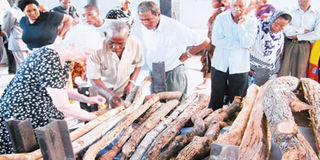
Damiano Doamsi’s wife lights a match stick as friends and relatives watch during Damiano’s cremation in 2009.
PHOTO | COURTESY
What you need to know:
Rajab Ismail*, an undertaker based in the city says cremation gives people the flexibility to search for types of tributes that reflect the life being honoured.
Before his death in 2009, Damiano Mandoo Doamsi would once in a while over a drink, with friends and relatives, reiterate his desire to be cremated when he passes on.
Some of his friends would blame it on the alcohol, but as the days went by, his craving for such a bizarre ritual was evident.
“My brother was quite a character; every now and then he would remind me of how he wanted to be buried,” recalls Laurenti Irafay, a brother to Damiano.
According to Mr Irafay, Damiano was incessant on his desire that they had to convene a number of family meetings, in a bid to persuade him not to resort to his wish.
“We thought it was very strange for someone to get cremated, we only hear of such things among the Hindus and Japanese, but not among Africans,” says Mr Irafay.
Though valid, such arguments did not hold any water, as on April 22, 2009, Damiano was given the burial he had yearned for, after succumbing to leukemia.
Before getting cremated, Damiano’s body lay at his home in Kigamboni for last respects, in the presence of the Parish Priest, before the trip to the Hindu Crematorium in Kijitonyama area.
Unfortunately, Mr Irafay was not among the people who made it to Kijitonyama for his brother’s cremation.
“His wife was around and so were some of our other relatives, but I did not want to be part of it, I would not stand seeing my brother burning.”
The day after his cremation, Damiano’s ashes were buried at Kigamboni cemetery. Mr Irafay is still hurt to date, and still wondering why his brother had to choose such a ritual.
“We need to be sensitised on cremation because it is still something new to many of us, it is just too much to stand watching somebody burning,” he says of the option some people are considering these days instead of the traditional burial.
Strange as it may be, cremation is turning out to be a new trend of burial to some Tanzanians. Though it is a common ritual among the Hindus and other Asian communities living in the country, some Africans also opt for such means.
As it was the case with Damiano, he had in fact documented in his will that he preferred to be cremated.
Before he died last year, the late Tonny Baretto, one of the media gurus to have graced the profession had left a will to be cremated upon his death. His wish was later granted at the Hindu Crematorium, before his family members.
A new trend
Cremation is becoming increasingly popular in Tanzania, especially amongst the younger generation. Among the many reasons for this growing trend is the breadth of options cremation provides for a final memorial service.
Actually, cremation is only part of the commemorative experience. It is said that cremation can increase your options when planning a funeral. Information is available on the internet to help you build an understanding of what cremation and Tanzania cremation services are, allowing you to make an informed decision when arranging a funeral for yourself or a loved one.
Rajab Ismail*, an undertaker based in the city says cremation gives people the flexibility to search for types of tributes that reflect the life being honoured.
He says this doesn’t mean aspects of traditional funeral services have to be discarded.
“Even with cremation, a meaningful memorial that is personalised to reflect the life of the deceased could include special music, a ceremony at the funeral chapel, your place of worship or other special Tanzania location and participation by friends and family,” he says.
Commonly, cremated remains are placed in an urn and committed to an indoor or outdoor mausoleum or columbarium; interred in a family burial plot; or included in a special urn garden, according to Rajab, adding that the ritual gives families in Tanzania the option to scatter the remains.
This, he says, can be done in a designated cemetery garden in Tanzania or at a place that was special to the person.
Describing the whole process, Rajab says a casket or a container is placed in the cremation chamber where the temperature is raised to approximately between 1400 degrees and 1800 degrees Fahrenheit. After approximately two to two and a half hours, all organic matter is consumed by heat or evaporation.
“The remaining bone fragments are known as cremated remains. The cremated remains are then carefully removed from the cremation chamber. Any metal is removed with a magnet and later disposed of in an approved manner.”
According to the undertaker, the cremated remains are then crushed into fine particles and are placed in a temporary container provided by the crematory or placed in an urn purchased by the family.
Thanks to scarcity of burial sites, some people opt to get cremated, opines Rajab.
“Some people go for the easy way, rather than go round looking for burial sites, they would rather get cremated”.
According to him, anyone who dies can access the service of burial or cremation irrespective of religion and social status.
The Hindu crematorium in Kijitonyama is a popular cemetery and crematorium site in Dar es Salaam.
A quick internet search on the Shree Hindu Mandal established that Hindu crematorium was initially located along Ocean Road.
Later in the 1960s, it was decided that the crematory should be moved and was given a plot in its current location.
Almost 100 bodies cremated each year at the crematorium are from Dar es Salaam.
According to Rajab, though it saves time, cremation is still an expensive ritual compared to traditional burial.
An internet search of crematorium services in the country established that a normal urn which is used to store the ashes after cremation retails from $100 (Sh170, 000) whereas elegant designs are available at prices up to $2,000 (Sh3.4million) in Dar es Salaam.
The more expensive urns are typically made from rarer materials and are usually more meticulously crafted.
Rajab says that families that originally plan to spend $1,000 on an urn often end up finding the perfect urn for their loved ones for far less.
“Because the selection is so large, establishing a budget can help you narrow the choices to a manageable size. You will certainly find plenty of urns to choose from in Dar es Salaam no matter what your price range,” says Rajab.