Those who have travelled far and wide will attest to the sheer delight derived from learning new cultures and basking in the merriment of foreign exposure. But beyond the allure of scenic sites and coveted landmarks, there is one thing that should underpin a travel experience: knowing the history of your destination and what continues to shape its future.
I had the unique opportunity to visit South Korea as part of a team of journalists from Africa and Europe who were selected to participate in the 2023 international journalist program organised by the Korean Culture and Information Service (KOCIS), a government-affiliated institute engaged in promoting the beauty of Korea and enhancing cultural exchanges with other countries.
Africa was represented by a team of senior journalists from Tanzania, Ethiopia, Angola, and Gabon, with print and broadcast journalists from the Czech Republic and Poland representing Europe.
The program, which included visiting some of Korea’s most notable landscapes and sites that have defined the country’s present and continue to shape its future, was to be covered in a span of six days. As such, we hit the ground running and were ready to savour each moment.
Korea has had a very complex past, which continues to be a subject of discussion beyond its borders. To begin with, the East Asian country constitutes the southern part of the Korean Peninsula and borders North Korea along the Korean Demilitarized Zone, popularly known as the DMZ—a place we were fortunate enough to visit on the last leg of our tour. The country's western border is formed by the Yellow Sea, while its eastern border is defined by the East Sea.
Despite its tragic history of being under Japanese servitude and having to fight for sovereignty and autonomy during the Korean War, South Korea is today regarded as one of the world’s most developed nations and the tenth-largest economy by nominal GDP.
When I landed at the Incheon International Airport, it became very apparent that the "economic miracle" that is closely associated with Korea’s rebound has shaped Seoul and other major cities into modern metropolises.
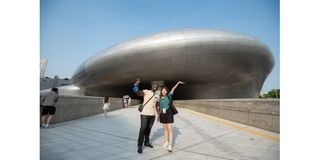
The Citizen Managing Editor Mpoki Thomson with Jasmine from the Korea Herald at the DDP in Seoul.
Blue House
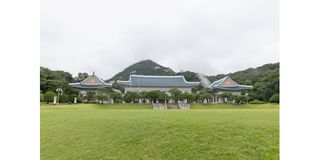
We cannot admire the present and plan for the future without recounting the past. So, on day one of our visit, the mission was to retrace Korea’s political and administrative history. We visited an estate where Korean presidents have lived and worked, that has remained an important part of Korea’s modern history and power: the famous Cheong Wa Dae, also known as the Blue House (an attribute to the blue roofing tiles used during construction).
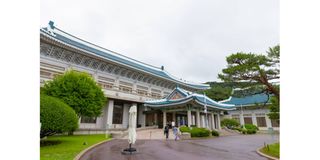
On a rainy morning, with umbrellas in tow, we visited Cheong Wa Dae, which is now a public park that formerly served as the executive office and official residence of the president of South Korea from 1948 to 2022. It is located in the South Korean capital, Seoul.
Cheong Wa Dae (Blue House) in Seoul. PHOTO | KOCIS
We visited this symbolic site a year after it was opened for public viewing. The Blue House is indeed a commanding structure built in the traditional Korean architectural style and adorned with some modern architectural elements and facilities. We were taken on a brief tour inside the palatial estate, which now hosts the main office hall, Bon-gwan, the presidential residence, the state reception house, the press hall, and the secretariat buildings.
An important landmark and representation of South Korea’s history, Cheong Wa Dae was subject to North Korean infiltration in January 1968, when they nearly reached the building in a bid to assassinate President Park Chung-hee in what became known as the Blue House raid. Even though the attempted assassination was unsuccessful, 28 North Koreans, 26 South Koreans, and four Americans were killed.
Cheong Wa Dae (Blue House) in Seoul. PHOTO | KOCIS
Gyeongbokgung Palace
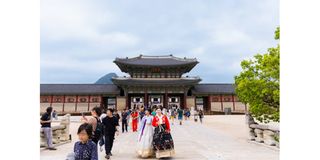
Despite the intriguing run down Korea’s political memory lane, I still yearned for a more cultural-centric historical account of the dynasties that ruled Korean land. This was fully delivered when we visited the Gyeongbokgung Palace, which is said to be one of the largest of the Five Grand Palaces built by the Joseon dynasty and served as the home of the Kings, the Kings' households, as well as the government of Joseon. Gyeongbokgung is the quintessential reminder of how dynasties operated and lived. It has been well preserved and remains open to the general public, with thousands of tourists from all walks of life visiting the palace daily.
The fact that the Gyeongbokgung Palace is preserved within Seoul creates the perfect contrast where, against the backdrop of the ancient ruins, lie modern skyscrapers.
Dongdaemun Design Plaza
There’s a reason why Seoul is regarded as one of the world’s design capitals: the Dongdaemum Design Plaza (DDP), a major urban development landmark, put Korea’s capital on the global design map and continues to attract tourists in droves. As far as architectural designs are concerned, nothing exemplifies modern aesthetics and oozes power, innovation, and the future quite like the DDP, and I for one didn’t think that I would ever get to see in person the creative work of Iraqi-British architect Zaha Hadid. And the fact that I got to see her last official masterpiece sealed the surreal moment.
Hadid’s mastery of curving the DDP into a top attraction remains a historic undertaking. Opened in 2014, the landmark is now the centrepiece of Korea's fashion hub and a popular tourist destination. The DDP features a walkable park on its roofs, large global exhibition spaces, futuristic retail stores, and restored parts of the Seoul fortress.
Gyeongbokgung Palace
Global Knowledge Exchange and Development
Next on the itinerary was the Global Knowledge Exchange and Development (GKED), which was set up by Korea’s Ministry of Economy and Finance as a research and academic facility to showcase the country’s economic development and share Korea’s development experience with others.
Situated in Seoul, we got to see an exhibition of artefacts and documents as well as interactive learning programs on Korea’s economic development.
However, despite the great economic strides achieved over the years, a long-time staff member at GKED, who gave us a brief lecture detailing the country’s past glory and what the future holds, is pessimistic about the future owing to what he terms as political interference affecting the country’s economic outlook.
Busan’s bid for World Expo 2030
When you land in Korea, one of the things you will often see on billboards is the promotion of the country’s bid to host the World Expo in 2030.
To attain this ambitious goal, Korea chose its second-largest metropolis, Busan, located at the south-eastern tip of the Korean peninsula, as the ideal host city for the globally acclaimed event. Busan’s bid to host the World Expo in 2030 was formalised in June 2021 when the country submitted its bid to the Bureau International des Expositions (BIE). As a port city, Busan bustles with trade activities amid a growing fusion of cultural heritage and modern city planning.
Our visit to Busan required us to take a two- to-three-hour metro ride from Seoul. When we arrived in the lively city, a warm embrace of captivating beauty greeted us as we made our way to the hotel. The next day we visited the Busan Port Authority, where we got a detailed tour of the port and the preparations to host the World Expo in 2030.
Busan prides itself on the "3Ws": well-developed, well-placed, and well-experienced. The Korean government believes that this gives Busan the upper hand over its competitors in hosting the expo. Korea is up against Riyadh, Saudi Arabia, and Rome, Italy.
We boarded a cruise ship and started navigating the busy Busan port waterways, which is Korea’s largest seaport and ranked sixth in the world's container throughput.
What makes Busan a unique destination for both business and pleasure is the strategic investment that the Korean government has made to mould the city into an oasis of modern beauty.
With a logistics hub that connects the Eurasian continent to the Asia-Pacific and advanced infrastructure, including high-speed railways, Busan is home to approximately 3.3 million people and has attracted a whopping 40 million tourists globally over the years.
The World Expo 2030 is set to be hosted for 184 days, from May 1 to October 31. It is estimated that 34.8 million people will attend the expo.
Gamcheon Culture Village
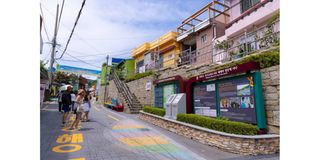
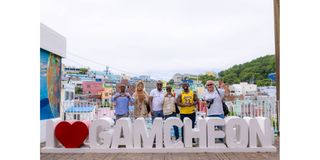
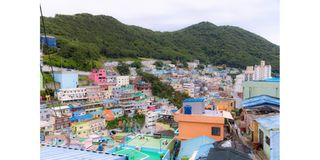
To experience the more touristy side of the port city, we made our way to the Gamcheon Culture Village. Words cannot do justice to the beauty that is inherent in this cultural estate that has somehow found a way to blend nicely into its natural forest backdrop and changing external interlinks, where tall structures are redefining the Busan skyline.
Gamcheon is formed by houses built in staircase fashion on the foothills of a coastal mountain, providing the perfect view of the waterways and one of the best sunsets you will ever see.
We got to take a stroll around the narrow streets that were filled with tourists. Those of us who have visited Zanzibar in Tanzania might feel a bit nostalgic, with streets reminiscent of Stone Town. However, Gamcheon offers a different experience and has its own unique story to tell.
If you are not caught staring at a BTS painting on one of the street walls, then you will be caught taking a photo with the hundreds of unique adornments that are embracing the terraced group housing of this one-of-a-kind village.
An aerial view of Gamcheon Culture Village, Busan. PHOTO | KOCIS
DMZ
Visiting the DMZ was not on the list at first; however, a request was made, and our hosts obliged. Some of us in Africa first heard of South Korea in history classes when we were taught about the Korean War. Being a keen follower of geopolitical affairs, the prospect of visiting the Demilitarized Zone (DMZ) was a moment that will forever be etched in my memory.
The DMZ, a border barrier that divides the Korean peninsula roughly in half, is renowned for salvaging the two territories that had been embroiled in war for three years, costing the lives of over 3 million people from both sides. Today, the DMZ, especially from the South Korean side, remains a place of historical accounts where patriotism and bravery are encapsulated, and through an immersive experience, one gets to take a front row seat back in history.
An honourable mention goes out to Korean cuisine. Hands down, some of the best dishes I’ve tasted anywhere in the world. I still need to learn how to use the chopsticks, though.
Register to begin your journey to our premium contentSubscribe for full access to premium content