Meet brave grandma raising four family members with disability
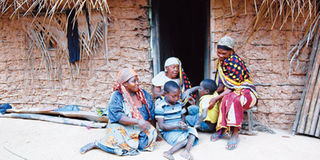
From right, Nuru, her grandson Halifa, her mother Mariam Abdallah, her grandson Gambo and her daughter Mwajuma outside their house.
PHOTO | SALOME GREGORY
What you need to know:
The family’s toilet is a banana leaves’ enclosure and it is also just close to the house. An old bed-sheet serves as the toilet’s door. You just don’t expect such a toilet to be user-friendly to Nuru’s disabled family. But do they have a choice?
She is her family’s pillar of hope and their tower of strength.
Her daughter, Mwajuma, 32, who is disabled and a mother of two disabled children can’t imagine life without her.
Mwajuma’s mother, Nuru Rajab, 56, who is a widow, is the only person in the family of five who is not disabled. She is the family’s sole breadwinner. The family’s everything!
Nuru depends on her quarter-acre farm to feed her family. Just that. She grows cassava, maize and sweet potatoes on this farm. Putting food on the table gets tough at times.
But despite all the hardships that she goes through to ensure her family does not lack, Nuru considers herself lucky to have people to call family.
“Although my family is poor and all its members disabled, we are happy as a family. We live as one and spend most of the time together. Living with disability has made us one,” says Nuru.
The strong woman and her family live in Kidugalo village in Kisarawe district. You could call hers a special needs family. Her elderly mother, Mariam Abdallah, her daughter Mwajuma and her two grandchildren Gambo,10, and eight-year-old Halifa are all disabled. Mwajuma and her children cannot walk but crawl. Although she is crippled, Nuru’s mother can walk, though with a limp.
Poor living conditions
The family lives in a dilapidated two-room mud house whose roof and small windows are made of palm leaves. The family’s kitchen, which is just a few metres from the main house is also not in good shape.
Nuru and her family were sitting outside the house when I visited them. They all looked happy, their faces full of hope. All seemed well with the family except for Mwajuma and her children’s legs and hands which were dirty given that they crawl to move around. Her grandchildren who don’t go to school cannot speak properly.
The family’s toilet is a banana leaves’ enclosure and it is also just close to the house. An old bed-sheet serves as the toilet’s door. You just don’t expect such a toilet to be user-friendly to Nuru’s disabled family. But do they have a choice?
According to Nuru, taking care of four disabled people, one of them an elderly is not easy at all. However, she is thankful that at her age, she can manage to put food on the table for the family. There are days when they go without a proper meal though.
“I have been raising my daughter all alone since she was aged nine. Following her father’s death, things completely changed here. I remained alone and had to work extra hard to take care of her,” says Nuru.
She says it was not easy at the beginning to cope with the situation after she lost her husband. Her husband was a peasant and she a housewife who stayed at home to take care of Mwajuma.
Mwajuma’s disability started three months after she was born. She suddenly started gaining too much weight. When they took her to the hospital, doctors said she was okay.
At five months, Mwajuma could not sit like other children her age. Neither could she crawl. Nuru and her husband decided to take her back to hospital for further consultation. The doctor confirmed all was not well with Mwajuma. He broke the bad news to Nuru and her husband that their daughter would never be able to walk.
Learning the bitter truth
Both Nuru and her late husband were shocked with the news. They could not comprehend what the problem was. Neither did the doctors have an answer.
When Mwajuma was old enough to enrol in school, her parents could not afford the costs involved. Someone had to carry her to school daily.
“I wish I had enough money for her education. It wasn’t easy and it still isn’t easy for my grandchildren. Mwajuma was too heavy to carry to and from school,” says Nuru. Her husband could not afford to hire transport for their daughter.
She tried to enrol Mwajuma in several schools and the majority did not accept her. Two schools agreed but on condition that Nuru remained at the school to help her daughter whenever she wanted to use the toilet. This was a difficult condition to fulfil as she had others duties to attend to.
“I tried doing so for some time but it did not work. In the end I just decided to take our daughter out of school. Thank God my farm is not far from home. I can manage to take care of the family and farm at the same time,” says Nuru.
It took Nuru about 11 years to train Mwajuma to be independent. Things like using the toilet, washing dishes, clothes and doing other domestic chores. Although she does not do much, at least she helps her mother when she is working on the farm.
Already with her disabled mother and daughter to take care of, 10 years ago, Nuru received the shocking news of her daughter being pregnant. As angry and disappointed as she was when she learnt that Mwajuma was pregnant, Nuru did not throw her vulnerable daughter out of their home.
Mwajuma says the father of her child had promised to marry her. However, he disappeared after he learnt she was pregnant. He has since never returned.
“He used to tell me he loved me and promised to marry me. He used to visit whenever my mother was not around,” says Mwajuma.
Since he spent a lot of time with her whenever her mother was away and was also a good friend, Mwajuma trusted him and easily gave in to his sexual demands. “Three months into our relationship, I missed my periods,” says Mwajuma. The poor girl had no idea she had conceived until she started experiencing morning sickness. She told her boyfriend about it only for him to never show up at the house again.
“I would spend hours crying every time I was alone. I had no one to share my problem with. I feared hurting my mother especially after realising the man did not love me,” says Mwajuma who knew nothing about her sexuality at that time.
Learning her daughter was pregnant
Her mother found out the truth two months later. To confirm her fears, Nuru threatened to chase Mwajuma from home if she did not tell her what was troubling her. She had been sad for quite some time and this worried her mother. Mwajuma had no choice but to tell her mother the truth.
Mwajuma recalls how her mother broke down in tears after learning the bitter truth. However, she did not chase her out of the house and never forced her to bring the child’s father.
Adding a new member to the family meant more responsibilities to the already burdened breadwinner. The most challenging part was learning her grandchild would also be disabled.
In a desperate move to see if there was anything she could do to rescue the situation, Nuru visited different hospitals but to no avail. To make matters worse, Mwajuma became pregnant again three years later, this time with a different man.
“My mother complained about it so much. Thank God the other man was good enough to face my mother and agreed to take care of his child. But he did not want anything to do with me anymore. He ran away from his responsibilities four years later,” says Mwajuma.
“So it is my mother who takes care of all of us. My children don’t go to school. She feeds us, takes care of everything and cannot afford to be far from us because no one is willing to carry the heavy burden she carries,” explains Mwajuma.
The family is so grateful that they have Nuru to look after them. They just cannot imagine life without her. Mwajuma says she does not even like giving the idea a thought.
She prays that God keeps her mother as long as possible. Her world would just crumble without her loving and caring mother.
On every 17th of October, the World commemorates the International Day for the Eradication of Poverty. In simple words poverty can be defined as lack of basic necessities such as food, water, shelter, healthcare, and primary education.
Available information shows that the level of poverty in Tanzania is high. More than a third of households live below the basic needs poverty line earning less than Sh 1,200 a day, while 20 per cent of the total population live below the food poverty line just like Nuru’s.