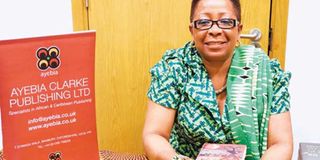
Ayebia is establishing itself as a leading international publisher of quality African and Caribbean literature from both established and new authors, filling the gap left by the demise of active publishing in Heinemann’s African and Caribbean Writers’ Series.
Becky Ayebia Clarke is a Ghanaian Publisher based in Oxfordshire. She set up Ayebia Clarke Literary Agency & Publishing Limited in 2003 with her husband David.
Ayebia is establishing itself as a leading international publisher of quality African and Caribbean literature from both established and new authors, filling the gap left by the demise of active publishing in Heinemann’s African and Caribbean Writers’ Series.
Can you assess your earlier experience with the Heinemann African Writers’ Series and the impact of the Series on the development of modern literature in continental Africa? Becky: Forty years ago, writing from Africa was unheard of in the wider world. The history of the African Writers Series encapsulates the history of Africa’s struggle to rid itself of colonial domination and post-colonial oppression. By presenting to the world stories written by Africans in which Africans are themselves subjects of their own histories, the African Writers’ Series positioned itself at the vanguard of the movement for representing an African identity in the modern world. With nationalism, independence, and the post-independence disillusionment (captured in the Series by titles such as Chinua Achebe’s Things Fall Apart, 1962; Kenneth Kaunda’s Zambia Shall Be Free, 1965; and Ayi Kwei Armah’s The Beautiful Ones Are Not Yet Born, 1969)—and the new global diasporas of Africans, the power and influence of the Series grew and it came to be seen as the canon and carrier of this struggle, being its most visible public voice in creating an international audience and getting the message across to it.
It is therefore no exaggeration to claim that African literature could not have attained its present form without the pioneering role that Heinemann played.
What do you consider the different cultural and economic challenges in writing and publishing Africa today?
Becky: According to Charles Larson, ‘those who say that nothing good has come out of Africa have not read the continent’s writers. African writers inhabit a world devoid of privilege or advantage, lacking many of the things that their Western counterparts take for granted such as—informed and understanding critics, rarely encounter enlightened political leaders willing to acknowledge the importance of the arts. They are often denied social and political stability and their lives are threatened by censorship, forced exile, imprisonment and sometimes worse. And yet contemporary African writers have left an indelible mark on the continent’s psyche as well as on the international literary scene. In this climate, very few writers writing on the continent can live on their royalties.
Why were you involved with the Caine Prize for African Fiction and other projects focused on new writing from Africa?
Becky: The Caine Prize for African Writing, also known as the “African Booker” set up by Baroness Emma Nicholson in memory of her late husband Sir Michael Caine, former Chairman of Booker plc has unquestionably become one of the most important yearly events on the African literary calendar. Now in its 8th year, it has become synonymous with new writing from Africa. Each year, the winning candidate is supported by a plethora of media events, is catapulted into the media gaze with a year’s fellowship at a prestigious university either in Europe or the US.
What are some of the memorable encounters you have had in working with African writers for the development of African literature?
Becky: When I worked at Heinemann, as the Submissions Editor, I would often read manuscripts from Africa which smelled of wood smoke or kerosene indicating that perhaps the person was probably writing without the luxury of electricity. I have on occasions even received manuscripts with palm nut stains—perhaps from a working mother. I was always encouraged to see such dedication and commitment. I have worked with writers to develop their work and celebrated their success when the manuscript finally becomes a book. But unquestionably, one of my most treasured moments is also tinged with a sad irony: editing Ngugi wa Thiong’o latest book—Wizard of the Crow. The manuscript came in at over 1,000 pages. Sadly, Heinemann declined the book in 2002—a period which corresponded with the demise of the AWS. Ngugi’s book was eventually published by Random House in 2006.
As not only a publisher and promoter of African literature, but also an informed reader, what is your opinion and treasured memories of some African books you have read?
Becky: As a Publisher, I read voraciously, and I have been fortunate enough to read some of the best classics in the African literary canon. Whilst I have read my way through the Western classics and have fond favourites such as Austen, Shakespeare, Dickens, the Bronte Sisters, Goethe et al, when I read African writers I feel a keen sense of affinity—as if their message(s) is transmitted intravenously.