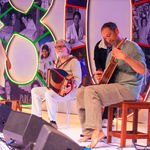
Marking the golden jubilee: Students from Shabaan Robert Secondary School in Dar es Salaam perform at the ceremony to mark 50 years since the establishment of the school. PHOTO I SALIM SHAO
What you need to know:
And now, even as the school turns 50, this man has stood by the school through it all. He is the only surviving founder of the school and seems not to be in a hurry to watch from the sides.
From the days when only three per cent of primary school leavers could obtain admission into secondary school, at a time when the country’s five-year education budget was only 20 per cent of the national budget, Sir Andy Chande has never looked back in ensuring that Shaaban Robert Secondary School maintains its image as the place to be for private education in Tanzania.
And now, even as the school turns 50, this man has stood by the school through it all. He is the only surviving founder of the school and seems not to be in a hurry to watch from the sides.
As far as he is concerned, there is a lot to be done, despite the fact that the school, which celebrated its Golden Jubilee last week, is one of the few academic institutions that have maintained a reputation of delivering excellent results every year.
At the celebrations to mark the Golden Jubilee, the prominent Tanzanian businessman and philanthropist shared with Success, the rich history of Shaaban Robert School, its future and what secret has made it arguably one of the most successful stories of private education in the country:
EQ: How significant is this day to Shaaban Robert Secondary School?
AC: This is a milestone event to us; we are here to portray to the community and the general public what the society has achieved in the last 50 years through humble beginnings. We are among the top 100 schools despite the challenges that we faced when we were starting.
We’re also here to pay tribute to the founders of this school and show the society what they had struggled to do.
What are the major highlights of the school in the past 50 years?
Excelling academically, inculcating the spirit of community service among students and of course instilling an all-round development of our students is what we can so far be proud of. Students who graduate at this school are not only happy with the certificates they are being presented with, but they also leave this place with a vast knowledge horizon.
We look at the opportunities out there and strive at ensuring that students leave Shaaban Robert ready to enter the competitive market.
What was the role of the school during post-independence Tanzania?
Our role was to accommodate students who missed a chance of joining government schools by then.
There was this huge demand and we were very ready to take it up. We decided that we could raise enough funds and do something about it. There were schools in Tanga and Mwanza similar to us, because there was this necessity. Shabaan Robert started off as an exclusively Indian school but later accommodated all races.
What can you say about the transition?
When we formed the school, our concept was to make this school available to everyone, whether they were white, brown or black, but the majority intake 50 years ago comprised Indians who were Tanzanian and those who were not.
This changed gradually, and today we have more classes and more teachers, today we have reached a stage where Shabaan Robert has become the most cosmopolitan school in the country.
To us merit is more important than anything else.
Are there any major changes to write home about?
We had to change because circumstances required us to do so, in the beginning we were able to get substantive financial support, but later on, it dwindled; therefore we had to find ways and means of getting more money.
We had to better ways to accommodate an influx of students who were now enrolling at our school, we then had to have more laboratories, classrooms, find more accommodation. Now we have more classrooms, laboratories and other facilities.
Though there is a lot to be done, by and large we have managed to reach this far and usually we would ask students what they want, particularly when it comes to extracurricular activities.
We have a school council which is so committed and it would always remind us of what we need to do for the welfare of the school, and they come to us with pragmatic ideas.
After 50 years, what next for the school? What direction is it taking?
Ideally, we would like to have a guaranteed intake of students, meaning we would like to have a dedicated primary school, at the moment our intake is based in scouting around.
We also aspire to have more qualified teachers in a bid to make Shabaan Robert a force to reckon with. It is my hope that somebody sitting in my position would have achieved what we have achieved fifty years later.
What do you think was the reason behind last year’s Form 4 massive failure?
Even though the change of curriculum and text books are said to be the possible causes of the dismal performance, I still think a major contributing factor was a sudden change in the criteria that the examiners had put in, which teachers and students were unaware of.
At one point, Mwalimu Nyerere decided to nationalise all private schools during your time, what effect did this have in running Shabaan Robert?
This was a very unsettling moment to us, we were even wondering how we would have moved on with such developments; but I’m glad the political leaders of those days were quite different to those of today because they grew up with the system.