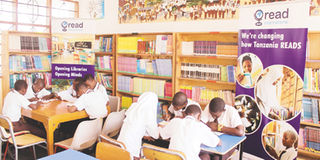
Students from Makumbusho Secondary School reading books in one of the library which was funded by READ InternationaL. PHOTOI COURTESY
What you need to know:
Apart from the poor availability of textbooks and rundown classrooms, many schools do not have libraries and those that have are faced with limited library information resources.
A number of schools across the country have been facing major challenges in offering the right quality of education for students. Poor quality and quantity of classrooms, an insufficient number of desks and a lack of textbooks are some of such challenges.
Apart from the poor availability of textbooks and rundown classrooms, many schools do not have libraries and those that have are faced with limited library information resources.
School library is considered to be of great help to students in fulfilling their information needs. However, inadequate funding, with little or no government financial support has left students with no access to books.
Considering the immense influence that educational materials have in the learning process and looking for ways to help parents who are already over stretched with education cost, a number of stakeholders are exploring the best ways to come up with possible solutions.
Founded in 2004, after a student from University of Nottingham travelled to Tanzania and got exposed to lack of resources in the country decided to make a change, READ International has become one of the organisations that have been closely addressing lack of access to educational resources in the country’s secondary schools.
For the last ten years, the organisation has so far succeeded in donating over 1.4 million books to Tanzania and has created 68 libraries in secondary schools, serving 43,701 students across the country.
The organisation has also teachers on literacy activities, library management and reading promotion. Following such trainings, a number of confident and independent readers have been created with an energised culture of reading within the school community and schools that run efficient and friendly libraries.
Rob Wilson who is the founder of the Non-Governmental Organization (NGO), READ International, said a reading culture amongst students in community schools across the country is the path to sustainable education development.
He said since founding the NGO ten years ago, the organisation in partnership with Realizing Education for Development has built libraries and donated books in wide range of subjects, including sciences, mathematics, languages, life skills and commerce.
“We provide books after having in-depth discussions and negotiations with teachers, stakeholders and students, and delivering based on their needs,” he explains adding that the initiative has paved the way for the development of a reading culture.
Since its establishment, the organisation has used a youth-led volunteer model, to provide thousands of students in Tanzania each year with the resources they need to learn. Alphonce Shayo, was one among the 4 young people that participated in the library refurbishment program at Nasuli Secondary School in Songea.
His school boasted the largest library in the region with an abundance of books.
“I always knew that there were students who wanted the opportunity I got, but weren’t as fortunate, so working as a volunteer with READ International was a privilege for me, as a young Tanzanian, to get the chance to do something significant for the development of my country,” he said.
After training by READ International, 3 weeks of planning and working at Nasuli with his fellow volunteers, he and his team made an impact not only to the school, but also to the community.
He also learnt various skills that have proved to be valuable and applicable in his career.
“Currently, I’m working towards becoming a product developer and a business consultant. This project gave me the chance to learn how to be an effective team player, how to manage my time and how to communicate with multiple stakeholders. Additionally I gained organizational skills, financial management skills, problem solving skills and learned the importance of attention to detail.”
READ International’s Programmes and Volunteer Manager, Raquel Araya, said that the NGO encourages students to be independent readers and provides training to Tanzanian teachers on creating a welcoming and encouraging environment for students to learn.
Araya said they also collaborate with local publishers in preparing and printing books based on local content. A Form Two student at Makumbusho Secondary School, Peter Aidan, said following READ International’s library creation initiative at his school, the number of students visiting the library regularly has increased as they have become inspired to read.
“We are very happy with the library in our school and we thank the organisation for their support. We now have a place where we can get inspiration to learn as our library is filled with books in all subjects” he said.
As part of their Library Refurbishment Programme, READ volunteers transform unused rooms in secondary schools into well-stocked libraries. The libraries are provided with shelves, tables, seats and books.
The books provided are donated books from the UK and newly purchased Tanzanian books that follow the country’s syllabus.