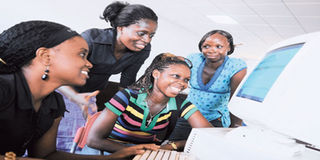
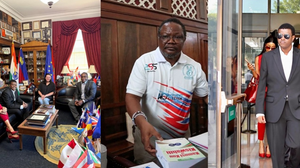
Most Tanzanians now have access to ICT technologies . PHOTO I FILE
What you need to know:
“In Sengerema, the community had a sense of owning the tele-centre and that’s why the project was successful,’’
Throughout his much distinguished career as a director of information and documentation at the Tanzania Commission for Science and Technology (COSTECH), Theophilus Mlaki had concentrated most of his effort and time in promoting access to knowledge and improved information and communication technology (ICT) infrastructure in Tanzania.
Now retired, Mlaki is contented that his ideas have influenced thinkers, policy-makers, and international development circles. Mlaki was an early pioneer of enhancing communication and knowledge access particularly in rural areas.
When he joined COSTECH in 1989, he started mobilizing the use of ICT for development, especially building pilot networks and infrastructure to provide unserved rural communities with knowledge and communication services. In the latter years, fibre optic technologies were applied. A fibre-optic communication is a method of transmitting information from one place to another by sending pulses of light through an optical fiber. The fibre is usually built by government or its agencies for communication, when extending power supply, railways, water and energy utilities.
Communities in Sengerema, Mwanza, Kilosa, Lugoba and Chalinze in Coast region, Bunda and Serengeti districts were among beneficiaries of the first public telecentres and fibre network communication service.
Sengerema stands out to be an iconic area where his anticipations were fulfilled. A tele-centre, a place where people could use internet facilities to access knowledge, was created. A radio station that sensitized on pressing issues of the community was also established and it is still running.
The community in Sengerema was empowered with information and services. Announcements from the community radio increased the number of vaccinated children from 50 to 100 per cent. Farmers found markets through communicating with clients in the cities.
“In Sengerema, the community had a sense of owning the tele-centre and that’s why the project was successful,’’ he says.
Mlaki says that involving women in ICT projects was a powerful way to make the technology reach communities. “In areas where we did our communication projects, more women volunteered and were very committed,” he adds, ‘I think it’s because women are more affected and concerned with development issues especially those related to health and education”.
He has also participated in making the country’s first ICT policy that was adapted in 2003. The policy included popularization of computers through exemption of import tax on ICT equipment. This increased the use and awareness of computers in the country.
The policy also enabled the country to embrace the convergence of technologies, bringing together telecommunication, radio, computers and television for national development.
He has represented Tanzania globally in organizations such as UNESCO, International Telecommunication Union, CABI International, Commonwealth Science Council, IDRC of Canada, Global Biodiversity Information Facility (GBIF) and Economic Commission of Africa.
His happiest moments in his career were the launching of the telecentre in Sengerema and organising the Global Biodiversity Information Facility conference in 2008 in Arusha. He gave Tanzanian scientists recognition when he initiated posting of the country’s biodiversity data and knowledge to the GBIF website.
“Through the GBIF website, many international researchers became interested in conducting research in Tanzania,” he says.
Mlaki previously worked at the National Library where he established the National Bibliographic Agency which collected, recorded, documented and preserved the nation’s literary output.
This was after earning his Masters degree in Library and Information Science from Loughborough University in UK.
“Working with COSTECH gave me immense satisfaction because I had the liberty to work on new things. I never had a routine,” he adds. “All my failures were tolerated because I had concrete reasons for not achieving targets”.
In a career spanning more than two decades, everything has been smooth sailing for Theophilus Mlaki –the recognition and the accomplishments. If anything that he considers low points of his life was convincing people to accept innovation.
“My team and I spent more time to convince people in various sectors in using new technology. Many people feared change,” he says.
His other disappointment was seeing projects not being absorbed or scaled up after international donors withdrew sponsorships.
“CT is not rocket science. The government has an important role of creating an enabling environment for community networks to thrive,” he adds, “They should be quick to implement projects that have an impact for the future and not to indulge in cosmetic projects that will not build a knowledgeable society.”
As a retiree, he has no intentions of spending his remaining years watching TV in a rocking chair. He exercises and eats healthy.
“It is important for me to stay intellectually alive,” the 65-year-old says.
He is currently working as a Senior Advisor for an NGO Digital Opportunity Trust (DOT) based in Dar es Salaam. The Canadian organisation trains youths on using ICT for job creation and economic empowerment. DOT also works closely with a US based technology company, International Business Machine Corporation (IBM) Corporation, in deploying IBM international staff to work on pro Bono basis in development projects in public organisations in Tanzania.
Coming from a religious Lutheran family in Kilimanjaro, he dedicates his time volunteering in church and diocese as an elder and a chairman of the media board. His diocese owns a radio station; Upendo Radio and a weekly newspaper, Upendo.
Mlaki never forgets where he comes from. He has occasionally mobilized his home community in Kilimanjaro to raise funds to create access to water, electricity and better education. He was the board chairman of his village ward secondary school.
“My father was my role model. He was not arrogant or standoffish,” he says. “He wanted us to aim higher and that is what I have passed on to my children,” he asserts.
Mlaki gives a high priority in maintaining family ties. He is a father of two sons and a daughter.
His children are all grown up and pursuing careers in economics with finance, engineering and business. His wife, Rita Mlaki, is a renowned member of Parliament.
His advice to the youth in ICT career is that they should take advantage of opportunities that technology has to offer. ‘Good policies have been set; the infrastructure for ICT has improved. It’s time for youth to make success out of this,” he sums up.