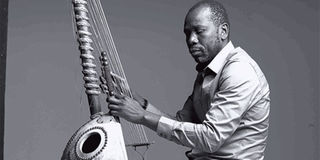
Ballaké Sissoko is a noted player of the kora. He has worked with Toumani Diabaté and Taj Mahal and several others. He can be heard on Diario Mali. Ballaké’s father, Djelimady Sissoko, was a notable musician in his own right
What you need to know:
Mali has some of the most diverse and internationally recognised music cultures in the world that dates back hundreds of years
Blistering heat, beverages, women and music may provide a short list of memories of the capital city of Mali, Bamako.
The heat something you realise the minute your plane touches down and sweat starts trickling down from the groove of your back. You are in the Sahel, the place where the Sahara Desert in the north meets the northern most savannahs.
The beverages: luckily as hot as it is, almost at every stall or turn you find huge bottles of fresh, home-made gem-gem ginger juice and hibiscus, to cool you off.
And there is just something about this non-alcoholic beverage that gives you a feeling that it has medicinal properties. Besides ginger and hibiscus is tea, which on the one hand is served hot in small glasses.
The women: make of it what you will, but it truly is a spectacle that needs some getting used to, to see the women of Bamako pull up their long robes to spread their legs across tiny motorcycles on which they zip through the chaotic traffic at mind-numbing speeds.
It is only the music that can rival the spectacle of these fascinating women.
Mali has some of the most diverse and internationally recognised music cultures in the world that dates back hundreds of years to the early Griots who served as royal praise singers, political advisors, historians, and storytellers who used it as a medium.
Igo Diarra is a local music producer, radio personality, author and all round cultural operator who has an insight into the music of his country.
“There are many types of instruments in our music, but the Kora has been the most popular for a long time. Another popular one is a smaller guitar-like instrument called the Ingoni and they are usually played side by side,” says Igo.
“But the Kora is like a wife, that’s why after many years of experience there is even a real marriage ceremony between the player and his instrument, especially when you attain a certain level. This is because it is the only instrument in the world that is held directly in front of you and caressed like a woman.”
To back Igo’s wacky revelation of the matrimonial attachment between the instrument and its player, you have to hear and see the instrument being played live to appreciate and understand why for an artiste; the Kora is not a one night-stand partner.
It is one that requires commitment. The soul-consuming sound of this 21-stringed instrument is sweet and sensual.
He continues to name others: There is also the balaphon also known as the marimba or xylophone. So basically, it is the Kora, the Ngoni and the balaphone that are the three indispensable melody instruments of the ‘Manding griot’.
For instance, the late Ali Fakar Touré played guitar, as does Habib Koite. Toumani Diabaté is the king of kora, Bassekou Kouyaté is the king of ingoni and all these are well known international artistes.”
Igo further explains that Ali Farka Touré and Toumani Diabaté’s 2005 album In the Heart of the Moon with Farka Touré on guitar and Diabaté on the Kora was nominated for the Album of the Year Award in the BBC Awards for World Music the following year, but lost out to Dimanche à Bamako by another Malian duo Amadou and Mariam.
However, the album won the Best Traditional World Album at the 48th Annual Grammy Awards in the same year.
“Nick Gold from World Circuit signed the contract with Toumani right here in my office. This too helped open up the rest of the world to the music of Mali. As you might know, Nick was the producer for The Buena Vista Social Club from Cuba. He helped bring them to the world stage as well,” adds Igo.
He continues to highlight how diverse the music is, where it is coming from and how seamlessly it blends with 21st Century music styles and trends.
“Mali music is very diverse, it has so many different sounds. If you go to the North, there is Toureg music, like Tinariwen a desert blues band in Segou. There is a different style.”
He explains that the skill of playing music is handed down from older to younger people, and in many cases it is taught in high schools, but more serious teaching is done in the homes.
“We are a very old culture. Preserving heritage is a way of life. Mali music is traditional but it’s very international. People come from all over the world to sample our music and also to collaborate,” adds the part-time open air concert organiser.
As much as the Griots disseminated oral tradition, close to one million ancient documents known as the Timbuktu Manuscripts, ranging from scholarly works to short letters have been preserved by private households in Timbuktu, north of Bamako dating as early as the 13th century.
Igo talks of the collaborations with foreign artistes. “At Balanise, my production company, I am doing this project called Roots To Roots where we are collaborating with hip-hop and ragga artistes from the UK. We mix rap with the Kora.”
“If you leave Mali and settle in Europe you lose the vibe. Some say the music of Mali is inspired by the flow of the Niger. Right now with the technology you don’t have to go to Europe – maybe just for some last minute mixing, that’s all. But it can be done here.”
This is why most of their cream remain rooted in Mali apart from the occasional visits to other parts of the World that have accepted the diversity of Malian music.