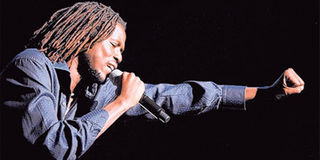
Emmanuel Jal performs during one of his concerts in Sudan
What you need to know:
Jal says the movie ‘Good Lie’ has opened up a platform where the story of South Sudan can be told on the big screen worldwide
Rags to riches stories in the entertainment industry are a dime a dozen, but very few would beat Emmanuel Jal’s “from child soldier to global superstar” tale.
Jal’s life reads like a movie script. It is a Hollywood movie waiting to happen. A former South Sudanese child soldier turned political activist, musician and actor, Jal has had opportunities that many can only dream of.
Just this year, Jal had the golden opportunity to act alongside Hollywood award winning actress, Reese Witherspoon, in the drama movie The Good Lie.
Initially contacted to find actors for the movie, Jal passed the message along through his social media pages and got a couple of people to audition for the movie.
But later on, they asked him to audition as well. Still reeling from the whole experience, Jal feels like the entire process was a dream.
“I still feel like I’m dreaming and I haven’t woken up. We were spoiled; I was taken to a world I had never experienced before, being picked and driven around in sleek cars, red carpets rolled out and cameras flashing. Even when I would sneeze someone would ask if I was okay. From the time we were shooting to the time we were promoting, you forget your life for a moment,” he says.
However, getting the role was not that easy. Before landing his role as Paul in the movie, Jal auditioned seven times and failed. Regardless of his numerous fumbles during the audition, the director saw something special in him and did not want to let him go.
Men can cry
Soon after, he was invited to Los Angeles where he auditioned with Reese Witherspoon. She made him relax and he dropped the script, freestyled with her, something the director was looking for and just like that he got picked.
The Good Lie brings to life the story of a group of young men who fled the war in Sudan and sought refuge in Kenya. Thirteen years later, the young adults are given an opportunity to leave Kakuma refugee camp and settle in America.
Although revisiting those painful memories was not something he let affect him, Jal had to emotionally dig deep in order for him to cry. His fellow actor Ger Duany with a few consoling words told him; “We are in America; here men cry so it’s okay.”
Jal says the movie has opened up a platform where the story of South Sudan can be told on the big screen and has become the voice of the departed and those who can be heard now. He has been telling the same story through music, books and documentaries, and to finally see it told on a Hollywood scale gives more hope that help is coming.
At the tender age of seven, Jal was recruited as a child soldier. Raised in violence without knowing what he was fighting for or against, he saw his village burned down where his mother died during the conflict and his brothers and sisters scattered.
Through his grandmother, he recently came to learn that her mother was pregnant at the time and died of exhaustion while running for her life.
During one of the long treks running away from the war that only left 16 people alive out of 400 on that trek, Jal somberly remembers that he was tempted to eat one of his dead friend’s carcass.
He finally met Emma McCune a British aid worker who adopted and smuggled him into Kenya.
Jal stumbled upon hip hop and quickly discovered its power. Music kept him going and has been his therapy. Through it, he found something that allowed him to be a child again. Jal sees music as a tool that has power to influence people the way they live.
Even during the war when they hated the North, he still listened to their music.
Reviled activists
Although his influence was American hip hop, his first album titled Gua was strongly influenced by African beats. The track ‘Gua’, a rap song done in Arabic, English, Swahili, Dinka and Nuer was a hit in Kenya.
In September 2005, he released his second album titled Ceasefire and in September this year, he dropped his third album, The Key. In the album, he features Nelly Furtado and two of the songs are featured in the movie’s soundtrack.
He also worked with Chris Adwar whom he says understands the international market.
Through music, Jal’s biggest mission is to protect the childhood of his people in South Sudan and provide education for young children.
Although he would sometime question what he was doing and felt like quitting, the voices of the dead he dreamt of urged him to go on. But not everyone shares his vision.
In December 2012 while doing a peace concert back home, Jal was beaten up and thrown in jail for his activism.
“My government doesn’t like activists. When I was there they told me we don’t like activists, we remove their eyes and tie their bodies in bags and throw them in the Nile. I thought they were joking and the next day I was beaten by the police.
It’s sad because I know the people who assaulted me and they denied it in the media. They said I was beaten by thugs. It was very embarrassing for them because I spoke up about it. I’m still fighting for our freedom, not with guns but with words of positivity,” he says.
Good Lie is not his first stint in the movie world; in 2008 he produced a documentary titled War Child and was yet again cast in a UK movie Africa United.
Although he lives in London and hopes to return home to Juba one day, he considers Kenya his home where his dreams began to take off.