One that suggests that the genre is on its death bed with no keen disciples any more.
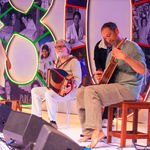
But that can only be assumed to be the truth before you meet Tanzanian reggae star Jhikolabwino Manyika aka Jhikoman, a man who has remained true to his trade even as some sought easier routes.
There are times when people get into what is becoming a common debate regarding reggae music.
One that suggests that the genre is on its death bed with no keen disciples any more.
But that can only be assumed to be the truth before you meet Tanzanian reggae star Jhikolabwino Manyika aka Jhikoman, a man who has remained true to his trade even as some sought easier routes.
Even as such misconceptions fill the air, Jhikoman is a popular figure in the Scandinavian countries where his shows are usually a sold-out affair.
On that afternoon as I set out to meet him at his Bagamoyo home, he pops in hanging his trademark left-handed acoustic guitar.
His two children greet him with great affection as they take the guitar away from their father.
“The older one is Chimwemwe and the other one is Ifetayamika,” he introduces them.
He had been working with his wife in his personal studio which is located on his two-acre farm on Block P in Bagamoyo; his has been such a long journey that he is not shy to share with anyone who cares to listen.
Early January, Jhikoman,43, released his new song called ‘Africa Arise’ featuring Jamaican Peetah Morgan. It is one that has got him flying.
This was after his curtain raising performance for Peetah Morgan (of the Morgan Heritage) in Helsinki Finland in May 2014.
“When I got an invitation to warm up at Morgan’s show I was happy because it was an opportunity to explore new ideas career wise. I had no idea that it would lead to doing a song together,” says Jhikoman.
On that evening, the two artistes had had a brief encounter during the sound check session but not much about the future was discussed.
It was not until he got that call from Mac Lion Promoters that he realised that something had really come out of that brief encounter.
The agent who sounded equally impressed told him that Morgan was very impressed with his performance and that he wanted the two to work together.
“Though this was more of a surprise to me, I was more than ready to meet Morgan the following day at his hotel. In my mind it had an idea of telling Africans to stand up in whatever they choose to do,” says Jhikoman.
He adds: this has always been a dream of many Africans both here and in the Diaspora, to see Africa and Africans achieve great things. So I felt it was the right time for Africa to stand up.
Because both of them were up to the task, it hardly took some time before they could come up with something tangible.
“I had already made a sketch of what I was going to sing. I shared it with him and he was okay with it. That same day in the evening he entered his voice and flew to the United States for another performance.”
However, even with such a quick finalisation of the project, it actually took close to eight months before the song was released and it was an instant success, especially in the Scandinavia.
Jhikoman whose career started some 22 years ago while still in high school says social ills in society inspired him to become a singer and that is how he came up with the song Don’t Bleach.
He admits that has not been an evening walk in the park and he remains focused on the core values that have made him who he is today.
Though he and his Afrikabisa Band has toured widely, Jhikoman is not very famous in Tanzania in comparison to the other Bongo Flava stars.
The tours have made him grow as an artiste whose performance meets international standards.
While in the Scandinavian countries he usually works with Sound Explosion that plays instrument with the one of Finland’s biggest stars Jukka-Poika, something that makes it easy for him to perform live.
He has performed at different international music festivals such Mela in Oslo, Norway, World Village Festival / Maalma Kylassa in Helsinki, Finland Exeter Respect Festival in Exeter City-Devon UK and locally at ZIFF- Zanzibar International Film Festival, and Sauti za Busara in Zanzibar as well as at the Bagamoyo International Art Festival.
At a time when his compatriots seem to be struggling with piracy, Jhikoman’s music is available online through iTunes, Amazon, and CDBaby.
“Online marketing is where the future of music lies and by doing this it means we defeat piracy in a way or two.”
He is not happy with the state of affairs in the music industry especially on how reggae music is doing in comparison to Bongo Flava.
“Reggae music is all about the message on what is happening in society; but what is happening is that people have chosen to listen to love songs and forget that people are dying in hospitals with no medication due to corruption.”
He doesn’t understand why reggae isn’t taken seriously locally.
“I make more money mostly through my tours, my music targets my community because reggae is accepted worldwide that is why I keep on taking the message to those who are willing,” says Jhikoman.
Apart from the tight schedules Jhikoman is also a committed family man and business man who has an eye for profits. His wife who is also a gospel musician seems to have gelled in quite well and the two take turns in taking care of their growing brood because they don’t have a maid.
“We are all busy with work and there is no way we can let our children in the care of a maid. Things have completely changed with time. No one to trust. So there are times I spend days taking care of the children when my wife is busy,” says Jhikoman.
The family owns Afrikabisa Restaurant which is quite close to his residence. The restaurant serves only African cuisines.