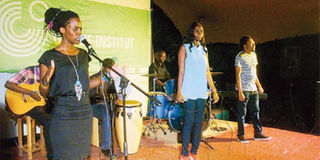
Poets performing at a past Woman Scream event. PHOTO I FILE
What you need to know:
Poetry as an art is used to educate the society in an effort to stop gender-based violence
On the 3rd of March, 2015, the BBC posted an article titled “Delhi rapist says victim shouldn’t have fought back”—a follow up story on the 2012 rape and consequent death of a female Indian student. The men who raped her not only said that she deserved it; they felt that she should have accepted what was happening to her. In a culture that dictates that women are inferior from birth, it perhaps comes as no surprise that the rapists believed that what they had done was teach the girl a lesson.
In Tanzania, a group of young women have joined the global movement known as ‘Woman Scream’ which organises an annual poetry festival in an effort to put a stop to the rampant gender-based violence cases in Tanzania. These women, using the art of poetry among other artistic expressions air out a message of hope, support and strength to every victim of gender-based violence.
The Woman Scream International Poetry Festival is sponsored by, and began with, the Women Poets International Movement (also known as the Movimiento Mujeres Poetas Internacional MPI) in the Dominican Republic in 2009. Their aim is to promote female poets and poetry through a series of collective projects and cultural events, an approach more proactive than protests following an instance of tragic violence. As they say, prevention is better than cure.
One of the things that Woman Scream tries to achieve is change the mindset of those who somehow find GBV to be acceptable and therefore condone it.
Being heard is perhaps easier said than done. Finding a voice in writing – poetry has provided many women with a platform where they can express how they feel on matters of importance. The platform might not resonate with many Tanzanians, but it’s a basis which, if utilised can bring about tremendous changes for the greater good.
Participating female poets
Woman Magazine got an opportunity to speak with some of the female poets participating in this year’s festival taking place today at the University of Dar es Salaam.
Gaude Kalabamu, an environmentalist participating in Women Scream festival for the second time joined because she wants to support any efforts to giving women a voice. “I want to support efforts to bring about social justice, for all sexes, but especially women,” she states. Adding, “I do not believe there is a ‘right’ or ‘wrong’ way to address the message. What works for one person may not work for another.”
With that said, Gaude is of the opinion that there is always room for improvement and dialogue about the relevance and effectiveness of different approaches aimed at promoting non-violence. “Woman Scream is necessary because it creates the conversation – a necessary conversation. It is easy to preach ‘to the choir’ on different platforms but nothing beats witnessing bravery in someone’s personal testimony. The type of bravery that makes you question yourself. That is the change we need – the change within ourselves. This is where Women Scream is most effective,” she asserts.
On preserving the dignity and safety of women, Gaude acknowledges the need for women to trust that they love each other, and will support each other. “This way we can stand together and be brave for each other. I do not believe we should be looking to others to save us/respect us, whether they do or not does not change who we are. We cannot wait to be given respect. We must take it – with love. And give it, even where there isn’t any. We must resist the urge to be blackened by the actions of those that try to oppress us,” she concludes.
Caroline Damian Manyika, currently working as a volunteer at YUNA and FEMA and also a poet says that GBV can be social (based on cultural beliefs), and that 95 per cent of women in Tanzania experience different kinds of violations in their lifetime. She states that inadequate knowledge on cultural beliefs has led to prolonged existence of GBV.
“The problem of GBV continues to be rampant because most societies, especially where such violations occur still don’t have enough knowledge on how their cultural beliefs can affect others living in that same society,” she states, adding; “for instance, a Maasai mother who got married when she was 9 years old would find it not a problem to wed off her own daughter at the same age. Because if she survived marriage life and other practices such as female genital mutilation and gave birth, why not her daughter?”
Manyika points to disunity and giving of wrong advice among women to be a factor undermining the fight to end GBV. “There are women who do not give positive advice to other women. This is even seen in a mother-daughter relationship. You find a woman abused by her husband decides to open up to her mother, but in return her mother advises her to go back to her husband and endure, claiming that marriage requires tolerance,” she speaks, concluding; “If we are able to change mindsets we can change the future. We need to prepare our societies to get ready to adopt new positive changes.”
Nancy Arbogas, a 3rd year student pursuing a Bachelor of Architecture at Ardhi University speaks of her role as a woman in the fight against GBV; “My role in fighting against gender-based violence is to educate the society on the impacts resulting from such violence. A woman is the mother of the entire nation and is responsible for its wellbeing. That being the case, violence against women will lead to a poor and immoral society”, she adds; “My role is to educate the society to do away with all sorts of violence against women through poetry and talks with fellow women on how we can deal with such matters.” Arbogas ends by advising women to wake up and work hard for both the society and economic wellbeing.
Caroline Uliwa, a writer and musician states that there’s a need for women to educate themselves more in the struggle to preserve their rights. “I wish women read more so they educated themselves on what other women are doing in the world to affirm their rights...”, she adds; “also we’re kinder to each other as well, we need to start practicing Self Defense.”
Neema Komba, a writer\entrepreneur thinks that GBV has received adequate support. “There are many people involved in the fight; both men and women, but there’s a need to do more work to reach vulnerable groups. The community is definitely willing to listen. And tremendous strides have been made; like having a gender desk at police stations and many organisations that help survivors of GBV”, she says. As a poet, Neema finds raising her voice against injustice to be a key factor in the fight against GBV. “Poetry goes beyond activism, it can carry the voice of a woman facing domestic violence, a child molested, a student raped. It can tug at heartstrings and reach people at an emotional level,” states Neema, adding that, “as a poet I can become the voice of the voiceless and help break the silence.”
Keziah Elaine Ayikoru, a graduate Architect thinks that GBV awareness is widespread in urban areas. However, that does not mean that it doesn’t still occur countrywide, it does. “I don’t feel that this fight has got adequate support from society especially from the part of society that actually needs to change,” she says and adds; “My contribution to this fight is to use whatever I have to fight against gender-based violence whether it’s a talent or material resource. In this case, I use poetry because it is very expressive.”
In a Tanzanian culture where women were largely viewed to be inferior to men from a young age, parents reacting in jubilation when a male child is born and in melancholy when a female child is born, instills a subservient trait in girls who find it hard to live up to expectations. From experiencing disregarded opinions, finding one’s voice becomes very difficult. This situation occasions acts of injustice in our society. In Tanzania, gender-based violence is widespread; the most recent Tanzania Demographic and Health Survey found that 44pc of married women have experienced physical and/or sexual violence from an intimate partner in their lifetime (National Bureau of Statistics).
Culture does not justify violence and those that assume it does are at best nihilistic. Woman Scream aims at creating hope for the future, fostering courage and determination of ordinary men and women who take to the streets to protest against this injustice, amidst indifference from society. They only want one thing: to be heard. A noble pursuit, no doubt; but considering that this is an issue that’s been ignored for far too long, it will understandably take time.
Raising awareness
In 2011, following the death of Mexican poet and female activist Susana Chávez in Ciudad Juarez, the Woman Scream International Poetry Festival expanded its focus to raise awareness of her murder and what she stood for. Chávez had protested against the brutal and unsolved murders of women in Ciudad Juarez, using the phrase Ni una muerta mas, or Not one more dead. In 2013 the Festival honoured Malala Yousafzai, a Pakistani activist for female education, and youngest-ever Nobel Prize laureate, with a story of her own to tell.
Many acts of violence are considered socially acceptable. Acts such as physical abuse by husband or partner are still considered acceptable in certain communities in Tanzania. Wives endure the brutal ordeal, instead of reporting the matter to the police. 2 in 5 girls are already married before the age of 18 and 23 per cent of girls of the same age are pregnant or already have children. Overall, respondents have a relatively high awareness of what constitutes GBV, and are even able to list a range of violent behaviours. However, victims often identify many types of GBV that are perceived to be acceptable within their communities’ social and cultural norms. This discourages them from reporting the incidents to the police.
Woman Scream is considered a platform for women’s participation but men are also allowed to participate. In this year’s event, there are men who are also taking part in supporting the fight against GBV.