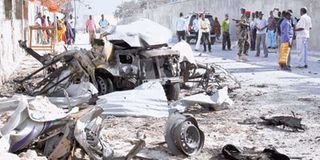
Somalis gather near the wreckage of one of the vehicles used for a car bomb, following a militant attack on the presidential palace in Mogadishu, Somalia Friday, Feb. 21, 2014. Nine al-Shabab militants wearing military fatigues and carrying guns and grenades died after attacking the presidential palace with two car bombs on Friday, in an assault the president called a "media spectacular" by a "dying animal." President Hassan Sheikh Mohamud was unharmed, but two government officials were
What you need to know:
Escalating civil strife and the consequent refugee crisis have been among the key drivers in increasing the cost of global violence containment, according to the 2015 Global Peace Index
London. Three East African countries – Somalia, Sudan and South Sudan – have been named among the top ten most dangerous countries to live in world-wide according to a new report.
The listing from the Global Peace Index based on research by the Institute for Economics and Peace (IEP) also lists Kenya, at 138 and Rwanda at 140 but not surprisingly Burundi (125) or Eritrea (132) as amongst the 25 most dangerous states to live in world-wide. Tanzania, at position 68 is regarded as the most safe destination across the East African region.
The figures based on 23 different sources, including factors like murder levels, perceptions of criminality, terrorism and military expenditure, have been collated to form a single figure.
The listing also rates Syria as the most dangerous and Iceland the most peaceful country to live in world-wide (out of a list of 162 countries).
Escalating civil strife and the consequent refugee crisis have been among the key drivers in increasing the cost of global violence containment, according to the 2015 Global Peace Index.
Since 2008 the total economic impact of violence has increased by US$1.9 trillion (+15.3%). The economic impact from refugees and IDPs (Internally Displaced People) alone has increased by 267% since 2008, and now amounts to US$128 billion. However military expenditure, homicide and police forces remain the most costly categories, accounting collectively for 68.3% of the total cost.
Steve Killelea, Founder and Executive Chairman of the IEP said that “reducing conflict is a crucial plank in ensuring continued world economic recovery. If global violence were to decrease by 10% uniformly, an additional US$1.43 trillion would effectively be added to the world economy. To put this in perspective, this is more than six times the total value of Greece’s bailout and loans from the IMF, ECB and other Eurozone countries combined.”
Overall, global peace levels remained stable in 2014; but are lower than 2008. However the overall score disguises an increasing division between the most and least peaceful nations. Since last year, 81 countries improved their levels of peacefulness while 78 deteriorated.