The bill is due: Africa demands colonial justice now
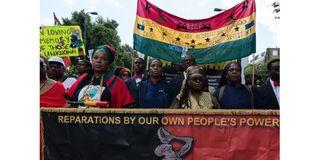
People of African descent take part in a past African Emancipation Day Reparations March. PHOTO | COURTESY
By Mustafa Fetouri
For decades, calls for colonial reparations in Africa were dismissed in Western capitals as rhetorical gestures—moral appeals from the margins that could be acknowledged with vague “expressions of regret” and little else. By the end of 2025, that era of complacency had begun to close.
With the adoption of the Algiers Declaration, the African Union (AU) has shifted from grievance to strategy, launching what amounts to a coordinated legal and political campaign.
Emerging from the International Conference on the Crimes of Colonialism held between November 30 and December 1, the declaration lays out a structured roadmap for the AU’s 2025 theme: Justice through reparations.
At its core is a bold demand—to codify colonialism as a crime against humanity under international law. It also calls for the restitution of looted wealth and a formal accounting of what it terms Africa’s “ecological debt.”
From declaration to action
Algeria moved quickly to translate principle into policy. On December 24, its parliament overwhelmingly voted to criminalise French colonial rule in Algeria, marking a decisive step from symbolism to legal codification.
In what Parliamentary Speaker Brahim Boughali described as a “day written in letters of gold,” lawmakers adopted legislation identifying 27 categories of colonial crimes—from mass executions to environmental devastation linked to nuclear testing in the Sahara.
By embedding the declaration’s principles into domestic law, Algiers is sending a clear message: the so-called “Decade of Reparations” is not aspirational—it is a demand for action.
Reframing colonialism in law
The broader significance of the Algiers gathering lies in its attempt to redefine how colonialism is treated within international law. For decades, colonial-era abuses have been framed as historical episodes beyond modern legal jurisdiction.
The declaration challenges that premise, reclassifying colonialism as a continuous, structured crime against humanity—one that carries no statute of limitations.
This marks a deliberate shift. Reparations are no longer framed as moral appeals advanced by civil society groups, but as state-led claims grounded in emerging legal frameworks and backed by continental consensus.
Africa, in this framing, is no longer asking for recognition—it is demanding settlement.
A multi-dimensional case for reparations
The declaration’s strength lies in its comprehensive approach. Rather than treating colonialism as a single historical wrong, it frames it as a layered system of exploitation requiring equally layered remedies.
It outlines four core pillars- Legal recognition: Calls on bodies such as the International Court of Justice and the African Court on Human and Peoples' Rights to formally recognise colonial crimes as crimes against humanity.
Ecological reparations: Highlights environmental destruction caused by extractive practices and military testing, including nuclear experiments in North Africa.
Cultural restitution: Demands the unconditional return of looted artefacts and heritage.
Economic accounting: Proposes a continent-wide audit to quantify the financial cost of colonial exploitation.
By consolidating these demands, the AU is reshaping the reparations debate into a unified diplomatic agenda grounded in data, law and historical record.
Building institutional momentum
Beyond rhetoric, the declaration proposes new institutional mechanisms to sustain this agenda. Among them is a Pan-African Committee on Memory and Historical Truth, tasked with harmonising historical narratives and coordinating access to colonial archives.
It also calls for the establishment of an African Reparations Fund—an effort to anchor the reparations movement within formal governance structures rather than episodic diplomacy.
The proposed economic audit is particularly significant. By quantifying losses in resources, labour and economic opportunity, it seeks to transform reparations from abstract claims into measurable obligations.
Europe’s slow response
This assertive African stance contrasts sharply with Europe’s more cautious approach. While the European Parliament acknowledged colonial injustices in a 2019 resolution, little tangible progress has followed.
The absence of concrete policy action has created space for African-led initiatives like the Algiers Declaration to take the lead in defining the agenda.
From defiance to mandate
Under the leadership of Abdelmadjid Tebboune, the movement has evolved into what some describe as a push for “memorial sovereignty”—a reclaiming of historical narrative and agency.
The declaration also builds on earlier, more unilateral efforts. Among the most notable was the late Muammar Gaddafi, who in 2009 called for $7.77 trillion in reparations at the UN General Assembly, framing colonialism as a “blood debt.”
That demand drew partly from the 2008 Italy–Libya Friendship Treaty, under which Italy agreed to pay $5 billion in compensation—still one of the few formal reparations agreements between a former colonial power and its colony.
Today, the AU’s approach signals a shift from individual advocacy to collective mandate.
A broader global shift
Ultimately, the Algiers Declaration represents more than a policy framework—it is a challenge to the long-dominant Western narrative of colonial history.
For decades, colonialism was often reframed as a “civilising mission,” minimising its violence and economic exploitation. The declaration seeks to dismantle that framing and replace it with a more complete historical account.
In doing so, it may offer a blueprint beyond Africa. Regions across the Global South—from the Caribbean to Southeast Asia—are watching closely as the continent moves to translate historical grievance into legal and political leverage.
The message from Algiers is clear: the debate over colonial justice is no longer symbolic. It is entering a new phase—structured, coordinated, and increasingly difficult to ignore.
Mustafa Fetouri is a Libyan academic, award winning journalist and analyst