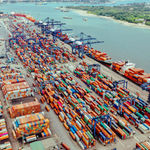
Arusha. Export expansion has emerged as the main driver of economic growth in the East African Community (EAC), pushing the bloc’s international merchandise trade to $42.4 billion in the fourth quarter of 2025, up from $40.3 billion recorded in the previous quarter.
According to the latest quarterly statistics report released by the EAC Secretariat, imports rose by 15.4 percent to $79.6 billion, while exports surged by 37.7 percent to $77.0 billion during the October–December 2025 period.
“This development resulted in a sharp reduction in the trade deficit to $2.5 billion, down from $13.0 billion in 2024,” the report states, underscoring an improved external trade position for the region.
Trade within Africa also recorded strong growth, rising by 40.1 percent to $39.0 billion, representing 25.2 percent of total trade.
Intra-EAC trade expanded by 28.0 percent to $19.3 billion, reflecting continued progress in trade facilitation and deeper economic integration among Partner States.
Mineral commodities remained the leading export category, particularly copper, alongside precious metals and gemstones. Agricultural exports such as coffee, tea and spices continued to play a key role in supporting export earnings and rural livelihoods across the region.
On the global stage, China maintained its position as the EAC’s largest trading partner, followed by the United Arab Emirates, South Africa, India, Japan and the United States.
Imports were largely driven by energy products, machinery and manufactured goods, supporting industrial production, infrastructure development and consumer demand.
"The stronger growth in exports relative to imports, together with the narrowing trade deficit, underscores a positive trajectory towards sustainable economic growth and deeper regional integration,” the report added.
Inflationary pressures across the region showed signs of easing towards the end of 2025.
Annual headline inflation declined to 13.3 per cent in December 2025, down from 15.2 per cent in November, and significantly lower than 27.1 percent recorded in December 2024.
However, average annual inflation for 2025 rose to 22.9 per cent, compared with 13.6 percent in 2024, largely driven by persistently high inflation in South Sudan and Burundi.
Core inflation, which excludes food and energy prices, fell to 9.6 percent in December 2025 from 12.0 percent in November, indicating easing underlying price pressures.
Growth in broad money supply (M3) moderated to 14.7 percent year-on-year, supported by a 12.6 percent expansion in credit to the private sector, reflecting continued lending to businesses and households.
Net foreign assets increased by 20.4 percent, signalling improved external financial stability across the region.
Arusha resident Federdaus Mosha emphasised the need for increased investment in trade infrastructure and economic opportunities to sustain the region’s growth momentum.
“There is a need to expand financial inclusion, reduce cross-border trade barriers, and align financial systems with the economic realities of individual countries to ease business operations, especially for entrepreneurs,” he said.
He added that such measures would be critical in unlocking further growth and ensuring the EAC continues to record stronger economic gains in the years ahead.