Elsewhere in Kimara Temboni, Ms Kundaeli Mosha stands in the middle of her one-bedroom house staring at the water drops from the tap.
She is uncertain whether she will have any water that she will use to cook for her family.
As she ponders on her next move, a two-tonne water service truck passes outside her house and she can hear the driver touting the price of the precious commodity to be at Sh300 a bucket.
“I have no choice…I need to have my 2,000 litre tank filled before sunset,” she says.
This means that the mother of three would have to cough up Sh30,000 to have her tank filled.
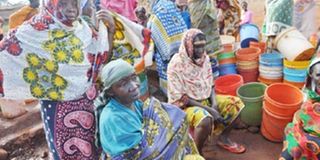
The two women are just a representation of what many Dar residents go through as they look for water.
It is supposed to be supplied like any other social service, but water has turned out to be the most sought after commodity in the city.
Huge trucks and other vehicles locally referred to as water boozers, which have recently become a common sight in many parts of the city, move around neighborhoods looking for potential buyers of the resource.
So common are young men pulling carts full of jerry cans of water as they look for potential customers.
The two women also represent many residents of Dar es Salaam have for a long time banked on the government’s promise of having their taps running with clean water, a promise that doesn’t look to mature anytime soon.
According to Mr Romanus Mwang’ingo, the project manager for Dar es Salaam Water and Sewerage Corporation (Dawasco), the city’s water sources have the capacity to produce 300 million litres per day. However, only 200 million litres are supplied.
And after it was shot down twice by Members of Parliament, the Sh582.5 billion worth of water budget for 2013/14 was finally endorsed by the house with some Dar residents casting doubt if it would ever meet the desired expectations.
However, it is not all gloom and doom for Dar residents. An environmental-friendly and low-cost technology designed by Aquavolve LLC experts from Melrose, Massachusetts in the United States, is set to save the government the huge amount of money it spends in curbing the water woes.
At the moment, the government loses 100 million litres of water daily, which is equivalent to 30 per cent of the 300 million litres produced by the Dar es Salaam Water and Sewage Authority (Dawasa).
Aquavolve’s experts have designed a WMS1000 Wind Turbine, a technology that offers sustainable access to safe drinking water.
With the earth’s atmosphere packed with moisture and a huge water reserve of almost 13,000km3, such a technology is able to turn the moisture into drinking water.
Creating water out of air is done using a condenser with a moisture exchange surface that is one metre wide and five kilometres long.
It is equipped with a revolutionary food safe stainless steel quality alloy, especially adapted to producing drinking water. It can sustain the water creation process for decades, without the risk of corrosion.
The water then flows through a five-tier water treatment system, including an ultraviolet filter, in order to make it perfectly safe to drink.
“The quality of water collected exceeds the drinking water standards required by the World Health Organization,” says Dan Konstanty, Aquavolve’s founder and chief executive officer. According to Mr Konstanty, unlike wells or boreholes, water is always present in the air.
The constraint has been to design a reliable technology able to create and collect the water. Thanks to its technical expertise and its high quality components, the WMS1000 wind turbine allows people living in remote areas to benefit from access to safe water for a period of twenty years. The device is capable of producing up to 1,200 litres of water a day.
He adds that the WMS1000 Wind Turbine has been designed to produce water without any external power source.
“Wind is the only energy used, with an installed capacity of 30kW and using air as a source of water…the WMS1000 Wind Turbine is perfectly adapted to supplying remote areas completely devoid of any existing infrastructure,” adds Mr Konstanty.
With such a technology, the environment remains intact as wind power is the only source of energy needed to run the water production turbines, with zero carbon dioxide emissions. No carbon nor groundwater or surface water is pumped. The environmental impact is practically nil.
According to Mr Konstanty, the water production machine can collect up to 1,500 litres of water a day depending on the climate. Consequently, in some countries, this may exclude the supply of isolated communities technically.
Should the technology find its way into the country, Mr Konstanty believes it would strive to improve the water economy.
“Aquavolve is building economies of water by connecting our sales, distribution, and operations with our global contact reach to support the evolution of delivering water,” says Mr Konstanty.
He adds that his company will be hiring local people to work in areas where the machines are put in place, and that they will be offering technical expertise.
“We hope that the government of Tanzania finds this technology interesting and gives us the opportunity of setting up such a technology here…Aquavolve is specifically poised to help the people of Tanzania to provide abundant supply of WHO-calibre water in a sustainable framework of a growing economy,” says the CEO.
According to Mr Konstanty, Aquavolve also seeks to improve the quality of life that will be accomplished by delivering cutting-edge technology that incorporates green solutions to expand the supply of clean natural resources.
The Aquavolve boss says the technology has a universal application fitting any neighborhood with current prototype units being set up in France and Dubai. Plans are underway to have the prototype in South Africa and also scale it up elsewhere.
All water collected using this technology comes from the surrounding air. The technology has been developed on the basis of an environmental approach, in particular the protection of natural water resources such as lakes, rivers, groundwater and oceans.
“Teams of local technicians will be trained on the installation and maintenance of the turbines or solar units... Aquavolve will then train and educate its locally-hired employees to sell, distribute and manage the water supply,” says Mr Konsanty .
According to him, economies of water will be built around each Aquavolve site to create a sustainable source of water that benefits employees and customers alike. Unlimited supply will be competitively sold and jobs will be created in the civil engineering, maintenance, water and electricity management, sales, and of course service sectors.
The wind and sun are the sole energy sources used for this technology.
“The Water Maker System is fully self-sufficient and does not release any carbondioxide into the atmosphere,” he insists.
With water resources decreasing quickly in large parts of the world, some isolated populations around the world are forced to walk thousands kilometres to find them.
This chore deny them time for essential tasks such educating their children, farming, creating businesses, or simply finding a job.
The company offers local access to drinking water. It ensures there is no need to wait for years before having a working water grid.
“Within a week, our teams are able to install the WMS1000 wind turbine which would enable people to have a peace of mind,” assures Mr Konstanty.
In July 2010, the UN General Assembly recognised access to quality water and sewage facilities as a human right.
Yet, even today, up to 900 million people in the world have no access to high quality of drinking water. Over 2.6 billion do not have any basic sewage facilities.
Every year, two million people, mainly children, die from diseases caused by the consumption of dirty water and the lack of sewage facilities.
The WMS technology esures there is local production and supply of drinking water, in accordance with World Health Organisation standards.
The United Nations Children’s Fund (UNICEF) says 21million people in the country do not have access to improved water supply. This places Tanzania among 11 countries worldwide which are worst off on access to improved water sources.
The UN agency has already ruled out the country’s possibility of realising goal seven of the Millennium Development Goals (MDGs) of halving the proportion of the population without sustainable access to safe drinking water and basic sanitation. There are just three years to go to meet the dedline.
UNICEF’s chief of Water, Sanitation and Hygiene Omar El-Hattab recently told The Citizen that the country needs an additional $100 million (Sh160 billion) for achieving target number seven of the MDGs, something which the State admits is difficult to achieve.
Dr Khalid Massa, the principal health officer with the ministry of Health and Social Welfare (Environmental Health Unit) says the government loses Sh 3billion every year due to water and sanitation related diseases.
Though he expressed the government’s commitment to mitigating the problem, Dr Massa admits there is an uphill task in achieving it.
“There is still a huge gap...we really do not know what to do with the remaining Tanzanians who do not have access to clean water,” he adds.