Iran hits Kuwait refinery, Israel kills Iranian Guards spokesman as war rages on
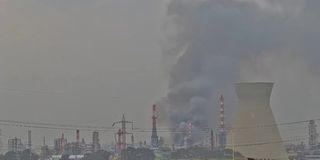
CCTV footage shows smoke rising from Israel's Haifa refinery after a reported Iranian attack, in Haifa, Israel, March 19, 2026, amid the U.S.-Israeli conflict with Iran. PHOTO | REUTERS
Tel Aviv. Iran attacked an oil refinery in Kuwait on Friday and Israel killed a spokesman of Iran's Revolutionary Guards as the U.S.-Israeli war on Iran showed no sign of ending.
Israel promised to avoid further attacks on Iran's South Pars gasfield the day after an Iranian retaliatory strike on Qatar caused damage that will leave the world short of natural gas for years to come.
The benchmark price of Brent crude oil stabilised at around $110 after surging the day before on growing fears that the largest ever disruption to world energy supplies would trigger a global economic shock.
But warnings mounted that even if the war ends soon, there will be no rapid recovery from the upheaval caused by airstrikes and Iran's virtual closure of the Strait of Hormuz, the conduit for 20 percent of the world's oil and liquefied natural gas.
Allies say their help presupposes Gulf ceasefire
President Donald Trump on Thursday repeated a call for major U.S. allies and others, none of which were consulted or advised on the war, to help secure the safety of shipping.
Germany, Britain, France, Italy, the Netherlands, Japan and Canada pledged in a joint statement to join "appropriate efforts to ensure safe passage through the Strait".
But German Chancellor Friedrich Merz made clear that this presupposed an end to combat.
French President Emmanuel Macron said after a European Union summit in Brussels that defending international law and promoting de-escalation was "the best we can do", adding: "I have not heard anyone here express a willingness to enter this conflict — quite the opposite."
On Friday, as Muslims around the region tried to celebrate Eid al-Fitr, which ends the fasting month of Ramadan, and Iranians marked Nowruz, the Persian New Year, the prospect of a quick end to a war about to enter its fourth week seemed remote.
Kuwait's state oil firm said its Mina Al-Ahmadi refinery had suffered multiple drone attacks, setting some units alight.
Flows of crude and petroleum have dropped by about 12 million barrels per day - roughly 12 percent of global demand - due to output cuts and export halts by Gulf producers.
Those barrels cannot easily be replaced by the transport, shipping and manufacturing industries that rely on them, and will make themselves felt for months or even years.
Israel's military said it had attacked government facilities in Tehran. Iranian state TV said Ali Mohammad Naini, deputy head of public relations for the Islamic Revolutionary Guard Corps, had been killed - the latest of dozens of leading government and military officials to be assassinated by Israel.
In Tel Aviv, air raid sirens howled as explosions from interceptors rang out. The military said Iran had fired a barrage of missiles at Israel.
Israel and U.S. pursuing different aims
Prospects of a truce have not been helped by the widespread perception that Israel and the U.S. are pursuing different goals and strategies.
"The Israeli government has been focused on disabling the Iranian leadership," U.S. Director of National Intelligence Tulsi Gabbard told the House Intelligence Committee on Thursday.
"The president said that his objectives are to destroy Iran's ballistic missile-launching capability, their ballistic missile production capability and their navy."
Israeli Prime Minister Benjamin Netanyahu on Thursday promised to heed Trump's instruction not to repeat the attack on Iran's gasfield, but also said Iran was now unable to enrich uranium, which can be used in nuclear warheads, or make ballistic missiles.
Yet Iran's ability to keep hitting targets such as refineries and U.S. interests as well as others across the Middle East - including Yanbu, the main Saudi Red Sea oil port more than 1,200 km (750 miles) away - belies such claims from Israel and the U.S.
The Revolutionary Guards said production of missiles was continuing, and that they were not running out.
The war has already killed thousands and displaced millions, mostly in Iran and in Lebanon, where Israel has attacked the Iranian-backed Hezbollah militia in the south and in Beirut.
It appears to be redrawing Israel's political map in Netanyahu's favour, while doing the opposite for Trump: trapping him in a conflict with no clear exit, exposing his Gulf Arab allies to spiralling risks and undercutting the economic storyline that powered his return to office.
Netanyahu said on Thursday, without elaborating, that overthrowing Iran's government would require a "ground component".
A U.S. official and three people familiar with the matter told Reuters this week that the U.S. was considering deploying thousands of U.S. troops to reinforce its operation in the Middle East, potentially even landing on Iran's shore or its Kharg Island oil export hub.
Asked about such reports, Trump said on Thursday: "If I were, I certainly wouldn't tell you. But I'm not putting troops. We will do whatever is necessary."