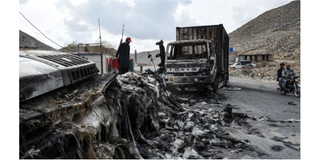
On January 31, Balochistan province in Pakistan witnessed one of its deadliest days in decades. The Balochistan Liberation Army (BLA) launched what it called “Operation Herof 2.0″—coordinated attacks across 12 districts, including Quetta, Gwadar, and Mastung.
Official figures report 17 security personnel and 31 civilians killed.
Pakistani forces claimed 145 insurgents were killed in retaliation, though the BLA disputed this figure. The attacks involved gun assaults, suicide bombings, and the temporary seizure of police stations and government facilities.
In the aftermath, reports have emerged of intensified security operations in the province, raising concerns among human rights observers about the treatment of local populations.
The recent violence in Balochistan represents not an isolated incident but a dramatic escalation in a conflict with roots stretching back to Pakistan’s independence. Understanding the crisis requires examining historical grievances, documented human rights violations, economic disparities, and what critics describe as political failures.
Balochistan comprises 44% of Pakistan’s land area but accounts for only 6% of its population. Despite substantial natural resources—including the Sui gas fields that provide an estimated 35-40% of Pakistan’s natural gas, plus significant copper, gold, and coal deposits—the province remains Pakistan’s poorest, with approximately 70% of residents living in multidimensional poverty and unemployment at 33%.
The province receives 12.5% of gas revenue despite supplying a substantial portion of Pakistan’s natural gas, and 9.7% of funds from the National Finance Commission. Critics argue these allocations are disproportionate to the province’s resource contributions.
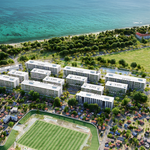
The $62 billion China-Pakistan Economic Corridor (CPEC), particularly the development of Gwadar port, has become a flashpoint. Local communities have voiced concerns about displacement and economic marginalization, alleging exclusion from employment opportunities and decision-making processes related to projects on their lands.
The most serious allegations in Balochistan involve enforced disappearances and extrajudicial killings. Multiple human rights organizations have documented what they describe as systematic abuses.
The Baloch Yakjehti Committee (BYC) documented 1,223 cases of enforced disappearance in 2025. The Human Rights Council of Balochistan reported 1,455 cases that year, including 1,443 men and 12 women. According to their findings, 1,052 individuals remained missing by year’s end, 317 were released, 83 were reported killed in custody, and three were transferred to jail.
Among the documented cases, more than 10 women were allegedly subjected to enforced disappearance in 2025, with eight remaining missing. One case involved Hani Baloch, an eight-month pregnant woman who disappeared along with three family members in December 2025. Human rights groups also report that a 14-year-old student, Raahi Assa, was allegedly killed by security forces in January 2026.
The BYC’s 2025 annual report documented 188 alleged extrajudicial killings, with 75 attributed to what activists describe as a “kill and dump” policy. The Makran Division and Awaran district were identified as particularly affected areas.
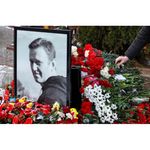
United Nations human rights experts issued statements in March 2025 expressing “extreme concern” over the detention of Baloch human rights defenders and the use of force against protests. International organizations including Amnesty International, Human Rights Watch, and Front Line Defenders have called for action to address rights concerns in the province. Dr. Mahrang Baloch, a prominent activist named to the BBC’s 100 Women list, Time magazine’s TIME100 Next list, and nominated for the 2025 Nobel Peace Prize, remains in detention.
Pakistani security forces maintain approximately 736 permanent checkpoints and 300 temporary ones in Balochistan—a presence that exceeds other provinces. Critics argue this militarization reinforces perceptions of occupation rather than integration.
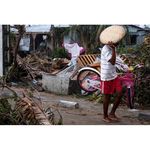
Reports from 2025 indicate that counterinsurgency operations caused civilian casualties, with 20 civilian deaths documented in aerial strikes in Khuzdar district alone. Human rights groups documented more than 122 peaceful protests against disappearances, with 39 allegedly forcibly dispersed, over 400 protesters arrested, and several injured.
In January 2026, Balochistan’s government approved the “Balochistan Prevention, Detention and Deradicalization Rules 2025,” establishing detention centers operating outside standard judicial oversight. Human rights organizations have condemned the measure, describing it as potentially legalizing enforced disappearances and undermining constitutional protections.
A notable development in the Baloch insurgency has been the participation of female suicide bombers. Since 2022, at least five women have carried out attacks, many from educated, middle-class backgrounds. The first, Shari Baloch in 2022, was a 30-year-old school teacher with an MSc degree studying for her MPhil. Recent attackers Asifa Mengal and Hawa Baloch were also educated young women.
In deeply patriarchal societies, female participation in armed resistance carries significant symbolic weight. Insurgent groups have presented this development as evidence that security measures have driven even women to take up arms, representing what observers describe as a shift that reflects deep societal alienation.
The recurring violence reflects what critics characterize as a fundamental failure of political engagement. The Pakistani state has often treated demands for autonomy and equitable resource distribution as separatism, with dissent frequently labeled as anti-state activity. The provincial government in Balochistan, which some view as federally installed, has struggled to address local grievances effectively.
Rather than dialogue, security-focused responses have intensified, with some analysts arguing this approach has pushed educated urban youth toward insurgency. Political observers emphasize that military solutions cannot resolve what they view as fundamentally political problems rooted in marginalization, economic exploitation, and rights concerns.
The recent attacks in Balochistan highlight not only security challenges but also what critics describe as longstanding political failures to address the province’s grievances. Documented human rights concerns—particularly enforced disappearances and alleged extrajudicial killings—have created an environment where, according to activists, peaceful dissent faces criminalization and armed resistance appears to some as the only avenue for change.
The situation in Balochistan suggests that security operations alone may prove insufficient when significant portions of the population feel marginalized, economically exploited, and deprived of political voice.
How Pakistan addresses these intertwined challenges—balancing security concerns with political dialogue, economic equity, and human rights protections—will likely determine the province’s trajectory in the years ahead.
Disclaimer: The views and opinions expressed in this article are those of the author and do not necessarily reflect the official policy or position of this publication. All factual claims and statistics are attributed to the sources cited within the article.
About the Author: Ankit Kumar, Assistant Professor (Research) at SICSSL, specializes in modern warfare, geopolitics, and nuclear policy. He has consulted for India’s Ministry of External Affairs and Defense and contributed to leading think tanks and international publications. He is pursuing a PhD on nuclear policy ambiguity with India as a case study.