Opinion: Did the Pakistan Army sell Pakistani neuroscientist Dr. Aafia Siddiqui to the US?
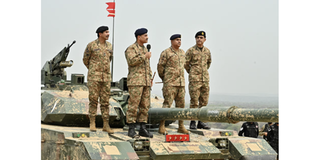
Chief of Army Staff of Pakistan Asim Munir holds a microphone during his visit at the Tilla Field Firing Ranges (TFFR) to witness the Exercise Hammer Strike, a high-intensity field training exercise conducted by the Pakistan Army's Mangla Strike Corps, in Mangla, Pakistan May 1, 2025.
By Asif Ullah Khan
Human rights lawyer Clive Stafford Smith, known globally for his defense of detainees held in U.S. custody, has levelled one of the most serious accusations yet in the long and troubled saga of Dr. Aafia Siddiqui. According to him, Pakistan’s military establishment — led at the time by General Pervez Musharraf — “sold” the Pakistani neuroscientist to the United States for reward money.
It is a claim as explosive as it is unsettling. But in a YouTube channel, Smith did not mince words. He directly blamed Musharraf and “corrupt elements” within the security apparatus for handing her over, alleging it was part of a transactional exchange.
What has given his allegation enduring traction is not simply the weight of his reputation, but the Pakistani military’s persistent refusal to provide clarity. For more than two decades, the establishment and intelligence agencies have maintained a deliberate silence on Siddiqui’s case. No formal denial. No formal admission. Only a silence — one that invites speculation, feeds mistrust, and allows accusations.
Siddiqui had been in the U.S. since 1990. She did an undergraduate major in biology at the Massachusetts Institute of Technology (MIT) and later earned a Ph.D. from Brandeis University in cognitive neuroscience.
As the atmosphere toward Muslims became hostile in the aftermath of the 9/11 attacks, she decided to return to Pakistan in 2003 with her three children after she separated from her husband.
Soon after arriving in Pakistan, she disappeared, and in July 2008, she was arrested in Afghanistan’s Ghazni province. According to U.S. and Afghan authorities, she was found carrying suspicious items and handwritten notes referring to potential attacks (including notes allegedly describing how to build “dirty bombs” and lists of possible U.S. targets).
It is alleged that during interrogation, she grabbed an M-4 rifle and attempted to fire at U.S. officers, who shot and injured her. In 2010, she was sentenced to 86 years in prison by a U.S. federal court.
“Dr. Siddiqui was handed over to the United States in a transaction that involved corrupt elements within the Pakistani military who accepted bounty payments,” Smith alleged. He went further: “The Pakistani army is not genuinely interested in securing her release because doing so would implicate them in illegal activities they want to keep hidden.”
Journalist and analyst Syed Muzamil Shah, who has studied the case in depth, offered a more layered perspective. He acknowledged that Pakistan and the United States engaged in extensive intelligence cooperation during the War on Terror, including controversial renditions. But he cautioned that Siddiqui’s story cannot be reduced to a single transaction.
“Clive Stafford Smith rightly highlights complex realities,” Shah said. “Pakistani agencies have often cooperated with U.S. counterparts, sometimes sacrificing national interests for strategic gains. But Dr. Siddiqui’s case is layered with misinformation. It is unclear whether her rendition was purely transactional or part of broader geopolitical calculations.”
Shah also pointed to the domestic and international pressures under which Pakistan’s security establishment operates — pressures that may explain, though not justify, its reluctance to revisit past decisions.
“The military’s silence reflects a broader unwillingness to open Pandora’s box of secret deals and compromises made in the name of counterterrorism,” he argued.
Smith’s criticism extends beyond the generals. He has repeatedly accused successive Pakistani governments of failing to pursue Siddiqui’s return with meaningful urgency. His assessment is blunt: if Pakistan truly wanted her back, she would already be home.
He has suggested prisoner swaps — including an exchange involving Dr. Shakeel Afridi — but claims Islamabad has never pursued such options seriously.
More troubling, he alleged that Siddiqui’s sister, Dr. Fouzia Siddiqui, has been subjected to years of intimidation: dead bodies left outside her home, bullets mailed to her, threats to abduct her daughters, attempted kidnappings, and blindfolded interrogations. If true, these actions raise critical questions about who fears the truth — and why.
On Pakistan’s claim that it spent $2 million on Siddiqui’s legal defense in 2010, Smith says the Pakistani legal team did not pursue the case seriously. Siddiqui’s sister and other family members have claimed that the legal experts hired by the Pakistani embassy were “incapable” and did not fight the case effectively.
Both Smith and Shah agree on one thing: Siddiqui’s case shows how sometimes governments sacrifice their citizens for ulterior motives or political convenience.
Two decades after her disappearance, the unanswered questions in Siddiqui’s case have only multiplied. And unless Pakistan’s institutions — military and civilian — confront the past with honesty, the shadow over her case will continue to darken public trust.
In the end, Smith’s allegations may be proven or disproven. But the silence from Pakistan’s establishment remains the most damning evidence of all. If it had nothing to hide, why has it said nothing at all?
Asif Ullah Khan is a veteran journalist who has held senior editorial positions at The Times of India, Khaleej Times, The Hindustan Times, and The Brunei Times. He currently writes for The Diplomat, The Wire, The India Legal, The ASEAN Post, and other international publications.