Political interference and operational inefficiency by Asim Munir intensify terrorism in Pakistan
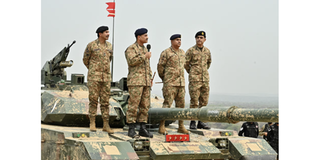
Chief of Army Staff of Pakistan Asim Munir holds a microphone during his visit at the Tilla Field Firing Ranges (TFFR) to witness the Exercise Hammer Strike, a high-intensity field training exercise conducted by the Pakistan Army's Mangla Strike Corps, in Mangla, Pakistan May 1, 2025.
Asim Munir was elevated to the rank of Field Marshal in 2025 for his “exemplary leadership” in enhancing Pakistan’s security, but the same year saw a 74 percent increase in combat-related deaths, reflecting the unprecedented deterioration of internal stability.
There appears to be a failure to rein in militant groups and a struggle to fulfil his core duty of ensuring domestic order, despite Munir exercising unparalleled authority and making repeated public assertions of control.
Munir’s prioritisation of political interference, border mismanagement, allegedly protecting terror groups in the country and operational shortcomings are cited as major reasons. As many as 664 security personnel were among the 3,413 deaths in 2025— up from 1,950 in 2024, according to a report released by the Pakistan Institute for Conflict and Security Studies (PICSS).
Jailed former Prime Minister Imran Khan held Munir responsible for the rising cases of terrorism in Pakistan. “Asim Munir’s policies are disastrous for this country. It is because of his policies that the scourge of terrorism has spiralled out of control. He first threatened Afghans, then expelled refugees by force, and conducted drone strikes on them; the consequences of which came in the form of rising terrorism inside Pakistan. This man has sacrificed the country to terrorism for his own personal interests.”
Munir has risked the lives of Pakistani soldiers fighting with the Taliban on the Afghan border when he could not even tame militancy in Balochistan, said Tamim Asey, former Afghan Deputy Minister of Defence.
“Come back to dialogue and avoid further bloodshed. Your forces are being killed in hordes. Every day of these confrontations will sleepwalk you into another epic mistake of Bangladesh magnitude!” he warned. Sharing a video of Pakistani soldiers being held hostage, Asey wrote: “Somebody should advise Asim Munir he is walking into a major catastrophic mistake.”
Khan said that governance in Pakistan was in a dire state and that internal affairs were being handled in the worst possible manner, arguing that the military leadership had become overly involved in domestic political affairs rather than security and counterterrorism.
“The primary role of intelligence agencies is to protect borders and counter terrorism. If they remain occupied with political engineering and attempting to dismantle Pakistan Tehreek-e-Insaf (PTI), then who will safeguard the borders?” he said. “Terrorism has once again taken root in the country.”
Pakistan’s military has always played a direct and active role in policy decisions and governance. But observers pointed to the expansion of the military’s political clout under Munir, especially after the recent controversial constitutional amendment. “He has unbridled power, now constitutionally protected,” said Michael Kugelman, Senior Fellow at Washington-based Atlantic Council. “Ultimately, it will be Munir’s rules, and his rules only.”
People in Pakistan, too, expressed concerns over Munir’s failure to protect them from the rising militancy, particularly in Khyber Pakhtunkhwa and Balochistan.
“Asim Munir’s incompetence and obsession with politics and eating chilghozy (pine nut) leads to nine more coal miners losing their lives in the BLA attack,” said a Pakistani national named MD Umair Khan.
Some even blamed him for inciting violence. “The entire nation knows that terrorism in the tribal areas is being carried out under the leadership of the mentally ill Asim Munir,” said Peshawar resident Amin Wazir.
The surge in terror attacks and related deaths is linked to the operational and tactical shortcomings of Munir-led security forces, as 2025 saw over 5,300 terror incidents. Pakistan’s military failed to devise a holistic plan to contain terrorism even as militancy continued to grow, said Pakistani analyst Zahid Hussain.
“It is mainly the absence of a coherent counter-terrorism and counter-extremism policy at home that has allowed terrorist groups much greater space,” he said. “It is the security establishment that is largely to be blamed for the aggravation of Pakistan’s terrorism challenges.”
The military-focused response to dissent in Balochistan and Khyber Pakhtunkhwa has alienated the populace, and Munir’s plan to mine copper in Balochistan is likely to further intensify militancy, said Pearl Pandya, senior analyst at ACLED, a US-based conflict monitoring firm.
“For militancy to abate in Pakistan, a combination of three factors is essential: sustained military pressure on militants, political engagement with Baloch and Pashtun groups, and cooperation from Afghanistan.
While the first is in Pakistan’s hands, both the army and the government remain hesitant toward the second and have limited ability to influence the third, and most crucial, piece of the puzzle,” she said.
“This points toward, at best, a continuation of the status quo with sporadic bursts in regional violence in 2026 and, at worst, a further deterioration in the security situation as militancy enters the mainland.”