Dons: Maalim Seif’s rich political legacy worth emulating
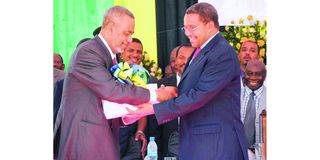
In this August 25, 2014 file photo, President Jakaya Kikwete hands copies of the Second Draft of the Warioba Constitution to Zanzibar’s First Vice President Seif Sharif Hamad at Karimjee grounds in Dar es Salaam. PHOTO | FILE
Maalim Seif’s unique place in Tanzania’s politics comes from the longevity of his influence in opposition politics in the country. No other opposition politician in the country sustained his supporters’ hopes and ambitions for as long as he did.
Following the death of Seif Sharif Hamad, the void left behind in Zanzibar politics will take time and effort to be filled, academicians say. Those aspiring to fill it would better learn from how the master himself conducted his politics.
His charismatic political leadership that enabled him to rally his base and channel his supporters’ political aspirations was a rare trait in Tanzania’s opposition politics, academicians add.
The fact that he was a stabilizing force in Zanzibar’s divisive politics was highlighted towards the end of his life in his decision to lead his party to join the Government of National Unity (GNU), himself becoming the First Vice President of Zanzibar.
“Seif Sharif Hamad was a balancing force between Pemba and Unguja politics,” says Dr Audax Kweyamba of the Department of Political Science and Public Administration of the University of Dar es Salaam.
Dr Kweyamba says Hamad, who was popularly known as Maalim Seif, was able to navigate the steeply sensitive matters and do the balancing act between Pemba and Unguja politics.
“Opinion polls conducted by our Department in the past show that Pemba residents regarded Maalim Seif as their leader and their representative in Zanzibar politics and beyond,” Dr Kweyamba adds. Maalim Seif died on February 17, this year at the age of 77.
The “too close to call” presidential results in Zanzibar polls from 1995 to 2015 notwithstanding Maalim was ultimately able to calm his supporters and look forward to the next elections.
Some critics accused Maalim Seif of contributing to the divisive politics in Zanzibar and of failing to appeal to non-Pemba Zanzibaris.
But Dr Azaria Mbughuni, assistant professor of History at Lane College, USA says: “On one hand, one can argue that some of his ideas were divisive and destabilizing. On the other hand, it is clear that he had the ability to assess a situation and find a compromise in order to avert turmoil. This ability and quality was very important.”
Dr Mbughuni adds that regardless of where one is in the political spectrum in Zanzibar, it is impossible to deny the influence Maalim Seif had on Zanzibar politics.
“In the end, he decided to be part of the government. Strengthening peace and working to bring about desired changes from the inside was more important to him in the final analysis. This says something about him!” Dr Mbughuni adds.
Maalim Seif’s unique place in Tanzania’s politics comes from the longevity of his influence in opposition politics in the country. No other opposition politician in the country sustained his supporters’ hopes and ambitions for as long as he did.
That, Dr Kweyamba says, is the hallmark of a politician with an agenda and a mission: “Maalim Seif was not an opportunist. Had he been one, he would have given up and faded out of Zanzibar politics long ago. He seemed to have a long-term agenda and a mission that he pursued to the end.”
Maalim Seif was groomed and prepared for leadership by CCM, says Dr Mbughuni. In his formative years in the ruling party politics Maalim Seif was a contemporary of former President Jakaya Kikwete, from the University of Dar es Salaam in the early 1970s to the upper echelons of the party. As Maalim Seif joined both the central committee (CC) and the national executive committee of the newly formed CCM in 1977, Kikwete was sent to Zanzibar to help entrench the new party.
But it was the nomination process for the Zanzibar presidential candidate in the 1985 election that Maalim Seif’s factor in Isles’ politics came to the fore.
In the nomination he gave the late Idriss Abdul Wakil, the then Speaker of the House of Representatives, a run for his money. Mwalimu Julius Nyerere, at the time still President of Tanzania and CCM chairman had to muster all his political sophistication and convincing power to persuade Maalim Seif and his supporters, mostly from Pemba, to wait for their turn. It was in political rallies he held in Pemba after CCM had nominated Wakil that Mwalimu Nyerere warned against the dangers of divisive politics in Zanzibar.
Maalim Seif could not get another opportunity to contest the presidency in CCM. He was expelled from the party in 1988 and later becae a prisoner of conscience. Interestingly as Maalim Seif’s star faded in CCM, Kikwete’s started rising in the same year when he was recalled from a grassroots party position in Mtwara to become deputy minister for Energy and Minerals.
What next after Maalim Seif’s departure?
It is clear that Tanzania needs opposition politicians in the calibre of Maalim Seif: “He was an ambitious politician who was ready to push boundaries to achieve his objectives. He amassed a large following because of his political acumen. His message often resonated with many people,” says Dr Mbughuni.
With inadequate strategies to groom young politicians in most political parties getting politicians of the quality of Maalim Seif could be difficult. “Failing to groom leaders is a challenge throughout Africa. But it is a fact that Zanzibar politics need a politician who would play the role that Maalim Seif played; a stabilizing force,” says Dr Kweyamba.