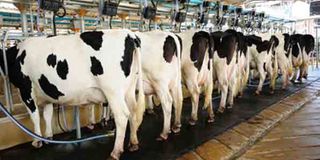
The exercise, to be spearheaded by the National Artificial Insemination Centre (NAIC), aims at improving quality and productivity of the dairy breeds to boost milk and beef production.
Arusha. A nationwide artificial insemination programme planned to involved at least three million cows a year through heat synchronisation will soon be rolled out.
The exercise, to be spearheaded by the National Artificial Insemination Centre (NAIC), aims at improving quality and productivity of the dairy breeds to boost milk and beef production.
Its implementation will start any time in this financial year, according to Dr Paul Mollel, the director of the centre based in Arusha.
It will begin at Meatu District in Simiyu Region, which is one of the regions with highest livestock population .
He revealed this during a briefing to the permanent secretary in the ministry of Livestock and Fisheries Development, Prof Elisante ole Gabriel, who visited the facility. “Breeding of cattle through artificial insemination is essentially for increased milk and beef production,” he said, noting that it would supplement the government’s industrialisation drive. Milk production in Tanzania is currently estimated at 2.4 billion litres a year, a stark contrast to a huge population of 30.5 million cattle the country has.
The 2.4bn litres are largely obtained from the 1.5 million dairy cattle with the remaining 27m traditional cows producing just a fraction of the amount.
Dr Mollel said NAIC can successfully implement the programme if production of good quality semen and training of inseminators is enhanced and sustained.
Currently, the centre has a total of 26 bulls for semen production, which is collected and inseminated into cows. Four of the bulls belong to Boran and Bonsmara breeds (two each), whose semen is for reproduction of beef cattle while Simmental and Mpwapwa breeds serve both purposes. Sixteen bulls at the centre; six Ayrshire, seven Friesian and two Jersey are specific for the reproduction of dairy cows, he told the visiting PS.
He noted that there was a high demand among the animal keepers for semen from Boran and Sahiwal bulls. Drought resistant Boran is preferred by local herders for the production of beef.
Prof Ole Gabriel called for increased sensitisation of the traditional livestock herders on artificial insemination technology, which he said,can transform their livelihoods.
Recently the government slashed the prices of artificial insemination services to between Sh3,000 and Sh5,000 per cow from Sh15,000 and Sh40,000 per animal previously charged.
The ministry insisted that besides ensuring high productivity, artificial insemination reduces the spread of venereal diseases among the livestock herds.