Experts see light at end of tunnel, hopeful for increased competitive politics

Dar es Salaam. Political analysts have said the continued holding of political rallies by both opposition and ruling parties across different regions is reviving hopes of more competitive, issue-based politics, though they caution that the emerging momentum must be safeguarded from disruption.

The remarks follow a wave of political activities that saw Chadema begin nationwide tours on Saturday, May 16, 2026, in the Victoria Zone before proceeding to Serengeti, Northern, and Central zones.
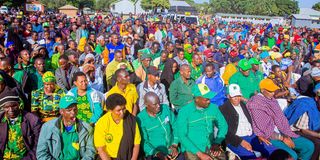
The tours came about a month after the Court of Appeal lifted a temporary order that had barred the party from political activities, a restriction that had kept Chadema away from public platforms for about eight months.

The order stemmed from a case filed by former Chadema Vice Chairman for Zanzibar, Mr Saidi Issa Mohamed, and two others, and was issued on April 15, 2026.

While Chadema resumed its political engagements, the ruling CCM also intensified its outreach, with its Ideology, Publicity, and Training Secretary, Mr Kenani Kihongosi, conducting a tour in Mara Region from May 14 to 16.

CCM Mainland Vice Chairman, Mr Stephen Wasira, also held meetings in the Kigoma Region between May 15 and 17.

Another opposition party, ACT-Wazalendo, maintained its political presence through activities in Dar es Salaam, where on May 16, 2026, it held a symposium on the country’s political and development direction.

Chaumma also engaged in campaign activities in Iringa Region, particularly in Isimani, ahead of an upcoming by-election.

Across all these activities, no major incidents of confrontation or police interference were reported during rallies or public engagements involving party leaders.

However, Chadema has been issued a notice by the Office of the Registrar of Political Parties (ORPPs) requiring it to explain why action should not be taken to suspend its registration over alleged breaches of the Political Parties Act, including claims of inflammatory statements and use of abusive language.

Political analysts say the development risks undermining the improving political climate.

According to the letter from the Registrar of Political Parties dated May 13, 2026, the allegations relate to statements allegedly inciting violence.

Positive signal

Speaking to The Citizen’s sister newspaper, Mwananchi, political analyst, Dr Baraka Mfinanga, said the current environment reflects a positive shift in the country’s political space and should be preserved.

He noted that Tanzania has previously experienced tensions over political freedoms, which at times eroded public trust in the fairness of the system.

According to him, the fact that both CCM and Chadema are now conducting activities simultaneously without major obstruction in several areas signals growing tolerance and responsiveness to public demand for democratic space.

“No political party can build lasting legitimacy without open competition,” he said.

Dr Mfinanga added that democracy is best strengthened when opposition parties are allowed to freely express themselves rather than being restricted.

“When citizens can listen to all sides without fear, it shows confidence in the political system,” he said.

He further observed that restricting political rallies often has the unintended effect of increasing sympathy and support for affected parties.

He said historical experience across Africa shows that opposition movements often gain momentum when perceived to be suppressed.

Another analyst, Dr Elias Mwakalinga, said the current wave of rallies suggests Tanzania is entering a phase where political parties will increasingly be judged on policy ideas and persuasion rather than institutional backing.

He said this is an important step in strengthening political competition and urged state institutions to safeguard the progress.

Dr Mwakalinga added that earlier tensions, where opposition rallies were often treated as security concerns, had limited democratic engagement.

“What we are seeing now is that politics can be conducted peacefully when institutions focus on their supervisory role rather than becoming part of political disputes,” he said.

Dr Mwakalinga added that simultaneous campaigns by CCM and Chadema are helping rebuild confidence in political competition, particularly among young people who had begun to doubt the vibrancy of the system.

He said the younger generation needs to witness open competition to trust electoral processes.

Another analyst, Mr Said Majjid, said the current trend indicates a return to competitive politics, away from a period dominated by legal and security disputes.

He said political discourse had for some time focused more on the right to assemble than on policy substance.

He noted that Chadema’s return to public activities demonstrates that political movements cannot easily be eliminated by restricting rallies, as they are often rooted in public concerns.

“State institutions, particularly security organs, must remain neutral facilitators of public safety rather than arbiters of political participation,” he said.

“When all major parties operate freely without conflict, it reflects political maturity. But when restrictions return, it raises questions about fairness,” added Mr Majjid.

He also criticised ongoing regulatory scrutiny against Chadema, saying such measures risk undermining trust in the political environment.

A political science student at the University of Dar es Salaam, Ms Zuhura Mwangonde, said sustained political openness would increase public participation in democratic processes.

She said prolonged restrictions on opposition activity had previously contributed to perceptions that political competition was weakening.

Furthermore, she added that multiparty democracy does not require consensus among parties, but rather the freedom to compete and present differing views.

According to her, while restrictions may produce short-term political control, they risk long-term damage to democratic credibility.

“A strong democratic system is one where all sides can be heard freely, and citizens make informed choices without fear,” she said.