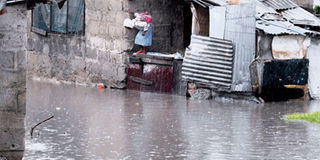
The floods damage has extended from the usual flood-prone areas to other parts of the city
What you need to know:
Experts say the floods problem in Dar es Salaam is a man-made disaster caused mainly by gross violation of urban planning rules and failure by local authorities to enforce them
The residents have accused the authorities of laxity in enforcing urban planning laws that has seen people build their homes in the path of streams, blocking the waterways and wreaking havoc
Dar es Salaam. Hundreds of residents here are living in pathetic conditions after a two-day downpour flooded their homes. The situation has been made worse by the fact that there are few or no outlets for the rainwater to drain away.
The residents have accused the authorities of laxity in enforcing urban planning laws that has seen people build their homes in the path of streams, blocking the waterways and wreaking havoc--with disastrous consequences. A two-day survey by The Citizen on Saturday found clogged drainage systems and roads and homes submerged in flood water, causing untold suffering to road users-- both motorists and pedestrians.
Citizens who spoke to this newspaper yesterday accused municipal authorities of allowing people to build in restricted areas such as river beds. Some have built walls and fences that have blocked the flow of rain water. The damage caused by the floods has extended from the usual flood-prone areas to other parts of the city.
An expert has blamed the problem on a poor building permit system, an outdated city master plan and a poor solid waste collection system. “We should expect the worst in the next few years if we don’t adopt robust measures to reverse this trend,” said Dr Robert Ntakamulenga, the director of environmental compliance and enforcement at the National Environment Management Council.
According to Dr Ntakamulenga, the flood problem in Dar is a man-made disaster caused mainly by gross violation of urban planning rules and failure by local government authorities to enforce the rules. “We need to ask ourselves who is issuing permits for people to build in river beds and our wetlands,” he added.
A road section along Mwai Kibaki Road--from Shoppers Plaza in Mikocheni to the residence of former President Ali Hassan Mwinyi--offers more evidence of how disastrous allowing construction in waterways can be. For two days, the road and businesses and homes along the road have been inaccessible as the area has remained under water because people have built in a wetland area that used to direct water to the sea.
The natural flood plains had been deliberately left undeveloped for years to absorb flood water and direct it to the sea. The problem started after authorities granted permission for the development of houses in that zone. Residents have complained in vain for years. Vice-President Mohamed Gharib Bilal visited the area in August last year but nothing has changed.
“The laws are there,” said Dr Ntakamulenga. “The enforcers are also there but people are enacting their own laws with impunity.” Areas such as Mikocheni A, Mwananyamala, Tandale, Tabata Kisiwani and Buguruni Kwa Mnyamani have been badly affected by the rainwater.
A spot check yesterday morning revealed that workers had a difficult time making it to their offices downtown as operators of commuter buses parked their vehicles for fear of being stranded in long queues. “I’ve been here for over an hour and there are no buses heading downtown,” said George Lymo, a resident of Tabata Kimanga. “Operators are telling us the roads in Kariakoo are flooded and they can’t risk taking their buses there.”
Across the road, Mikocheni ‘A’ residents spent Thursday night trying to rescue their possessions from the flood water. On Friday morning, they were at it again, using buckets to throw water out of their houses. Kisa Ali, a resident of Chura Street said: “This is not new experience for us here. Some neighbours have built their houses on wrong sites, blocking the waterways. We didn’t sleep last night. During the rainy seasons, we don’t enjoy the nights at all.”
Opposite the road in Msasani Bonde la Mpunga, all was not well either. Some of the affluent residents used pumps to drain the water from their houses, which was not an easy task. Michael Kibunja moved to the area last September and this is his first flooding experience. On Thursday night, the water stormed his one-storey residence and damaged virtually everything that was on the floor--from suitcases to books, carpets and tiles.
Mr Kibunja, who is a civil engineer with over two decades’ expertise in storm water drainage, expressed his shock and disbelief that an area only a few metres from the ocean can experience floods during the rains. He added: “This is a low point. All the water around is running here. The immediate solution would be to drain these few hundred of metres as they plan for a better solution. They only need to open this area for the water to access the ocean.”
Kinondoni Municipal Council spokesperson Sebastian Mhowera, said they were working to avoid the situation but the courts of law have become a stumbling block in enforcing environmental and urban planning laws.
“We have issued demolition orders to those building or blocking waterways,” he said. “But they just go to court and secure orders to stop us. They win the cases and we are ordered to compensate them. This is a new headache.”
Meanwhile, Habel Chidawali reports from Dodoma that at least one person died and five others went missing after flood water swept away the engine wagon of a train at Gulwe in Mpwawa District, Dodoma.
According to Mpwapwa District Commissioner Christopher Kangoye, five people are missing after the cabin of a cargo train was washed away and sent several metres away.