Muhas has been leading a project to build its own teaching hospital, but new developments indicate the university has lost control of the plan
Dar es Salaam. Like most top-notch medical schools in the world, the Muhimibili University of Health and Allied Sciences (Muhas) should now be running its own teaching hospital.
Nonetheless, that dream may have vanished into thin air.
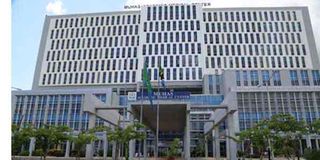
This follows news that the university’s Mloganzila Academic Medical Centre, (MAMC) has now been placed under the control and management of the Muhimbili National Hospital (MNH) contrary to an earlier plan where Muhas was going to lead the project.
The MNH confirmed to The Citizen that in the next two weeks, they would come up with a detailed plan on how to run the new state-of-the art facility, built at the cost of Sh206 billion, thanks to South Korea’s soft loan.
“It seems there were some challenges, which affected the provision of services at Mloganzila, but since our national hospital has a wide experience in the field, it will provide the anticipated quality services,’’ said MNH’s head of public communication and customer care unit, Mr Aminiel Algaesha when approached by The Citizen.
MNH’s Executive Director, Prof Lawrence Museru has since informed medical staff at Mloganzila that they would start receiving their incentives(which they had missed), as per an internal announcement dated October 5 and seen by The Citizen.
Earlier, some staff at Mloganzila had confided to The Citizen that due to the operational challenges at the facility, “they had lost motivation to work.”
“We are not like our counterparts at MNH. Whenever we attend to private patients, we are supposed to be paid some percentage as incentives, but we haven’t received this for a long time,” said one medic who preferred to remain anonymous for fear of retribution.
A senior practicing medic in Dar es Salaam (who also declined to be named) said he was aware that the university authorities were caught up in a dilemma of how to make Mloganzila generate income to pay back a large chunk of the Sh206 billion outstanding loan used to build it.
Mloganzila is supposed, after 16 years, to generate income to pay back the soft loan for construction to South Korea. The soft loan is managed by the Korean government’s Economic Development Cooperation Fund (EDCF) at Exim bank of Korea.
“What I see is that there are challenges on how to make Mlogazila generate income. I think the new changes are based on that fact. I think the university wasn’t able given their experience in hospital management and business,’’ said the doctor.
How news emerged
On Thursday last week, Muhas issued an announcement to all medical staff saying that with effect from October 3, Mloganzila would be placed under the management of MNH, but the varsity’s communication unit did not have much details on what the changes meant to the university’s plan to run a teaching hospital.
“No idea so far, we have been told it [Mloganzila] will be under MNH. Probably the ministry will clarify later,’’ responded the Muhas’ public relations officer, Ms Hellen Mtui, when The Citizen sought comment. Mlonganzila teaching hospital has been under the Ministry of Education, Science and Technology.
Sense of optimism last year
The latest decision to put the teaching hospital under MNH management is certainly not what Muhas was forecasting by last year when this paper exclusively interviewed the university’s then Vice Chancellor Prof Ephata Kaaya.
Prof Kaaya has since completed his office tenure at Muhas.
“We [Muhas] are going to operationalise the hospital in phases, focusing on critical departments which need to start and then eventually reach maximum functionality whereby we will recruit sufficient numbers of staff which is about 1,300 in total,’’ he said in the interview published on August 8, 2017.
‘Patients belong to hospital’ attitude
In the medical fraternity, especially for those in the academia, the sudden change has set tongues wagging. One insider, a senior academic and medical doctor, told this reporter that the change of plan evokes memories of how the “Mloganzila dream came about.”
The medic, talked of how, in the early 2000s, there emerged early attempts to free Muhas’ teaching activities from the Muhimbili National Hospital, leading to what later came to be described as, “Students belong to the university, patients belong to the hospital,” attitude among staff at MNH and Muhas.
He said he has watched the milestones for Mloganzila, as it morphed from a mere idea to the mega structures and the idea of putting the teaching hospital under MNH is not what could have crossed his mind. “There is more to this than meets the eye,” said the medic.
He says the vision for Muhas to have its own teaching hospital was premised on the varsity’s ever expanding needs but also(although not official reason) the growing desire to avoid the management and operational clashes between staff at MNH and the university.
In the early 2000s, that’s how the plan began to erect a wall that would later split Muhimbili between the hospital and the university. It was some sort of a battle to mark the territories, he says.
That is also how phrases such “patients belong to the hospital” and “students belong to the university” evolved at Muhimbili, leading to clear separation of clinical staff who would now concentrate on work in the ward and lecturers who had to assume the duty of both a teacher and a clinician. It hasn’t been an easy relationship since then, he says.
At Mloganzila’s inauguration ceremony of last year, President John Magufuli directed the stakeholders concerned with the running of the new hospital to meet and explore the best management system needed for a successful outcome.
At that time, it was clear that all was not well. After the President’s directive, there followed announcements to transfer patients from MNH to Mlogazila. Over 80 patients were transferred on the order of the Ministry of Health, Community Development, Gender, Elderly and ChilAgainst the backdrop of the events, a senior Professor who formerly taught at Muhas, Prof Zulfiqarali Premji, wrote an article in The Citizen, titled: Operationalisation of Mlonganzila Hospital a major challenge, in which he suggested the course of action.
“What Mloganzila needs is an autonomous committee that will have its own CEO and management team. Muhas does not have the expertise or experience to manage a big hospital.’’
Muhas signed MoU with Yonsei University of South Korea, aimed at helping Muhas train sufficient teaching staff to teach at Mloganzila and also offer the required health services. It remains to be seen whether the MoU would change in the wake of the new changes.