Is UN losing relevance amid disrespect of its key decision?
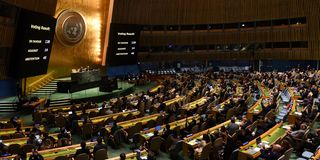
The UN General Assembly votes for an "immediate humanitarian truce" in Gaza, as the Israel-Hamas conflict raged for a 21st day at the UN in New York on October 27, 2023. PHOTO | AFP
The recent outbreak of wars between nations and internal conflicts explains how the 78-year-old body is struggling to enforce its decisions, putting its credibility at stake.
Dar es salaam. As the world grapples with an increasing number of conflicts and disputes, questions abound about the relevance and effectiveness of the United Nations (UN).
The recent outbreak of wars between nations and internal conflicts explains how the 78-year-old body is struggling to enforce its decisions, putting its credibility at stake.
The world watches as powerful nations choose to ignore or defy the UN as days go by.
Related
The frustration of East African leaders with the UN system, for instance, and the divisive UN General Assembly vote on a humanitarian ceasefire in Gaza have left many questions about the impartiality of the global body.
Is the UN still capable of addressing global challenges and fulfilling its primary responsibility for international peace and security?
According to the UN Charter signed on June 26, 1945, the UN can take action on a wide variety of issues due to its unique international character and the powers vested in its Charter, which is considered an international treaty.
As such, the Charter is an instrument of international law, and UN Member States are bound by it. The UN Charter codifies the major principles of international relations, from sovereign equality of states to the prohibition of the use of force in international relations.
However, one of the major challenges to the UN’s relevance is the repeated instances of countries disregarding its decisions and acting unilaterally.
Observers say the Iraq War in 2003 serves as a poignant example of this disregard.
The United States, despite widespread opposition within the UN, invaded Iraq. The failure of the UN to pre-vent this conflict from taking place left a lasting scar on its credibility.
More recently, the ongoing Russia-Ukraine conflict saw Russia’s annexation of Crimea despite a vote against it at the UN. This blatant disregard for international consensus raised questions about the UN’s ability to prevent aggression and protect the sovereignty of nations.
Israel’s reaction to the recent UN General Assembly vote for a humanitarian ceasefire in Gaza further under-scores the UN’s limitations. Israel’s insistence on continuing its military operations, despite international calls for an immediate truce, has called into question the effectiveness of UN resolutions in practice.
During the assembly, Israel’s envoy to the UN, Gilad Erdan, delivered a strong message, stating: “This week, the UN celebrates its 78th birthday, yet looking at this resolution at the honorary guests hosted here today, this organisation has shown that it is so broken and so morally corrupt that I do not have high hopes that it would make it to 90, let alone 100.”
“Today serves as the clearest proof that this body is bleeding its relevance, legitimacy, and justification,” he further affirmed, while stressing his country’s unwavering focus on “eradicating Hamas”.
Expert views
Local and international relations experts who talked to The Citizen shared a common view of the UN’s capability, saying the body was struggling to maintain its credibility.
International relations expert from the University of Dodoma (Udom), Dr Jane Msumba, said the recent turn of events has put the UN in a tight spot.
“The recent events show that the UN is struggling to enforce its decisions, and its credibility is at stake. When powerful nations choose to ignore or defy the UN, it weakens the credibility of the body and the global situation as well,” she said.
A senior lecturer at Cape Town University (South Africa), Prof Elias Mwakasaka, called for major reforms at the UN for the body to go with time and current demands.
“The UN must adapt to a changing world order. Its structure, particularly the Security Council, needs a serious overhaul to reflect the realities of the 21st century. The lack of an African member with veto power is a glaring example of its outdated nature,” he affirmed.
A diplomacy expert from the University of Dar es Salaam (UDSM), Prof Abdallah Safari, expressed his sadness at the way the UN has continued to conduct its affairs and apply double standards in recent years.
“Don’t wait for things to get worse because that’s where we’re headed with the current status quo.” Instead, as they reviewed the League of Nations, the UN Charter must also be reviewed to maintain or return its relevance and trust,” he said.
Prof Safari added: “Together with its institutions like the International Court of Justice (ICJ), which some countries have not listened to or followed, all of these require major reforms if the UN is to continue to exist and be respected.”
According to Dr Msumba, a comprehensive reform of the Security Council is long overdue. She said African countries, with their growing influence on the global stage, should have a more significant role in decision-making.
She also said that the UN needs to find ways to strengthen the enforcement of its resolutions. This may involve creating mechanisms to hold nations accountable for their actions.
An international diplomacy student (PhD), Ms Grace Makame, gave her views: “The UN should prioritise peaceful negotiations and diplomacy. Preventing conflicts is often more effective than trying to intervene after they’ve begun.”
An undergraduate student in international relations at UDSM, Rahim Mwakyoma, told The Citizen: “It’s dis-heartening to see powerful nations ignoring the UN’s decisions. It makes you wonder if the UN is still the beacon of hope for a peaceful world that it was meant to be.”
While experts agree that reform and adaptation are necessary, whether the UN can regain its status as the global authority for peace and security remains uncertain.
The formation of the UN
As World War II was about to end in 1945, nations were in ruins, and the world wanted peace. Representatives of 50 countries gathered at the United Nations Conference on International Organisation in San Francisco, California, from April 25 to June 26, 1945.
For the next two months, they proceeded to draft and then sign the UN Charter, which created a new international organisation, the United Nations, which, it was hoped, would prevent another world war like the one they had just lived through.
Four months after the San Francisco Conference ended, the UN officially started existing after its Charter had been ratified by China, France, the Soviet Union, the United Kingdom, the United States, and a majority of other signatories.
Now, more than 75 years later, the UN is still working to maintain international peace and security, give humanitarian assistance to those in need, protect human rights, and uphold international law.
“As the world faces complex challenges, the debate over the UN’s role and future will undoubtedly continue... However, in a rapidly changing world, the UN’s ability to address global crises effectively is crucial, and the international community will be closely watching for signs of change and progress within the organisation,” said Dr Mwakasaka.
One question remains: Do Africa’s “born frees” and the world at large still need this body in its current setting, or is it time for a re-evaluation of its role and structure in a new era of global politics?