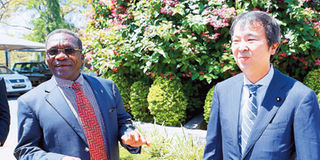
Prime Minister Mizengo Pinda talks to the Japanese Deputy minister for Foreign Affairs, Mr Hirotaka Ishihara, in Dar es Salaam yesterday.
PHOTO | PMO
What you need to know:
“I agree there has been a great competition from other countries for investments in Africa but Japan has been here for a long time and we need to just maintain that and polish up some of our policies,” he said.
Dar es Salaam. Japan is now looking for new strategies in which it can expand its investments and promote trade with Tanzania and Africa in general in the wake of growing influence by China and the United States.
The Japan’s director general of African and Middle Eastern Bureau Affairs in the ministry of Foreign Affairs, Mr Yasushi Misawa, told journalists in the city yesterday during a seminar to introduce a delegation of 60 Japanese businessmen who visited Tanzania that it was obvious that the kind of approach that the country used some years ago must change.
He said the country now opts to involve the Tanzanian private sector in trade because they have seen it growing at a good rate and that the country has a lot of natural resources that with Japanese assistance both can benefit from.
“I agree there has been a great competition from other countries for investments in Africa but Japan has been here for a long time and we need to just maintain that and polish up some of our policies,” he said.
The government of Japan has been attaching priorities to economic and social infrastructure building such as roads, electricity supply and water supply as well as transfer of technology related to rice production and irrigation and Tanzania is one of the largest recipients of Japanese assistance in Sub-Saharan Africa.
The tour was aimed at promoting trade and investments between Tanzania and Japan.
He said the fact that the country’s economy has not been very stable in the last few years has contributed to the fall of Japanese firms’ presence in the continent. He said since the beginning of the 21st Century, Tanzania has achieved stable GDP growth of around 7 per cent annually.