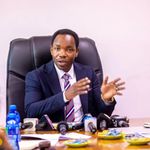
Dar es Salaam. Prime Minister Dr Mwigulu Nchemba was confronted with a wide range of grievances from residents of Mbeya Region, spanning the justice system, access to quality healthcare, water shortages, land disputes, taxation and business closures.
The concerns were raised on Thursday, December 18, 2025, during a public meeting in Kiwira, Rungwe District, held as part of the Prime Minister’s visit to the region.
Residents used the forum to air long-standing problems, some of which drew immediate responses from Dr Nchemba, while others were referred to relevant government authorities for follow-up action.
Despite intermittent rainfall disrupting the session, residents remained in place, insisting they would endure the conditions to ensure their voices were heard and their concerns addressed by the government.
The first resident to speak, Ms Evelyn Brown, drew attention to persistent shortages of essential medicines at local health centres, despite visible improvements in infrastructure. She said the situation was particularly worrying for vulnerable groups.
“We are told that medicines for pregnant women and children under five are free, but when you go to the health centre and there are no drugs available, it is deeply troubling,” she said. Ms Brown also raised concerns about alleged irregularities within the justice system, claiming that securing bail at some police stations required payments of up to Sh500,000.
“There are people who act as if they are above the law, pressuring judges to keep others in detention. This creates resentment among citizens, and these individuals are well known,” she said.
As Ms Brown spoke, another resident, Mr Bashiru Matolwa, raised the issue of limited access to clean and safe water in Kiwira. He said the area lacks potable water services despite being surrounded by three rivers, a situation he described as unacceptable.
“Kiwira has rivers all around it, yet water does not reach our homes. This is shameful and should not be happening,” Mr Matolwa said.
Access to loans also featured prominently among the complaints. Ms Stella Hashim told the Prime Minister that although residents had formed groups and complied with all requirements, promised loans had yet to be disbursed.
“We have no capital to sustain our activities. We registered our groups and followed all the procedures, but the loans have not come. We ask for your attention to this matter,” she said. Ms Hashim also complained about what she termed excessive taxation, noting that even transporting maize for personal use attracted levies. She appealed to the Prime Minister to intervene.
Adding to the concerns, Mr Amos Mwankenya said that although education is officially free, school levies imposed on parents were excessive and burdensome. He also claimed that traders were being arrested and their goods confiscated.
“Education is said to be free, but the levies are too many. People are also arrested with their goods. I do not know how you will help us, but we need assistance,” he said.
Business closures were another source of discontent. Mr Oscar Emanuel complained about the closure of his bar by the Tanzania Roads Agency (Tanroads), which he said had been declared to be within a road reserve despite following all procedures.
“We invested heavily and complied with all the requirements, yet our bar in Tukuyu town was closed. More than 100 people lost their jobs as a result,” Mr Emanuel said.
Concerns were also raised about restrictions on development activities linked to infrastructure projects. Ms Asha Mwakipale said residents in her area had been barred from improving their businesses following government assessments, even after an electricity project passed through the area.
“We were told not to undertake any development activities, yet electricity lines passed through our land. To this day, we do not know our fate, and we seek your assistance,” she said.
Dr Nchemba’s responses
Responding to the concerns, Dr Nchemba said the government was taking steps to address gaps in healthcare access. He said that by January 2026, a health insurance programme targeting groups such as pregnant women, children and the elderly would be rolled out to improve access to medicines.
On allegations of abuse within the justice system, Dr Nchemba said it was unethical and unacceptable for anyone to order unlawful detentions. He noted that such concerns had prompted President Samia Suluhu Hassan to establish the Criminal Justice Commission.
“The commission has already made recommendations, including reducing arrests at lower courts,” he said, urging residents to report abuses to local leaders. He added that the President expects leaders’ performance to be judged by how effectively they address citizens’ complaints.
On access to loans, Dr Nchemba said the government was working to improve disbursement mechanisms. He said that within 100 days, Sh200 billion would be allocated nationwide to support loans for eligible groups.
He directed the Rungwe District Council to address taxation and school levy issues that fall within its mandate. On land-related complaints raised by Ms Brown, he instructed the District Commissioner and District Executive Director to take action after his delegation leaves Kiwira.
The electricity project concerns were addressed by the Tanzania Electric Supply Company Limited (Tanesco) Customer Relations Officer in Tukuyu, Mr Osward John, who said the matter would be escalated for resolution.
Dr Nchemba also announced that from January 10, 2026, 7,000 teachers and 5,000 doctors would report to their respective duty stations. He said the recruits form part of the jobs pledged by President Hassan to be created within 100 days of her October 29, 2025, election campaign.
The Ministry of State in the President’s Office (Public Service and Good Governance) is currently vetting young applicants for the positions, a process that began on December 13 across mainland Tanzania, Pemba and Unguja.
“By January 10, 2026, 5,000 doctors will be in health facilities and 7,000 teachers, including science and mathematics instructors, will report to schools,” Dr Nchemba said.