Revealed: Two contrasting sides of water crisis in Dar

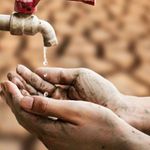
Dar es Salaam. As water shortages persist across parts of Dar es Salaam, a prolonged crisis has reshaped daily life in the city, giving rise to a fast-growing informal water trade while simultaneously deepening financial strain for thousands of households.

For several weeks, intermittent supply and dry taps have forced residents to seek alternative sources, turning water into a valuable commodity and pushing some people to abandon or supplement their regular livelihoods in search of income.
However, the government says measures are underway to stabilise supply and restore normal services.

Water minister Jumaa Aweso recently held a working meeting with the management of the Dar es Salaam Water and Sewerage Authority (Dawasa), directing them to ensure that during the current transition period, water rationing schedules reach all affected areas and that supply, where available, runs throughout the day.

Mr Aweso acknowledged that the shortage has been worsened by prolonged dry weather and delayed rains, which have significantly reduced water production at key treatment plants.

“Due to drought and delayed rains, our systems are not producing at full capacity,” the minister said, noting that Dawasa’s infrastructure is designed to produce about 508 million litres of water per day, but current output has dropped to around 320 million litres, leaving a deficit of nearly 200 million litres.

Mr Aweso said the situation has necessitated rationing to ensure the limited supply is shared more fairly across the city.

“This is a temporary challenge. We are in a transition period, and I want to assure residents that we will overcome it,” he added and urged calm as corrective measures continue.

The minister said the government has increased investment in the water sector and is implementing large-scale projects to strengthen long-term water security, including linking major urban centres to reliable sources such as Lake Victoria, the Rufiji River and the Pangani Basin.

“These are not promises. These projects are ongoing, and some have already been completed and are already supporting supply.”

Mr Aweso also directed Dawasa to implement clear zoning and transparent water distribution schedules, warning that vague rationing plans worsen uncertainty and public frustration.

“Water must be shared fairly. Schedules must be clear, and people must know when to expect supply,” he said.

Even as authorities work to restore services, the shortage has continued to alter livelihoods across the city.

In a city often described as one of opportunity, residents are adapting quickly, though for many, the crisis has also made daily life increasingly difficult.

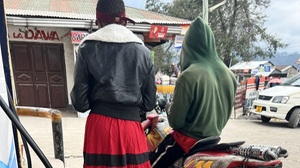
Motorcycle taxi riders, popularly known as bodaboda, are among those who have shifted gears. Instead of transporting passengers, many now ferry 20-litre plastic containers of water to residential homes, charging Sh1,000 per container.

“I used to struggle to make even Sh25,000 a day carrying passengers. With water, if I deliver fifty 20-litre in a day, that is Sh50,000. It is heavy work, but the money is better and guaranteed,” said Mr Hassan Juma, a bodaboda rider in Buguruni.

He added that demand peaks in the mornings and evenings, when households need water for cooking and bathing.

In densely populated neighbourhoods, women who previously worked as cleaners or food attendants at roadside eateries, popularly known as mama ntilie stalls, have also turned to water vending, carrying containers on their heads.

Ms Neema Ally, who worked at a food kiosk in Tandale, said the switch has significantly improved her income.

“At the food stall I was earning between Sh4,000 and Sh6,000 a day, sometimes even less. Now I buy 20 litres of water at Sh200 or Sh300 and sell it at Sh1,000. Even after the struggle, the profit is worth it, making over Sh15,000 was like a dream in my previous work” she shares.

She adds that although the work is physically demanding, it provides immediate cash compared to casual food service jobs where payment is often delayed.

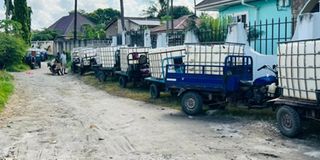
Meanwhile, operators of bajaj and small trucks, traditionally used to transport passengers, household goods and farm produce, have also joined the water business.

In some areas, neighbourhoods are pooling money to hire vehicles to deliver water in bulk.

“For one trip, a neighbourhood can pay between Sh50,000 and Sh80,000. Before, I depended on passengers. Now, water has become my main business,” said bajaj operator Kelvin Mrema from Kimara.

However, not all residents are benefiting from the emerging water trade. For many households, the shortage has become a heavy financial burden.

“Life has become very hard because we are spending more money on water than we earn. Sometimes I spend up to Sh5,000 a day on water, yet my income is not guaranteed,” said Ms Rehema Salum, a mother of three in Kigogo.

She said money previously used for food and school needs is now diverted to buying water.

“We are pleading with the government to resolve this issue urgently. Water is not a luxury, it is a basic need,” Ms Salum added.

Similarly, a casual labourer in Manzese, Mr John Mwakalebela, said the crisis has disrupted his household budget completely.

“I earn between Sh8,000 and Sh10,000 a day, but almost half of that goes to buying water. You work the whole day only to spend the money on water. It is exhausting,” he said and urged authorities to treat the situation as an emergency.

“The government should intervene quickly because ordinary people are suffering. We cannot continue living like this.”