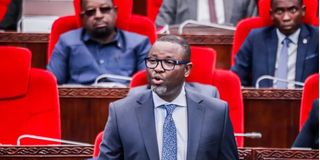
Nchimbi ceased to be Vice President on August 26 after losing CCM membership, Attorney General says

Attorney General Hamza Johari. PHOTO | COURTESY

Dar es Salaam. Attorney General Hamza Johari has said Dr Emmanuel Nchimbi ceased to be Vice President after losing his membership of Chama Cha Mapinduzi (CCM), despite his resignation having been set to take effect on September 4, 2026.

Speaking in Parliament on Friday, August 28, 2026, Mr Johari said Dr Nchimbi’s resignation would ordinarily have taken effect on September 4, in accordance with Article 149(2) of the Constitution, which allows a resignation to take effect either when the notice is received or on a later date specified in the notice.

However, he said Dr Nchimbi subsequently lost a constitutional qualification required to hold the office after he was expelled from CCM on August 26.

“Therefore, on August 26, 2026, information was received that the former Vice President had been stripped of his party membership,” Mr Johari said.

He said Article 47(4) of the Constitution sets out qualifications for a person to be appointed, contest or hold the office of Vice President, including being a Tanzanian citizen by birth and a member and candidate of a political party.

“So, once he lost his party membership, who is the Vice President? I have interpreted that one of the qualifications has been removed,” he said.

Mr Johari said the constitutional provisions should be interpreted together rather than separately, invoking what he described as the doctrine of harmonious construction.

He said Article 52, which sets out circumstances under which the office of Vice President becomes vacant, should be read together with Article 47.

According to Mr Johari, the office may become vacant through circumstances including expiry of tenure, death, the Vice President becoming President, conviction for an offence involving dishonesty, the swearing-in of a new President, removal from office, or “leaving the office of Vice-President otherwise in accordance with the provisions of this Constitution”.

He said the final provision was broad enough to cover circumstances in which a Vice President ceased to meet constitutional qualifications.

“That ‘H’ provision carries all those circumstances, all those qualifications, including if he ceases to be a Tanzanian citizen or, perhaps, if he loses his party membership,” he said.

Mr Johari rejected the interpretation that Article 47 qualifications applied only to presidential and vice-presidential candidates during elections.

He argued that the same qualifications applied to a person appointed to fill a vacancy, saying failure to apply them could result in an “absurdity”.

Mr Johari cited the appointment of the late Philip Mpango as Vice President in March 2021 as an example of Parliament approving a presidential appointment to fill a vacancy.

He said President Samia Suluhu Hassan presented Mr Mpango’s name to Parliament on March 30, 2021, before he was sworn in by the Chief Justice the following day.

He said Parliament’s approval of a Vice President appointed to fill a vacancy was intended to provide democratic legitimacy because the appointee had not been directly elected by citizens.

“In ordinary circumstances, the Vice President is elected together with the President during a general election and there is no problem because he has already received the people’s mandate through that election.

“But when the position becomes vacant and the person appointed has not been directly elected by the people, the Constitution requires approval by this Parliament, representing all the people, so that the mandate can be given by Parliament on their behalf,” he said.

Mr Johari also backed President Hassan’s nomination of Energy Minister Deogratius John Louis Ndejembi as Vice President, describing him as capable, disciplined and compassionate.

He said there was no constitutional obstacle to Parliament approving Mr Ndejembi before he was sworn in.

“In short, the resignation notice could have caused the office of Vice President to become vacant from September 4, 2026. But before that date arrived, the issue of losing party membership occurred, and this resulted in the loss of the qualification to hold the office under Article 47 of the Constitution, when read together with Article 52, which provides for other circumstances under which the office becomes vacant,” he said.

Mr Johari added: “There is no constitutional challenge, and as the Government, we will continue to ensure that we adhere to the Constitution in the various decisions that we make.”

He subsequently supported the motion for Parliament to approve Mr Ndejembi as the new Vice President.