NHIF unveils supplementary packages for January UHI rollout

What you need to know:

  • At the core is the standard benefits package, developed by the Ministry of Health, which covers 372 essential health services.

Dar es Salaam. As Tanzania approaches the nationwide rollout of Universal Health Insurance (UHI) in January 2026, the National Health Insurance Fund (NHIF) has unveiled a tiered benefits structure designed to ensure equitable access while addressing varying needs and income levels.

At the core is the standard benefits package, developed by the Ministry of Health, which covers 372 essential health services.

The package targets low-income earners, informal sector workers, and vulnerable households, providing broad coverage for primary and preventive care, outpatient and inpatient treatment, maternity services, and management of common illnesses.

For contributors, it is priced at an affordable Sh150,000 per year.

To enhance inclusivity, the government is finalising the identification and registration of the most vulnerable families using national databases and community mapping, enabling full premium subsidies and issuance of dedicated insurance cards.

For citizens seeking cover beyond the standard package, the NHIF offers optional higher-tier supplementary packages, allowing access to wider provider networks, specialised treatments, and enhanced services.

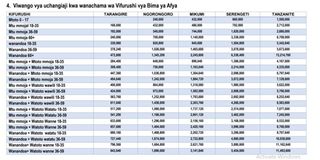
Named after Tanzania’s iconic national parks and natural attractions, the tiers include Tarangire, Mikumi, Ngorongoro, Serengeti, and Tanzanite, each offering progressively broader benefits and higher contribution levels to match individual preferences and financial capacity.

These supplementary packages complement the mandatory minimum cover, expanding choice while advancing the goal of universal health protection.

For young people aged between 18 and 35, the entry-level Tarangire package is the most accessible option, costing Sh168,000 annually.

Those seeking mid-tier cover in the same age bracket may opt for the Ngorongoro package at Sh432,000 or the Mikumi package at Sh480,000 per year.

For comprehensive cover, the Serengeti package is priced at Sh792,000, while the top-tier Tanzanite option costs Sh2,712,000 for an individual young adult.

Family premiums rise considerably depending on the number of dependents and the selected level of care.

A young couple with four children, for example, would pay Sh796,560 per year under the basic Tarangire package.

The same family of six would pay Sh1,684,800 for Ngorongoro, Sh2,621,760 for Mikumi, and Sh3,880,800 for Serengeti, while the premium Tanzanite package would cost Sh11,162,640 annually.

Prices increase slightly for older age groups; for instance, a single person aged over 60 would pay Sh240,000 for the Tarangire package, while the premium Tanzanite option would cost Sh6,708,000.

Beyond pricing, the NHIF has outlined several key conditions that citizens must meet to qualify for and maintain coverage.

Registration is now strictly tied to legal identification, requiring every principal member to have a National Identification Number (Nida).

To register a spouse, members must present a marriage certificate and the spouse’s Nida number, while children must have RITA-verified birth certificates and digital photographs.

The fund recognises one spouse, and up to four children, biological, adopted, or stepchildren, under the age of 21, as dependants, and anyone under 18 must have a guarantor.

Members must also observe the “30-day rules” to keep their cover active.

A mandatory 30-day waiting period applies after registration and payment before accessing services.

In addition, expired memberships must be renewed within 30 days; failure to do so results in the applicant being treated as a new member under fresh conditions.

All new members must complete a Health Assessment Form and register digitally via the NHIF Self-Service portal, where a control number is issued for a single lump-sum payment.

For details on the standard package or to compare higher-tier benefits, citizens are advised to visit the official NHIF Self-Service portal.