Researchers identify Africa’s tallest tree on Mt Kilimanjaro
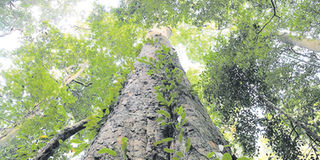
Africa's tallest tree reaches far above the canopy. PHOTO|AGENCY
What you need to know:
The giant specimen is a Entandrophragma excelsum, a rare species that is typically found in upland semi-deciduous forest, and it might be over 600 years old. Researchers first noted the mammoth size of some of the valley’s trees during an expedition 20 years ago, but the location’s remoteness kept the true height of its vegetation a secret until researchers recently found their way back there.
Moshi. Researchers exploring a remote valley on Mount Kilimanjaro, Africa’s highest mountain, have discovered a towering tree that reaches over 260 feet into the sky. That’s enough to make it the new record holder for the tallest tree on the entire continent of Africa, reports New Scientist.
The giant specimen is a Entandrophragma excelsum, a rare species that is typically found in upland semi-deciduous forest, and it might be over 600 years old. Researchers first noted the mammoth size of some of the valley’s trees during an expedition 20 years ago, but the location’s remoteness kept the true height of its vegetation a secret until researchers recently found their way back there.
In all, 32 specimens were measured with laser instruments, with the 10 tallest each registering over 190 feet. The record-breaking tree is still significantly shorter than the world’s tallest tree-- a coastal redwood in Northern California that measures in at over 379 feet-- but it’s still impressive considering its location. Africa is not a continent typically known for its towering trees.
The trees in this valley are nurtured by rich volcanic soils, high temperatures and higher-than-normal levels of precipitation, which undoubtedly helps them to reach such great heights. “They are like a city in the forest,” described Andreas Hemp, one of the team’s researchers.
Their isolated location also helps them to grow for another reason: they are relatively safe from logging efforts that have decimated forest habitat elsewhere. The grove of trees lies outside the borders of Kilimanjaro National Park, which means they’re still vulnerable. But their discovery could lead to a park expansion that encompasses the grove and keeps the trees safe.
The colossus has matched Africa’s previous tree-height record established by a specimen of the introduced Sydney blue gum (Eucalyptus saligna) in Limpopo, South Africa, which died in 2006.
Hemp who is a researcher at the University of Bayreuth in Germany first spotted a bunch of tall Entandrophragma excelsum trees while exploring Mount Kilimanjaro’s vegetation 20 years ago. But it was not until recently that he and his team were able to measure their heights accurately using new tools.
They sized 32 specimens with laser instruments between 2012 and 2016, finding that the 10 tallest individuals ranged from 59.2 to 81.5 metres in height and 0.98 to 2.55 metres in diameter. Hemp estimates from growth rates that the arboreal behemoths are between 500 and 600 years old. The world’s tallest trees are not normally found in Africa: for example, a 116-metre-tall sequoia tree grows in North America, and a 100-metre-tall eucalyptus in Australia.
This is probably a result of both a shortage of studies in Africa, so many trees are overlooked, and the fact that many of the continent’s tree species grow in places where limited resources prevent them from getting too tall.
Supporting life
The massive trees play an important role in the mountain’s buzzing ecosystem, harbouring ferns and multiple other plants that grow on them for physical support. “They are like a city in the forest,” says Hemp. But the green giants face the threat of illegal logging, which has plagued their precious habitat. The team therefore suggests that the valleys harbouring the giants be included in the neighbouring Kilimanjaro National Park for protection.
David Seaborg at the World Rainforest Fund in Walnut Creek, California, supports this view. He points out that protecting the trees could also allow us to preserve the abundance of plants, birds and insects that benefit from their presence. (www.newscientist.com)