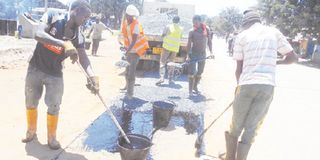
Maintenance of a Nansio-District stretch of road in Ukerewe, Mwanza Region, in progress in April this year. Women are rarely employed by road construction companies on the pretext that they may not be ideal for strenuous work. PHOTO | FILE
What you need to know:
Gender issues associated with mobility and transport of rural populations are well known, yet are hardly prioritised in transport planning and investment, according to a report by HelpAge
Dar es Salaam. Gender activists have urged the government to put in place a legal framework that will promote the participation of women in road construction projects.
This framework should oblige construction companies and contractors to employ an equal or a reasonable number of women to increase their involvement.
This was said during a presentation of a report by a non-governmental organisation, HelpAge, as a recommendation to the government. The report was about the impact and implication of gender mainstreaming in rural transport in Tanzania based on Kilolo and Kibaha districts.
It indicates that gender issues associated with mobility and transport of rural populations are well known, but are hardly prioritised in transport planning and investment. When gender issues are discussed they also tend to focus on women of reproductive and productive age and fail to recognise that women experience gender discrimination at all stages of their lives.
It states gender mainstreaming should have a transformative impact on women of all ages and on those facing intersecting inequalities due to age, gender, disability and widowhood, who also face multiple barriers to realising their rights and consequently experience abject poverty.
The report shows that despite efforts to ensure gender equality in a rural travel and transport programme (RTTP) and a local government transport programme (LGTV), women lack voice and participation in consultation and implementation of road projects mainly due to misconceptions that women are not as capable as men are in service delivery. It was also says that their participation through direct employment in road construction is limited.
Most residents in both districts, where the study was conducted, explained that in road construction, supervisors do not involve women, saying there are jobs of uprooting tree stumps, assembling pipes and digging ditches among many other and women may not be ideal for those jobs.
Contractors are required to report quarterly on how many women have been involved in their projects and expenditure on women and HIV/Aids-related activities. As regards procurement, the emphasis is on quality and experience.
According to the National Transport Policy, 2011, the main objective is to mainstream gender in transport infrastructure, services and operations. The policy recognises the importance of gender mainstreaming in transport and infrastructural projects.
For instance, one of its policy statements emphasises a need to ensure gender policies are mainstreamed in the development of transport infrastructure and the provision of services to enable women to have equal access to economic opportunities and guarantee their social inclusion.
However, further analysis indicates that the policy does not provide adequate strategies and instruments to ensure gender balance is achieved in the transport sub-sector and hence gender mainstreaming.
The report considers this a failure since guidelines have not been adequate to embed gender mainstreaming, including their enforcement in infrastructural development. The gap is evidenced by the fact that there is only 25 per cent of women holding leadership positions in the sector.
On the other hand, the National Construction Policy, 2002 targets involving women in road works, setting a target of at least 25 per cent of women benefitting from road works and related infrastructural development activities.
The target, however, is not supported by law. For instance, during road construction, contractors are not obliged to recruit women. Therefore, in most cases contractors employ more men than women. The situation is even worse for women with multi-dimensional vulnerabilities. This issue has been confirmed by the findings of this research.
Tthe National Roads Agency Strategic Plans 2000/13 and 2014/18 as well tends to ensure gender mainstreaming is included in key crosscutting issues. The National Roads Agency develops these two strategic plans.
Although gender is highlighted as one of the key crosscutting issues, strategies do not provide systematic approaches to guide the mainstreaming of gender and do not offer indicators by how these will be measured and enforced.
Additionally, the report also notes that there are no deliberate efforts to sensitise contractors and consultants to involve women and to hold them accountable for their actions. Therefore, women’s involvement in road works is not happening by design.
There have been other initiatives addressing gender gaps in infrastructure and road construction projects, including in 2011, the Ministry of Works Transport and Communications in collaboration with the African Development Fund, developed the road sector support project II.
The project incorporated the need for stakeholders and community sensitisation to appreciate the need for gender mainstreaming. The initiative is good, but since it was a project based, it was not sustainable.
The President’s Office (Regional Administration and Local Government) through the Department of Infrastructural Development developed the Local Government Transport Programme 2007/12 and 2013/18, which is ongoing. Both programme mentions gender as one of the cross-cutting issues aiming at ensuring that women’s voices are heard and participate in decision-making processes.
Ms Josephine Mwankusye, a gender issues advisor said: “Most contractors don’t employ women engineers because they believe that they have family chores such as bearing children, taking care of their husbands and look at this as a hindrance to the success of their projects.”
She added that there was a great need to train more women engineers and appoint them in decision-making positions in the road and transport sector to champion gender mainstreaming, recognise the voices of women facing multiple levels of exclusion and sensitisation of contractors, community and local leaders.
For his part, lead researcher Godfrey Mulongo said in areas, where there was new or improved roads in Kilolo and Kibaha, women said benefits were seen through improved access to health care, income from marketing of farm produce, improved travel safety, improved education to girls and more for domestic chores as well as multi-tasking in different projects.
In some areas, improved roads have helped reduce road accidents.
For those sing wheelchairs, road improvement has greatly improved their ability to travel.