Samia orders special fund for ex-inmates to curb repeat offences
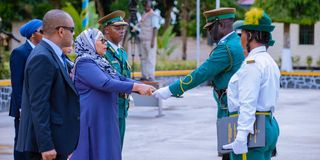
President Samia Suluhu Hassan hands over certificates to graduands during the graduation ceremony at the Tanzania Correctional Training Academy on Saturday, May 9, 2026. PHOTO | JOSEPHINE CHRISTOPHER
Josephine Christopher is a senior business journalist for The Citizen and Mwananchi newspapers
Mwananchi Communications Limitted
Dar es Salaam. President Samia Suluhu Hassan has directed the establishment of a special fund to provide startup capital for former inmates who acquire vocational skills while serving prison sentences, saying the move is essential in reducing repeat offences and helping ex-prisoners rebuild their lives.
Speaking during the graduation ceremony for High-Level Leadership Course No. 28 and Second-Class Leadership Course No. 48 at the Tanzania Correctional Training Academy on Saturday, May 9, 2026, President Hassan said many inmates leave prison with practical skills but fail to reintegrate into society due to lack of financial support to start businesses or income-generating activities.
“Let a special fund start now for those prisoners who graduate with good skills to begin receiving support to start work so that they do not return to prison,” she said.
She noted that the prison service has made significant progress in equipping inmates with vocational skills, including tailoring, shoemaking, carpentry, beekeeping and dairy farming, but stressed that lack of startup capital remains a major challenge after release.
“They have the skills. The challenge is startup capital. A place to begin. Capital is the problem,” she said.
President Hassan said some former inmates deliberately return to criminal activities because they see no economic opportunities outside prison.
She recounted a conversation with an inmate who told her that some released prisoners intentionally commit crimes in order to return to prison, where they are guaranteed food and shelter.
She directed the Commissioner General of Prisons and relevant authorities to conduct research into the causes of recidivism and develop long-term solutions.
She also instructed the responsible ministry to begin considering a policy framework that would support contributions towards rehabilitation and reintegration programmes for prison graduates.
In addition, President Hassan called for the integration of Information and Communication Technology (ICT) systems to monitor former inmates after release, assess how they are utilising acquired skills and connect them with economic opportunities through local government authorities, the Vocational Education and Training Authority (Veta) and the Small Industries Development Organisation (Sido).
She said the government’s reforms in the prison sector are aimed at transforming correctional facilities from centres of custody into institutions focused on rehabilitation and behavioural change.
She noted that inmates are now able to obtain recognised certifications through partnerships with Veta and the Arusha Accountancy College.
Furthermore, President Hassan also expressed concern over the welfare of vulnerable groups in prisons, particularly young female inmates and juvenile offenders.
“As a parent, I am concerned when I see very young girls in prison,” she said, urging prison authorities to ensure female prisoners’ dignity and biological needs are respected.
She further directed that juvenile offenders should be separated from adult inmates to protect their welfare and support rehabilitation efforts.
On modernisation, the President stressed the importance of technology in improving prison operations, describing ICT adoption as “unavoidable."
She praised the use of virtual court sessions, saying the system has helped reduce transportation costs and improve security.
She also commended the prison service for adopting clean cooking energy, saying the initiative protects the environment and safeguards the health of officers and inmates.
On economic sustainability, President Hassan said the prison service has already saved the government more than Sh21 billion through its production activities.
She directed prison authorities to utilise the institution’s vast land resources more efficiently through partnerships with the private sector to achieve full food self-sufficiency.
Earlier, the Commandant of the Tanzania Correctional Training Academy, Senior Commissioner of Prisons Willington Kahumuza, said the academy was established in 1959 during the colonial era as the Ukonga Prisons Officers College.
He said after Tanganyika attained independence in 1961, the institution shifted from military-style prison training to a rehabilitation-focused approach centred on behavioural change.
According to him, the training programme, which started on December 27, 2025, produced 657 graduates, including officers from Zanzibar.
He said the programme combined classroom instruction with field tactical training, with facilitators drawn from within and outside the prison service to prepare officers for modern correctional operations and technological advancement.