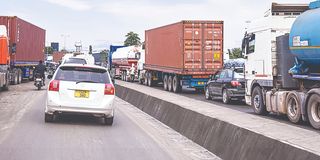
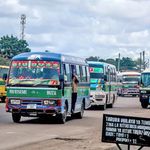
Dar es Salaam. Traffic congestion in Dar es Salaam is costing the city’s economy up to Sh7.2 billion daily in lost production time as commuters sit stranded on gridlocked roads.
Annually, this economic drain could exceed Sh2 trillion if the daily figure is projected across 300 working days.
This cost does not represent direct government expenditure or commuter out-of-pocket expenses, but rather the economic value of time and productivity lost to traffic jams.
The estimates were revealed in a joint study by Tanzania Investment and Consultant Group Ltd (TICGL) and the Tanzania Economic Research Institute (Teri), published in 2025 using data gathered between 2023 and 2025.
How productivity is lost
The report highlights the scale of the crisis by examining commuting durations, noting that workers across various parts of Dar es Salaam lose between 2.48 and five hours daily in gridlock.
Citing a worker residing in Tegeta and working in the central business district (CBD), the study notes that an off-peak journey of 45 to 50 minutes stretches to between 120 and 135 minutes during peak hours.
For a round trip, commuters travelling from suburban areas spend between 3.5 and five hours daily in transit.
“This is not just time lost for an individual. If a worker spends hours on the road, time that could have been spent working, serving clients, operating a business, resting, or with family, productivity drops significantly,” the report states.
Impact on earnings
The study linked lost time to hourly labour value, using the benchmark of a worker earning an average monthly salary of Sh494,812, equivalent to roughly Sh2,378 per working hour.
Losing 2.5 hours per day equates to an estimated daily productivity loss of Sh5,945. Over 26 working days in a month, this totals roughly Sh154,570, translating to approximately Sh1.85 million annually per worker.
However, this figure reflects lost productive time value rather than direct monetary deductions from salaries.
For small-scale traders, transit delays delay market openings and alienate early customers, whilst transport operators complete fewer daily trips, depressing revenues.
“Workers, traders, service providers, small business owners, and logistics firms are all adversely affected. For transport companies, the impact is severe because vehicles spending longer on the road execute fewer trips while fuel consumption rises,” the study highlights.
Economic implications
Commenting on the findings, economist Prof Aurelia Kamuzora stated that time wasted in traffic carries a heavy economic price tag by shrinking productive work hours and reducing incomes.
She noted that whilst these losses begin at the individual level, aggregating them across thousands of delayed workers yields massive losses to the national economy.
“We are losing income. Income is evaluated individually before being aggregated to present the macroeconomic picture. When individuals fail to arrive on time, collective losses occur,” she said.
Prof Kamuzora noted that traffic congestion is not unique to Tanzania, stressing the need to adopt proven global solutions.
She recommended constructing ring roads to allow vehicles to bypass the city centre entirely.
“Dar es Salaam requires a ring road to intercept upcountry traffic and divert it elsewhere. Port-bound cargo traffic should have dedicated bypasses to relieve urban bottlenecks,” she said.
She further urged expanding road capacity, including constructing six-lane highways along major transport corridors connecting commercial hubs.
She emphasised prioritising infrastructure connecting the port to upcountry routes toward Tunduma, Kagera, and Kenya via Moshi to bypass Dar es Salaam’s central bottlenecks.
Government interventions
The findings coincide with a government competition aimed at sourcing innovative solutions to Dar es Salaam’s gridlock, won by University of Dar es Salaam student Tukay Thomas.
Presenting the award, Works Minister Abdallah Ulega noted that the government engaged youth not for lack of experts, but out of belief in their vital role in national development.
“We need their creativity and energy to drive Tanzania’s development,” he said.
Root causes
Dar es Salaam suffers severe congestion due to rapid urban expansion, a surging vehicle population, and concentrated economic zones.
Compounding the problem, an estimated 70 percent of all vehicles registered in Tanzania operate within Dar es Salaam, placing immense strain on existing road infrastructure.
BRT limitations
The report notes that whilst Dar es Salaam features major transport arteries, the Bus Rapid Transit (BRT) network has yet to attain required operational coverage.
Researchers concluded that expanding high-capacity public transport networks alongside road infrastructure upgrades and integrated land-use planning remains critical to mitigating economic losses.
Register to begin your journey to our premium contentSubscribe for full access to premium content