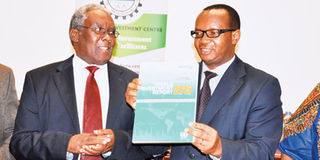
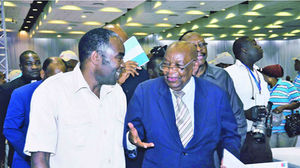
Tanzania Investment Centre board chairman Lucian Msambichaka (left) and Prime Minister’s Office permanent secretary Florence Turuka unveil the World Investment Report 2015 in Dar es Salaam yesterday. PHOTO| VENANCE NESTORY
What you need to know:
Natural gas discoveries account for the largest chunk of the FDI, according to the 2015 World Investment Report, which was launched in Dar es Salaam yesterday.
Dar es Salaam. Growth of 0.5 per cent in inflows helped Tanzania maintain its position as the leading destination for Foreign Direct Investment (FDI) in East Africa last year. And East Africa’s second largest economy appears set for even better times, a new report shows.
Natural gas discoveries account for the largest chunk of the FDI, according to the 2015 World Investment Report, which was launched in Dar es Salaam yesterday.
Through the ministry of Energy and Minerals, the government signed a loan agreement in 2012 on financing the construction of the gas pipeline from Mtwara to Dar es Salaam at a cost of $1.225bn. The 24-30 inch pipeline is largely complete, raising hope that the country will now produce enough electricity to meet the growing demand of industries.
The country is, moreover, attracting massive investment in form of natural gas exploration, with latest data indicating that at least 55 trillion cubic feet have been found by various multi-nationals. Some FDI will go to electricity generation, mining and quarrying as well as manufacturing and services.
Given this background, Tanzania out-performed its regional peers to attract FDI totalling $2.142 billion in 2014, up from $2.131 billion in 2013. It also settled comfortably as one of the top five FDI recipients among the Least Developed Countries.
This amount is significantly higher than the very low level of $640 million that was registered between 2005 and 2007, just before the 2008 global economic crisis, according to Dr Florens Turuka, the Permanent Secretary in the Prime Minister’s Office.
Uganda, which has economically viable oil reserves, registered $1.147 billion in FDI last year while Kenya, which is the largest economy in East Africa, received $989 million in FDI.
Rwanda and Burundi came fourth and fifth respectively, with FDIs to the tune of $268 million and $32 million respectively.
Within the Least Developed Countries group, Tanzania came third behind Mozambique, which received FDIs to the tune of $4.9 billion. Mozambique, which shares a border with Tanzania, has also received a great deal of investments in the natural gas sector. The latest data shows that the country has found at least 200 trillion cubic feet of natural gas.
Famed for copper deposits, Tanzania’s other neighbour Zambia registered FDI worth $2.5 billion while the mineral-rich Democratic Republic of Congo and Equatorial Guinea received $2.1 billion and $1.9 billion in FDI last year, the report notes.
South Africa was the Africa’s largest recipient of FDI in 2014, with inward FDI stock of $145.384 billion. Globally, China came first. The Special Administrative Region of the People’s Republic of China, Hong Kong, was in the second slot while the United States of America came third.
As a group, developing economies attracted $681 billion worth of FDI with a two per cent rise. They currently account for 55 per cent of global inflows. The report further mentioned that half the top 10 FDI recipients are developing economies--Brazil, Hong Kong (China), India and Singapore.
“In this light, strengthening the global investment policy environment, including both the International Investment Agreements and the international tax regimes, must be a priority,” said the minister.
According to the Tanzania Investment Centre’s board chairman, Prof Lucian Msambichaka, Tanzania will do even better with the guidance it receives from the United Nations Conference on Trade and Development (UNCTAD).
“I am confident that the United Nations in Tanzania, and UNCTAD and the United Nations Development Programme in Tanzania in particular, will continue to support the Tanzanian government more broadly with both strategic policy advice and more practical guidance based on global good practices as the country seeks to implement the New Economic Model and achieve Vision 2020,” he said.
But more work needs to be done to attract investment in other sectors that have greater chances of creating jobs, such as manufacturing and agriculture. “We have a lot to learn from Ethiopia and Mozambique,” he said. “Ethiopia FDI’s has surged on the strength of its improved performance in textile manufacturing. Mozambique has done well in gas and has been a star performer in attracting FDI in the SADC region.”