Tanzania’s Greater Udzungwa rescue plan seeks major funding boost
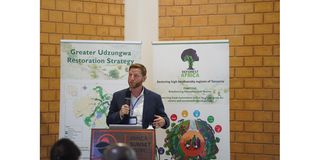
Reforest Africa chief executive officer Dr Robin Loveridge presenting the Greater Udzungwa Landscape Restoration Strategy before stakeholders in Iringa.
Iringa. Environmental stakeholders have been urged to strengthen partnerships and mobilise financing to support the implementation of the Greater Udzungwa Landscape Restoration Strategy, a long-term initiative aimed at halting forest loss, restoring threatened tree species and increasing sustainably managed carbon stocks.
The call was made during the Greater Udzungwa Landscape Restoration Finance Workshop held in Iringa on May 7 and 8, 2026.
The workshop was organised by Reforest Africa in collaboration with Commonland Foundation and Sustain.
The strategy seeks to restore biodiversity, ecosystems and livelihoods across the Greater Udzungwa Landscape by 2050, while reversing forest degradation in support of nature recovery.
Participants included representatives from the forestry and agriculture sectors, government institutions, non-governmental organisations, carbon trading firms, investors, donors and the banking industry. Discussions centred on financing opportunities for landscape restoration.
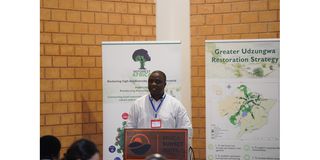
The Ministry of Natural Resources and Tourism representative, Dr Elikana John speaking during the launch of the Greater Udzungwa Landscape Restoration Strategy in Iringa on May 7, 2026.
Reforest Africa chief executive officer Dr Robin Loveridge said the strategy adopts a holistic approach, with sector-specific targets designed to strengthen collaboration between the public and private sectors.
He said the initiative aims to restore 40,000 hectares of land, increase carbon stocks by 10 million tonnes of carbon dioxide equivalent, and regenerate productive land to improve livelihoods for 120,000 people.
“The Greater Udzungwa Restoration Strategy is both a celebration of the landscape and a call to action. It represents the combined efforts of 32 organisations, including government institutions, NGOs, community-based organisations and commercial companies, over the last four years to develop a shared vision for collaborative restoration efforts,” he said.
A representative of the Ministry of Natural Resources and Tourism, Dr Elikana John, said the Greater Udzungwa Landscape remains one of Tanzania’s most important conservation areas and a globally significant ecological system.
According to the Greater Udzungwa Restoration Strategy 2026–2050, the landscape spans about 53,000 square kilometres and hosts unique biodiversity found nowhere else in the world, including endemic primates, forests, wetlands, rivers and wildlife corridors.
Dr Elikana said the landscape supports the livelihoods of more than 2.2 million Tanzanians through agriculture, forestry, livestock keeping, tourism and other economic activities.
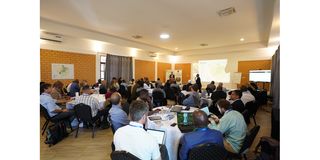
Different stakeholders participating the Greater Udzungwa Landscape Restoration Finance Workshop held in Iringa on May 7 and 8, 2026.
He added that the area also plays a key role in national water security and energy production by supplying nearly 70 percent of the water flowing into the Julius Nyerere Hydropower Project through the Kilombero River system.
He noted that Tanzania has already established regulations governing carbon trading and nature-based financing, creating opportunities for investments in restoration projects, carbon markets and community-based conservation.
“What is now required is stronger collaboration among public institutions, local communities, civil society organisations, development partners, researchers, financial institutions and private investors,” he said.
Dr Elikana further noted that many restoration initiatives across Africa have struggled due to inadequate long-term financing, despite the availability of viable ideas and strategies.
Meanwhile, the acting Tanzania Forest Services (TFS) manager for Kilolo District, Mr Pessa Ngenda, said the agency has been working closely with Reforest Africa to restore forests affected by human activities.
“They are doing commendable work in restoring the landscape. However, this task requires significant financial resources to expand restoration efforts to wider areas. We therefore call upon more stakeholders to join these efforts for a sustainable future,” he said.