Tanzania, Türkiye seal tax pact to boost investment
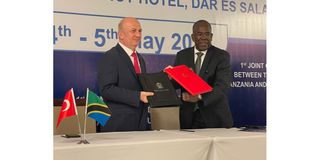
Minister for Finance Mr Khamis Mussa Omar (right) and Türkiye’s Ambassador to Tanzania, Mr Bekir Gezer, display a signed Double Taxation Agreement (DTA). PHOTO | COURTESY
Dar es Salaam. Tanzania and Türkiye have signed a double taxation agreement (DTA), a move expected to strengthen trade ties and attract more investment between the two countries.
The agreement on the avoidance of double taxation and prevention of fiscal evasion on income tax becomes Tanzania’s 13th such pact. It is designed to ensure that the same income is not taxed in both jurisdictions, a step widely seen as key to boosting investor confidence.
Minister for Finance, Mr Khamis Mussa Omar, said DTAs—when combined with bilateral investment treaties (BITs)—go beyond technical arrangements and serve as important tools for driving trade and economic growth.
“Data from the Organisation for Economic Co-operation and Development shows that countries with effective DTAs can attract up to 30 per cent more foreign direct investment,” he said.
According to him, although the two countries signed a BIT in 2011, the absence of a DTA had long been viewed as a missing link in their economic cooperation. The new agreement is therefore expected to send a strong signal to Turkish investors that Tanzania is open for business.
Relations between the two countries have deepened in recent years, gaining further momentum following President Samia Suluhu Hassan’s state visit to Türkiye in April 2024.
Trade between the two nations reached about $281.68 million in 2024, although the balance remains heavily tilted in Türkiye’s favour. Turkish exports to Tanzania stood at roughly $251 million, while Tanzania exported goods worth about $30.68 million.
Mr Omar said investment levels still fall short of potential. Tanzania currently hosts just over 30 Turkish investment projects valued at around $300 million—about three per cent of total foreign investments—mainly in construction, transport and logistics, trade and finance.
He noted that the scale of investment does not reflect the full potential of the partnership.
The minister also raised concerns over the slow pace of negotiating such agreements, noting that the newly signed DTA took more than eight years to conclude.
“There are agreements being discussed today that take eight years in negotiations, 10 years, and some even more than 15 years, while our presidents serve five-year terms for one mandate or 10 years for two terms,” he said.
“Yet by the time they leave office, we have not even concluded negotiations on a single agreement,” he added.
Türkiye’s Ambassador to Tanzania, Mr Bekir Gezer, welcomed the agreement, saying it reflects the growing relationship between the two countries, while acknowledging that more progress is needed.
“Our motto is clear: to engage together in fair and mutually beneficial cooperation if we are to achieve greater goals,” he said.