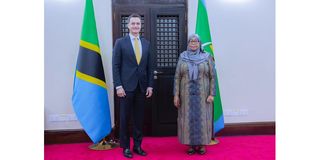
Dar es Salaam. Tanzania and the United States edged closer to finalising three landmark investment deals, following talks between President Samia Suluhu Hassan and Acting U.S. Ambassador to Tanzania Andrew Lentz at Chamwino State House.
State House described the discussions as a “defining step” in reshaping bilateral economic cooperation, with the two sides moving toward closure of negotiations on the $42 billion Liquefied Natural Gas (LNG) project, the $942 million Tembo Nickel investment, and the $300 million Mahenge Graphite development.
Ambassador Lentz, who was accompanied by senior U.S. political and economic officials, reaffirmed Washington’s commitment to a modern partnership anchored in private-sector growth rather than aid dependency.
“The United States is committed to a relationship based not on aid dependency but on shared prosperity,” he said.
According to the State House communiqué, talks on the LNG and Tembo Nickel projects have reached their last procedural milestones, with the parties now awaiting formal signing.
While Mahenge Graphite remains under technical and regulatory review, both governments confirmed that progress is steady and on schedule.
President Samia underscored Tanzania’s readiness to conclude outstanding processes and unlock investment flows that will directly stimulate growth.
“As a non-aligned country, Tanzania is open, ready and committed to working with all partners who respect our sovereignty and share our vision for prosperity,” she said.
She added that the strategic projects are vital for job creation, industrialisation and long-term fiscal stability.
Ambassador Lentz noted that Washington is keen to reinforce its political and economic engagement with Tanzania, praising President Samia’s reform agenda under Vision 2050 and the 4R philosophy — Reconciliation, Resilience, Reforms and Rebuilding.
Both delegations agreed on the need for streamlined communication and clear timelines to accelerate implementation.
President Samia highlighted the growing presence of American companies in Tanzania. More than 400 U.S. firms currently operate across energy, logistics, agriculture, finance and technology.
State House said their footprint reflects renewed investor confidence, policy predictability and Tanzania’s strengthening macroeconomic outlook.
The LNG development is among Africa’s largest energy proposals, expected to transform Tanzania into a major LNG exporter and boost fiscal revenues.
Meanwhile, nickel and graphite — critical to electric-vehicle and battery manufacturing — position Tanzania as a rising global supplier of clean-energy minerals.
The two sides also discussed security cooperation, health partnerships, academic ties and regional diplomacy. Lentz conveyed Washington’s support for Tanzania’s role in maritime security, counter-terrorism and East African economic integration.
State House said the meeting reflects a pivot toward transparent, market-based and mutually beneficial cooperation, aligning with global trends in strategic minerals and energy transition financing.
Analysts say that if concluded, the three agreements will shape the future of Tanzania–U.S. economic relations and cement the country’s position as a key player in Africa’s minerals and energy landscape.