Tanzanian girls take STEM innovations to African stage
Female students showcase their STEM innovations during a competition in Dar es Salaam. The projects displayed included solutions designed to address community challenges, highlighting the growing participation of girls in science and technology. PHOTO | COURTESY
Dar es Salaam. A rescue robot designed to access disaster zones beyond the reach of emergency workers, a low-cost cooling fan for low-income households and an excavator prototype have propelled three Tanzanian secondary schools onto the continental stage after their creators won a national Science, Technology, Engineering and Mathematics (STEM) innovation competition.
The projects, developed by female students from Kibasila, Jangwani and Charambe secondary schools, secured Tanzania a place in the African STEM competition organised by the World Association of Girl Guides and Girl Scouts (WAGGGS) through the Youth Exchange South to South (YESS) programme. The students will now compete against young innovators from across the continent.
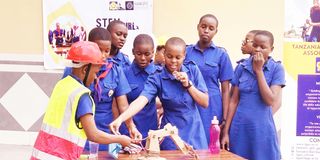
The winners emerged after a months-long programme coordinated by the Tanzania Girl Guides Association (TGGA), which brought together students from 10 primary and secondary schools in Ilala and Temeke municipalities.
TGGA programme officer Valentina Gonza said the competition was designed to demonstrate that girls can develop practical technologies capable of improving lives when given the right opportunities.
“We wanted the girls to move beyond classroom learning and identify problems within their communities before designing practical solutions. What we have seen today proves that they are capable of innovating when they receive the necessary support,” she said.
Ms Gonza said the three schools would represent Tanzania at the African competition.
Although both primary and secondary schools participated, she said the judges found that the secondary school students presented more mature and technically advanced projects.
“We had hoped to see winners from both education levels, but the secondary school teams demonstrated stronger innovation and better application of the skills they acquired during the training,” she said.
Youth Exchange South to South (YESS) Girls’ Movement volunteer Iris Irakoze said the programme had played an important role in building girls’ confidence in science and technology.
“Initiatives like this give girls the confidence to explore their ideas without fear. We want them to realise that they can become scientists, engineers and innovators who contribute to solving problems in their communities,” she said.
She added that the programme was helping girls overcome fear and believe in their abilities.
“We want to see these young girls reach another level. We want to see them doing things that many people never imagined they could do,” she said.
Another volunteer from Uganda, Agik Rachel, encouraged the students to value their education and the people supporting them, saying the opportunities they receive today could shape their future.
“You grow up to become a young leader who can help change the world. Today, we have women leading organisations and participating in politics. Girls should know they can also reach those positions,” she said.
For the students, the competition represented more than an opportunity to win trophies. It was also a chance to challenge stereotypes that have long discouraged girls from pursuing careers in engineering, technology and other science-related fields.
Jangwani Secondary School Form Four student Princess Jasmeen said science and technology had opened up new opportunities for girls.
“Girls have many creative ideas that can contribute to technological development. Programmes like this encourage us to turn those ideas into practical solutions,” she said.
A Form Three student from Charambe Secondary School said taking part in the competition had strengthened her confidence and convinced her that gender should never determine career choices.
“It has taught us that a girl can become an engineer, a doctor or a scientist if she is determined and believes in herself. We hope more girls will join STEM because they also have the ability to innovate,” she said.
Register to begin your journey to our premium contentSubscribe for full access to premium content