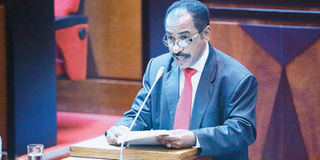
Minister for Health and Social Welfare Dr. Seif Rashid presents the estimate 2015/16 ministry budget in Parliament Dodoma. PHOTO|FILE
What you need to know:
Tanzania spent the least share of its healthcare budget on dealing with HIV in East Africa compared to Kenya, Uganda and Rwanda, according to data in a new UNAids-Lancet report released on Thursday. Although Rwanda was not in the top 10 nations most burdened by HIV, it has also invested more than Tanzania.
Dar es Salaam. Of the three East African states named this week in the top 10 countries with the highest HIV burden, Tanzania lags behind when it comes to dedicating financial resources to contain the virus. And this at a time when a lot more investment is required to control the public health threat in the wider Africa.
Tanzania spent the least share of its healthcare budget on dealing with HIV in East Africa compared to Kenya, Uganda and Rwanda, according to data in a new UNAids-Lancet report released on Thursday. Although Rwanda was not in the top 10 nations most burdened by HIV, it has also invested more than Tanzania.
While only 1.2 per cent of Tanzania’s health expenditure went to curbing the disease, neighbours Uganda and Kenya appear to have invested more, each spending 14.7 per cent of their healthcare budgets on HIV. Rwanda invested 4.2 per cent and Burundi was not included on the list.
The 10 countries named in the report as the world’s hotspots for HIV transmission have over one million people living with the condition. South Africa has the highest burden at 6.3 million. Nigeria is next with 3.2 million and India follows with 2.1 million.
Mozambique, Uganda and Kenya each have 1.6 million people living with the virus while Tanzania and Zimbabwe have 1.4 million each. Zambia has 1.1 million and Malawi has the least at one million.
About 61 per cent of the world’s 35 million cases of HIV are to be found in these countries. The same countries have the largest number of annual new infections, according to the report prepared by UNAids-Lancet Commission.
The sobering findings also indicate that sustaining the current HIV treatment and prevention efforts in the most affected countries would require up to two percent of a country’s GDP and at least a third of total government health expenditure over the next 15 years--and even then only for funding HIV programmes. The researchers warn of the possibility of seeing a rebound in the epidemic if urgent measures are not taken to address the funding gaps and stopping new HIV infections in the countries most affected. Published in the Lancet Journal, the new report is also critical of countries that have become complacent. Some with previously stable or declining infections appear to have reverted to risky sexual behaviour over the past five years. The Executive Director of UNAids, Mr Michael Sidibé, warns against delay in taking action on the wave of new infections, considering that the world is now headed for a new global development agenda--the Post-Millennium Development Goals likely to come into play in the next two months or so.
“We have to act now,’’ said Mr Sidibé, who also doubles as the Co-governor of the UNAids-Lancet Commission. He sees the next five years providing a fragile window of opportunity to fast-track the response and end the AIDS epidemic by 2030. “If we don’t [act now] the human and financial consequences will be catastrophic,” he warned.
His caution stems from the fact that many African countries have not kept up with the benchmarks for health spending, with most spending less than the Abuja target of 15 percent. Only Rwanda and Zambia have exceeded the target.
The latest report shows that benchmarking for health spending and the share of health budget dedicated to HIV would enable the 10 high-burden countries to finance a greater share of their total needs over the next five years if they met the proposed targets.
The lead author of the report, Prof Peter Piot of the London School of Hygiene and Tropical Medicine, is urging countries not to celebrate the little gains made over the years and instead take a forward-thinking approach to the fight against HIV.
Said Prof Piot, who is famous for discovering the Ebola virus: “We must face hard truths. If the current rate of new HIV infections continues, merely sustaining the major efforts we already have in place will not be enough to stop deaths from Aids rising within five years in many countries.”
The Minister for Health, Dr Seif Rashid and his Deputy Dr Kebwe Steven Kebwe were not available to comment.