Universities urged to align curricula with labour market needs
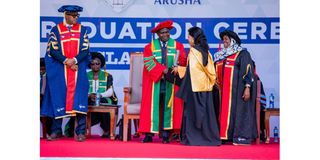
Deputy Minister for Finance, Mr Mshamu Munde, presents an award to one of the top-performing graduates during the 27th graduation ceremony of the Institute of Accountancy Arusha (IAA), where 4,821 students graduated at the certificate, diploma, advanced diploma, and degree levels. The event held on Saturday, December 20, 2025, was attended by IAA Principal, Prof Eliamani Sedoyeka (left), and IAA Board Chairperson, Dr Mwamini Tulli. PHOTO | BERTHA ISMAIL
The directive was issued on Saturday, December 20, 2025, by Deputy Minister for Finance, Mr Mshamu Munde, during the 27th graduation ceremony of the Institute of Accountancy Arusha (IAA), which saw 4,821 students graduate at certificate, diploma, advanced diploma and degree levels.
Arusha. The Government has instructed all higher learning institutions to regularly review and update their curricula to produce graduates whose skills align with labour market demands.
Universities have also been urged to strengthen modern teaching infrastructure and expand practical, hands-on training to equip students with competencies that match rapid advancements in science and technology.
The directive was issued on Saturday, December 20, 2025, by Deputy Minister for Finance, Mr Mshamu Munde, during the 27th graduation ceremony of the Institute of Accountancy Arusha (IAA), which saw 4,821 students graduate at certificate, diploma, advanced diploma and degree levels.
Speaking at the ceremony, Mr Munde said today’s labour market is changing at an unprecedented pace due to technological transformation, modern management practices, and digital systems.
He warned that failure by institutions to align curricula with these changes would continue to produce graduates ill-prepared for employment.
His remarks come amid worrying regional statistics showing that over 50 percent of university graduates in East Africa remain unemployed, largely due to skills gaps in critical sectors such as services, communication, technology, and vocational trades.
A study by the Inter-University Council for East Africa (IUCEA) shows that unemployment linked to skills mismatches affects 51 percent of graduates in Kenya, 55 percent in Burundi, 52 percent in Rwanda, 61 percent in Tanzania, and 63 percent in Uganda.
“I am pleased to see that IAA has been at the forefront of implementing this vision,” said Mr Munde, adding.
“The Institute has invested significantly in infrastructure, quality teaching, research, technology, and responsive curricula that address societal challenges and needs.”
He called on other higher learning institutions to adopt curricula emphasising practical teaching and job-readiness, particularly in fields of accounting, finance, procurement, ICT, marketing, auditing, public relations, economics, taxation, banking, insurance, tourism, business administration, and related disciplines.
Furthermore, the Deputy Minister urged graduates to apply their knowledge responsibly to bring positive change to society.
“You have been well prepared. Go and make a difference in the sectors you will serve. The true value of your education will be demonstrated through integrity, creativity, patriotism, and commitment in both the public and private sectors,” he said.
He also encouraged them to use the education acquired at IAA as a tool for personal and technological advancement, to improve their families’ livelihoods, and to act as catalysts for national development.
“Be young people who seek opportunities rather than wait for them, who are innovative in solving societal challenges, ethical in your professions, and who use knowledge to enhance productivity and efficiency wherever you are, so that Tanzania benefits from your skills, professionalism, and achievable dreams,” he said.
Earlier, IAA Rector Prof Eliamani Sedoyeka reported that the 4,821 graduates comprised 2,810 men and 2,011 women, marking an increase of 308 compared with last year’s total of 4,513.
Meanwhile, IAA Governing Council Chairperson, Dr Mwamini Tulli, said the Institute continues to uphold and strengthen the quality of teaching and learning in line with national higher education regulatory guidelines, an approach that has enhanced academic performance and graduate competitiveness in the job market.
Dr Tulli added that IAA academic staff remain actively engaged in research, scholarly publications, and national and international conferences, further elevating the institution’s academic standing.
One of the graduates, Ms Evalight Mboya, an ICT student, expressed gratitude for reaching the milestone and said she intends to use her skills to create employment rather than add to youth unemployment.
“The value of our education will be proven by how we use it to advance ourselves, our families, and the nation at large,” she said, urging fellow graduates to remain innovative, practically skilled, and committed to lifelong learning to keep pace with technological change.